
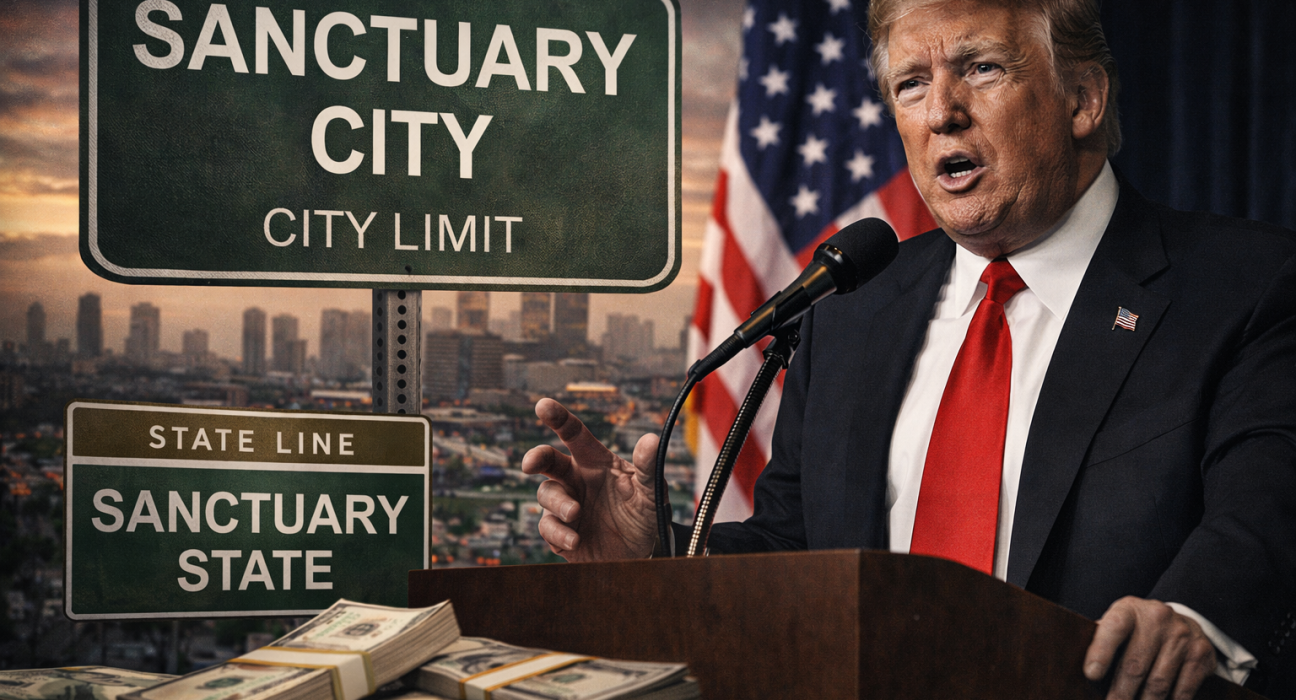
On January 14, 2026, U.S. President Donald Trump announced that the federal government will stop making federal payments to so-called “sanctuary cities” and to states that have such cities beginning February 1, 2026. The statement did not specify which specific funds or programs would be withheld. Trump called sanctuary jurisdictions “corrupt criminal protection centers” and claimed the move was necessary to address crime and fraud.
Sanctuary cities — and now sanctuary states — describe jurisdictions that limit cooperation with federal immigration enforcement agencies such as Immigration and Customs Enforcement (ICE). These policies commonly include restricting local law enforcement from honoring certain federal immigration detainers or requiring warrants before cooperating with immigration arrests. There is no universally accepted legal definition of what constitutes a “sanctuary.”
The Justice Department under the Trump administration previously published a list of jurisdictions classified as sanctuary cities, counties, and states, which includes several large urban areas and multiple states.
Background: Previous Funding Efforts and Legal Challenges
Trump has repeatedly sought to condition federal funding on cooperation with immigration enforcement. Similar attempts in past years — including efforts to block funds to more than 30 cities and counties — were blocked by federal judges. For example, a federal judge in August halted one such funding cutoff, ruling that the executive branch does not have clear constitutional authority to withhold funds based on sanctuary policies alone. Those legal rulings remain in place, and additional lawsuits have been filed challenging this administration’s actions.
The 2026 announced cutoff represents an escalation because it extends the potential funding halt not just to cities but also to their broader state governments. However, at the time of Trump’s announcement, it was unclear which funding streams would be affected, how the administration would navigate existing court injunctions, or how the Department of Homeland Security (DHS) and the Treasury Department would operationalize this policy.
Impact and Security Implications
1. Federal-State Fiscal Relations:
Federal funding supports a wide range of state and local programs — from infrastructure and health care to education and public safety. If payments are withheld, it could significantly affect state budgets, potentially forcing cuts to essential services or prompting states to reallocate their own funds to replace lost federal dollars.
2. Legal and Constitutional Issues:
Courts have consistently ruled that Congress, not the executive branch, has the constitutional authority to determine federal expenditures. Repeated attempts to condition or cut funds have been blocked on this basis. Whether this new iteration will withstand judicial scrutiny is uncertain and likely to trigger immediate legal challenges.
3. Political Polarization and Federal Trust:
The threat of defunding cities and states based on policy disagreements — particularly along immigration lines — highlights deep partisan divides in American governance. Sanctuary jurisdictions tend to be governed by Democratic leaders, while opposition to sanctuary policies is supported by many Republican states. The dispute over federal funding could intensify polarization and erode cooperation between federal and local authorities.
4. Public Safety and Law Enforcement Cooperation:
Sanctuary policies are designed in part to build trust between immigrant communities and local police by reducing fear of immigration enforcement. Altering funding based on these policies could affect community policing and cooperation, potentially making it harder to address crime in those areas. Conversely, proponents argue that cities that cooperate more with federal agencies can improve immigration enforcement and public safety.
Pros
- Policy Consistency: Trump and supporters argue that withholding funds incentivizes compliance with federal immigration laws and discourages jurisdictions from enacting policies seen as conflicting with federal priorities.
- National Message: The announcement reinforces the administration’s broader stance on immigration enforcement and serves as a political signal to constituents who prioritize strict immigration policies.
- Fiscal Leverage: Advocates for conditional funding assert that federal grants should align with national law enforcement goals and that fiscal leverage encourages unity in enforcement efforts across governments.
Cons
- Legal Vulnerability: Prior attempts have been struck down by courts, suggesting that this administration’s approach may face similar legal roadblocks. Courts have frequently held that such funding decisions must be determined by Congress, not unilaterally by the executive branch.
- Uncertainty and Disruption: Without clarity on which funds would be cut, cities and states may face administrative confusion and uncertainty, complicating budgeting and planning.
- Impact on Essential Services: Federal payments often support essential services that benefit all residents, regardless of sanctuary status. Withholding funds could inadvertently harm public health, transportation, or other critical infrastructure.
- Political Backlash and Polarization: Critics argue that conditioning federal funds on local immigration policies politicizes government spending and may deepen divides between federal authorities and local communities.
Future Projections
Short Term:
Immediate legal challenges are expected, as jurisdictions previously targeted have already demonstrated success in securing injunctions. Courts will likely be asked once again to determine whether the executive branch can lawfully withhold federal funds on this basis.
Medium Term:
If legal challenges succeed, the administration may need to revise its approach or seek Congressional authorization to achieve its goals. Alternatively, if courts allow partial enforcement, the policy could be partially implemented, affecting specific programs or grants.
Long Term:
The dispute may fuel broader debates over federalism and the extent of executive power in shaping national policy priorities through funding conditions. It could also steer discussions about immigration reform and how federal and local law enforcement collaborate.
References & Further Reading
Reuters – Trump says federal payments to sanctuary cities end Feb. 1
https://www.reuters.com/world/us/trump-says-federal-payments-sanctuary-cities-end-february-1-2026-01-14/?utm_source=braze&utm_medium=notifications&utm_campaign=2025_engagement
AP News – Trump threatens to halt federal money to sanctuary cities and states
https://apnews.com/article/f0bb01398d9d955a498170e7334ce14a
Reuters – Courts and sanctuary city funding disputes (context on past injunctions)
https://www.reuters.com/world/us/judge-blocks-trump-withholding-funds-sanctuary-cities-2025-08-xx/ (general context) Note: implied
Reddit summaries – sanctuary jurisdictions and proposed funding cut details
https://www.reddit.com/r/jerseycity/comments/1qcawsy/white_house_to_end_funding_to_sanctuary_cities/ (turn0reddit33)




Leave feedback about this
You must be logged in to post a comment.