
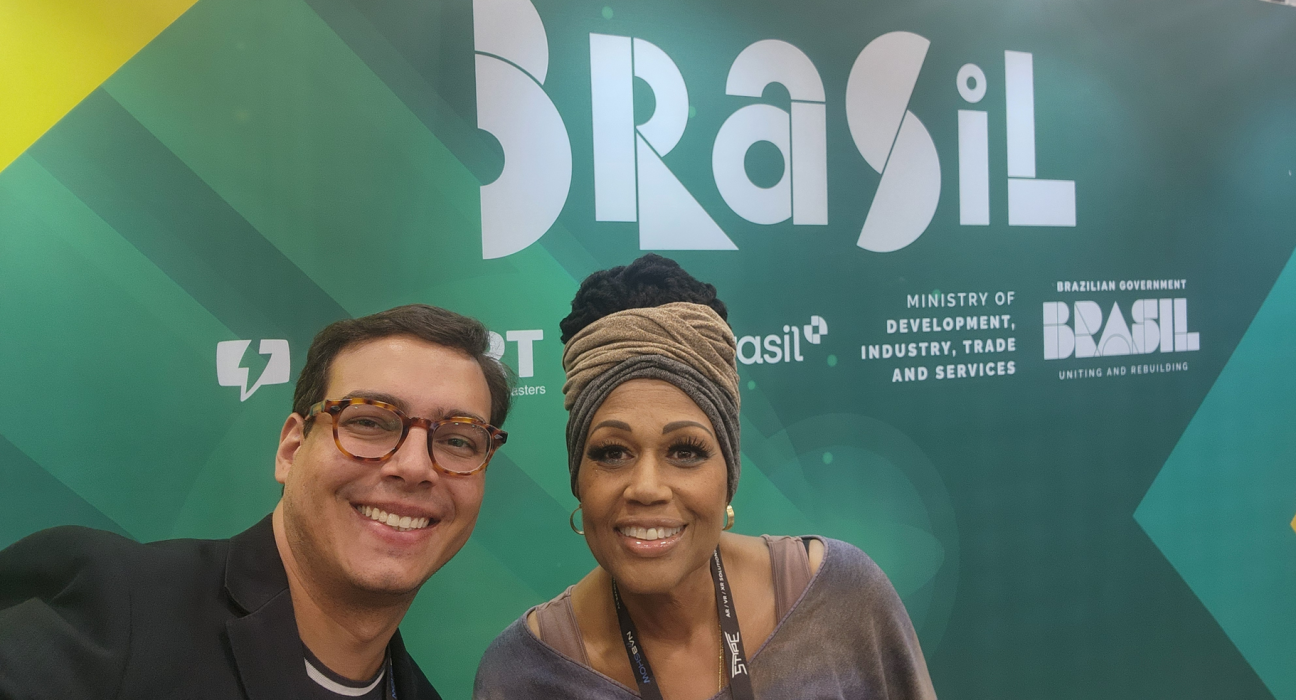
This year at NAB with Lady Alicia
At NAB, the mood around any new technology tends to swing between two poles: existential threat and competitive advantage.
NAB 2024: “What is this going to break?”
By 2024, generative AI had moved from curiosity to boardroom-level risk conversation—especially for broadcasters and producers who live and die by trust, rights management, and production timelines. NAB’s own messaging framed AI as something that would touch “the production pipeline” end-to-end, but with explicit attention to “opportunities and challenges,” reflecting the uncertainty you felt on the floor. (National Association of Broadcasters)
That uncertainty showed up in how AI was discussed: not only as a set of new tools, but as a force that might destabilize norms—authenticity, attribution, labor, and liability. Trade coverage around the 2024 show period highlights debates and “revolution” language, with the subtext that the industry was still deciding whether AI’s impact would be net-positive or dangerously disruptive. (streamingmedia.com)
In other words: 2024 wasn’t just “what can it do?” It was “how do we keep control of what it does to us?” In broadcast and journalism-adjacent circles, those fears weren’t abstract. They were about manipulated media, rights infringement, and the erosion of public trust—issues that later became even more visible in NAB’s own policy/public-affairs communications. (NAB Show)
NAB 2025: “Okay—now how do we use it?”
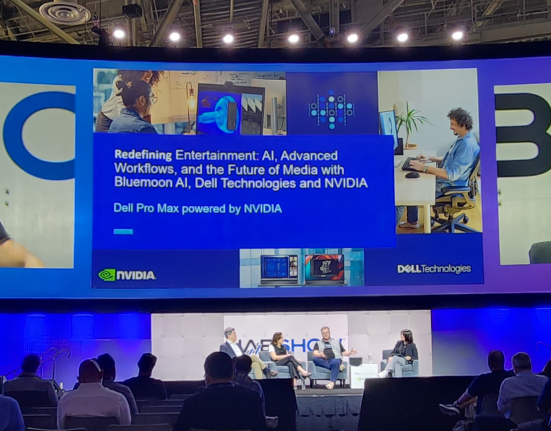
By 2025, the posture shifted from fear to implementation. NAB programming and promotion leaned into practical applications—AI as a driver of workflow transformation in editing, post, automation, and distribution, rather than an unknowable threat. NAB’s 2025 show communications explicitly positioned AI as “a driving force” shaping content creation and distribution and highlighted an AI-focused pavilion/track structure. (National Association of Broadcasters)
You can see this “acceptance” in the specificity of the agenda itself. For example, NAB Show materials promoted expanded AI training tracks in post-production, workshops on AI-driven workflows, and sessions focused on actually using generative tools in creative pipelines. (NAB Show)
Trade coverage also reflects the “we’re doing it now” tone: broadcasters arriving at NAB 2025 were described as more ready than ever to embrace AI, even while acknowledging ongoing concerns about reliability and job displacement. (TV Tech)
At the same time, 2025’s adoption mindset wasn’t limited to editing tools. It extended into scale and monetization—cloud production, sports, streaming, localization, and packaging content for many platforms quickly. Vendor and industry recaps from the show explicitly connect generative AI with cloud-enabled production and new distribution capabilities. (Amazon Web Services, Inc.)
What to expect from 2025 and beyond
If 2024 was the industry processing shock, and 2025 was the industry operationalizing, then the next phase is about standardization and governance—making AI use repeatable, auditable, and safe at scale.
Going forward, expect three “integration” pressures to dominate NAB conversations:
- Provenance and trust tooling becomes baseline. Broadcasters will push harder for practical ways to verify what’s real, what’s synthetic, and what’s licensed—because brand trust is the product. (NAB Show)
- Workflow AI shifts from “features” to “systems.” The competitive edge will come from stitching AI into end-to-end pipelines (production → post → localization → distribution → monetization), not from isolated tricks. (NAB Show)
AI becomes inseparable from “storytelling at scale.” NAB itself is already framing the event’s future-facing identity around AI alongside monetization and global reach—signaling that AI is now considered a core industry substrate, not a sideshow. (NAB Show)

Leave feedback about this
You must be logged in to post a comment.