
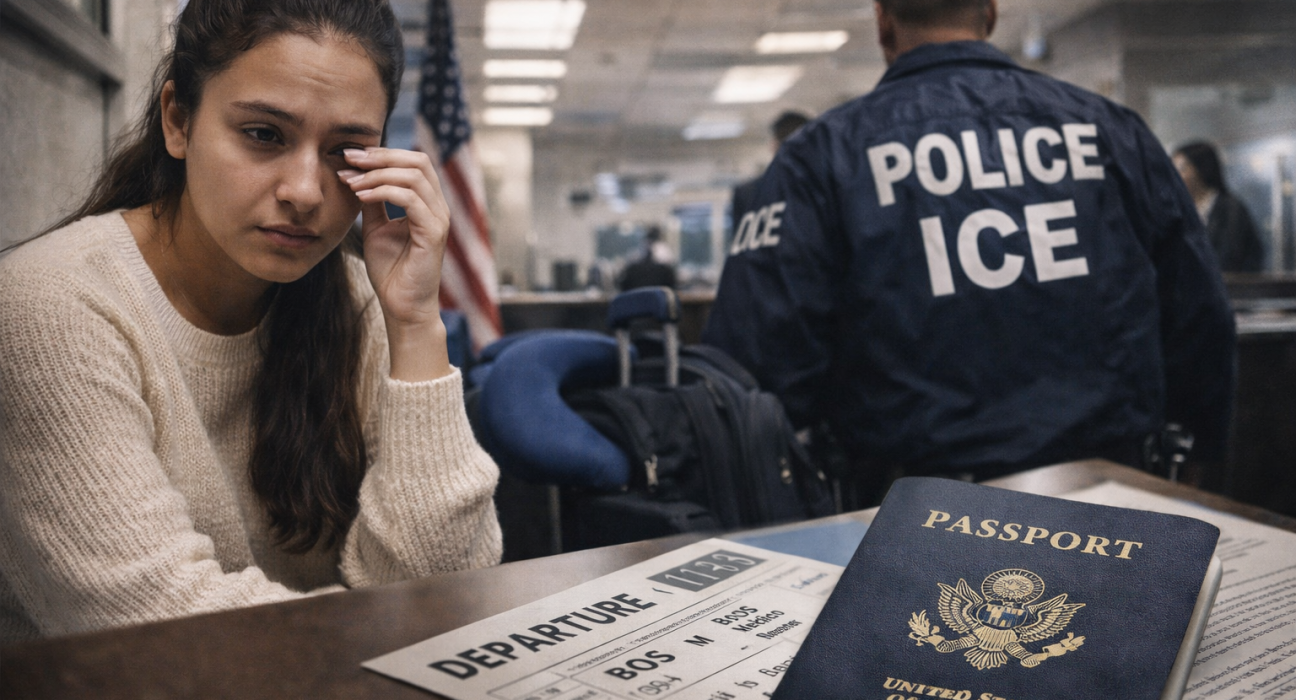
The Associated Press reports that the U.S. government apologized in federal court for mistakenly deporting Any Lucia Lopez Belloza, a 19-year-old Babson College student, after she was detained at Boston’s airport while trying to travel for a Thanksgiving surprise visit. According to the government, a court had issued an emergency order directing officials to keep her in Massachusetts or elsewhere in the U.S. for at least 72 hours, but she was nevertheless deported two days after her detention. Government lawyers characterized the event as an “inadvertent mistake by one individual”—an ICE officer who believed the order no longer applied once she had been transferred out of Massachusetts.
At the same time, the government argued the deportation was still lawful because Lopez Belloza had an earlier removal order dating back to 2016, and it raised jurisdictional arguments about whether the Massachusetts court could hear the case after her transfer. The judge recognized the seriousness of the error but did not hold the government in contempt, with the reporting indicating the court focused on intent, timing, and jurisdiction.
This case is being discussed in a broader climate where immigration enforcement has expanded in multiple regions, and where community groups, local officials, and some courts have raised concerns about due process, proportionality, and operational discipline. The central tension is not simply “enforcement versus no enforcement,” but whether the procedures and safeguards needed to prevent mistakes are keeping pace with the speed and scale of enforcement actions.
Hospitalizations and Escalation in Minnesota
In Minnesota, recent reporting describes a heightened atmosphere around federal enforcement. Separate AP coverage describes a federal officer shooting a man in the leg during an arrest in Minneapolis, with the wounded individual hospitalized with non-life-threatening injuries. The same reporting notes the federal officer was also hospitalized, and that the episode unfolded amid significant protests and ongoing legal disputes about the scope and methods of enforcement operations in the state.
In addition, AP reporting indicates that the ICE agent involved in the earlier, widely protested shooting of Renee Nicole Good was also reported as having been hospitalized (and later released) after that encounter, according to a DHS official.
Taken together, these hospitalizations are being cited by different sides for different reasons: federal officials often frame them as evidence of escalating danger to agents, while critics argue they reflect enforcement tactics that are producing volatile confrontations and increasing the odds of serious injury for everyone involved.
Continued Aggravation Claims and Perceived Administrative Support
The AP student-deportation case underscores a procedural concern: when enforcement accelerates, a single miscommunication or mistaken assumption can have major consequences for an individual—even when the government later acknowledges error.
In Minnesota, the debate is intensified because the federal government has publicly defended agents in high-profile incidents and continued operations despite local backlash. For example, coverage around the Minneapolis shooting describes the incident occurring amid demands from city leaders for de-escalation and clarity, while DHS statements emphasize officer safety and blame “organized resistance.”
From a fact-based standpoint, “support from the administration” is visible in the form of continued deployment, forceful public messaging, and (in broader context) the allocation of expanded funding for detention and enforcement capacity—though the precise practical effects depend on where and how those resources are used.
Is Enforcement Being Bolstered by the Minnesota Somali Fraud Scandal?
On your question about whether a ramp-up is being bolstered by the Minnesota “Somali tax scam,” the strongest grounded description from mainstream reporting is that the administration has linked a surge in federal officer presence in Minnesota to fraud allegations and cases involving daycare centers and other programs, some connected to Somali community members. PBS/AP reporting describes a surge of federal officers and notes that senior federal officials announced increased operations amid new or renewed fraud allegations tied to Somali-run daycare centers.
Separately, Treasury Department releases and Reuters reporting describe a major Minnesota fraud case and new federal initiatives to pursue recovery and prosecutions, including steps aimed at tracking certain financial flows.
What cannot be concluded as a fact from this set of reporting is that immigration enforcement actions are formally justified as a direct response to fraud by an ethnic community. What can be said is that (1) major fraud investigations are ongoing and highly politicized, and (2) the administration and some federal leaders have publicly tied Minnesota enforcement initiatives to fraud narratives—while local leaders and civil-rights advocates warn against broad community suspicion.
Pros and Cons
Pros (from an enforcement and governance perspective):
- Acknowledging error and apologizing in court can be viewed as a step toward institutional accountability, even if remedies are contested.
- Proponents argue that robust enforcement and expanded capacity deter unlawful entry and enable faster removals in line with policy goals.
- Investigations into large fraud schemes can protect taxpayer funds and deter exploitation of public programs.
Cons (from a rights, safety, and operational integrity perspective):
- The wrongful deportation episode raises concerns that rapid enforcement can outpace procedural safeguards and create irreversible harms.
- Minnesota’s recent shootings and hospitalizations illustrate how escalatory interactions can intensify community unrest and increase injury risk.
- Publicly tying enforcement surges to narratives about specific communities risks stigmatization and can undermine cooperation with authorities.
Future Projections
If current patterns continue, three developments are plausible:
- More litigation and court-ordered constraints: Cases involving alleged due process violations, mistaken removals, and use-of-force controversies are likely to keep moving through courts, potentially forcing tighter operational rules.
- Higher administrative burden on agencies: As enforcement expands, agencies may face increased scrutiny on training, compliance, and documentation—especially around transfers, warrants, and court orders.
- A growing “trust gap” with downstream public health and civic impacts: Fear of enforcement can deter some immigrants from seeking services (including healthcare), while communities experiencing repeated high-intensity operations may see heightened tensions with law enforcement partners.
References & Further Reading
AP News — Government apologizes for mistaken deportation of Babson College student (Thanksgiving case): https://apnews.com/article/1ebeee3f3ddc4cf04448d31bcd71b09b
Washington Post (AP syndication) — Detailed report on the apology and court arguments: https://www.washingtonpost.com/national/2026/01/14/college-student-thanksgiving-deportation-government-apology/7d3ae110-f172-11f0-a4dc-effc74cb25af_story.html
AP News — Federal officer shoots man in leg in Minneapolis; both hospitalized; tensions continue: https://apnews.com/article/337c778dc7667e765697ea2173220fe1
PBS NewsHour / AP — Surge in federal officers in Minnesota tied to fraud allegations at daycare centers: https://www.pbs.org/newshour/politics/surge-in-federal-officers-in-minnesota-focuses-on-alleged-fraud-at-day-care-centers
Reuters — Treasury Secretary Bessent vows to prosecute Minnesota fraud; broader probe signals: https://www.reuters.com/world/treasurys-bessent-vows-prosecute-minnesota-fraud-probe-other-states-2026-01-08/
U.S. Treasury (Press Release) — Initiatives to combat fraud in Minnesota (Jan. 9, 2026): https://home.treasury.gov/news/press-releases/sb0354
U.S. Treasury (Statement) — Further actions on Minnesota fraud investigations (Jan. 13, 2026): https://home.treasury.gov/news/press-releases/sb0358
Brennan Center — Analysis of expanded immigration enforcement funding and incentives: https://www.brennancenter.org/our-work/analysis-opinion/big-budget-act-creates-deportation-industrial-complex
Washington Post — ICE detention and capacity expansion planning (context on resources): https://www.washingtonpost.com/business/2025/07/04/trump-bill-ice-immigrant-detention/




Leave feedback about this
You must be logged in to post a comment.