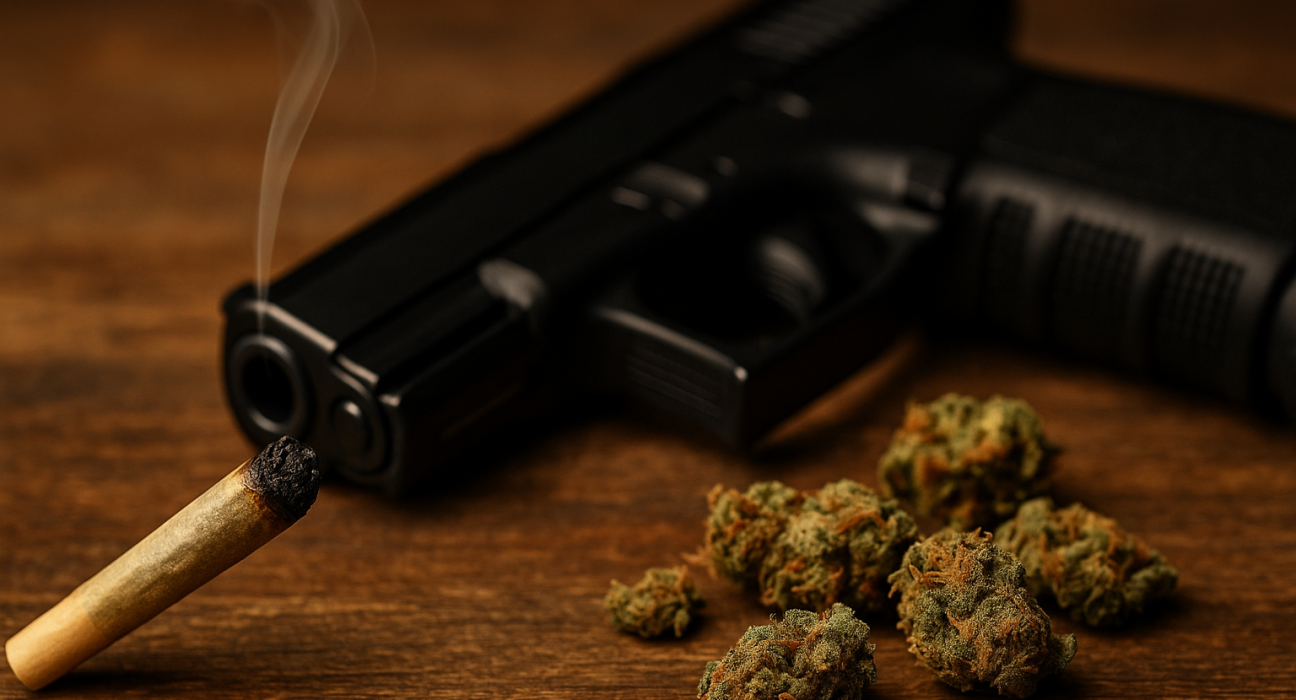
The U.S. Supreme Court announced on October 20, 2025 that it will hear a case challenging the constitutionality of a federal law that bars firearm possession by individuals who are “unlawful users of or addicted to any controlled substance.” The case arises from the gun possession charge against Ali Danial Hemani, a Texas man who admitted to regular marijuana use and was found in possession of a firearm during an FBI search. The Justice Department has appealed the Fifth Circuit’s decision, which had largely invalidated that statute as applied.
The statute in question—18 U.S.C. § 922(g)(3)—prohibits anyone who is an “unlawful user of or addicted to” a controlled substance from possessing a firearm. The 2024 Fifth Circuit ruling held that applying the ban to people who are not impaired at the moment of possession, merely because they use illegal drugs, lacked historical precedent under the framework established by the 2022 decision New York State Rifle & Pistol Association v. Bruen, which demands that firearms restrictions align with the nation’s historical tradition of firearm regulation.
In this instance, Hemani’s gun-possession charge was dismissed on constitutional grounds by the Fifth Circuit because the statute was deemed overly broad. The administration has now asked the Supreme Court to intervene to restore § 922(g)(3)’s enforcement. The Department of Justice argues that habitual drug users are unusually prone to firearm misuse, justifying the restriction. Opponents contend that millions of Americans could lose gun rights despite being sober and law-abiding. Former Vice-President Hunter Biden’s recent conviction under this statute (before his pardon) is noted in the article.
Arguments are expected in early 2026, and a decision could arrive by summer 2026. The case is emblematic of how the conservative-majority Court is continuing to reshape Second Amendment jurisprudence, particularly through the “history and tradition” lens. The article highlights how the clash between federal law, evolving marijuana legal status in many states, and the broad reach of firearms regulation intersects in this case.
Main Points
- The Supreme Court will review the statute banning gun possession by unlawful drug users (18 U.S.C. § 922(g)(3)).
- The case focuses on Ali Danial Hemani, a Texas man who admitted regular marijuana use and possessed a gun.
- The Fifth Circuit previously struck down the statute as applied, citing lack of historical analogue under the Bruen framework.
- The Justice Department appeals, arguing that habitual users present a heightened risk and thus the ban is justified.
- Widespread state legalization of recreational marijuana complicates the tension between federal prohibition and gun-rights enforcement.
- The decision will be viewed as a major turning point in gun-rights cases post-Bruen, affecting broad categories of firearm regulation.
Projections & What It Means for the Future
Legal landscape: If the Court upholds the statute, federal gun-possession restrictions could be extended to many more people who use marijuana—even in states where it is legal. If the Court strikes it down or narrows it, that could limit government power to restrict gun rights based on drug use alone, making § 922(g)(3) more difficult to enforce.
Second Amendment doctrine: The case will test how the “history and tradition” test from Bruen is applied to firearm restrictions based on personal conduct (drug use) rather than status (felon) or behavior (violent crime). A narrow or broad ruling will set parameters for future gun-law challenges.
State-federal tension: With about half the states legalizing recreational marijuana, the decision will affect how federal law interacts with state policies. A ruling favoring drug-user gun rights could weaken federal prohibition in practice. If the statute is upheld, it could create practical conflicts for legal pot users in many states.
Public-safety and regulatory implications: Law-enforcement and policy-makers may face pressure to revise or clarify how drug-use status is assessed, how “regular” use is defined, and whether separate rules apply to recreational versus other drug use. The decision could trigger legislative action to craft narrower, historically grounded firearm restrictions.
Social implications: If many marijuana users are barred from owning firearms, a large number of Americans may find their rights curtailed without necessarily posing demonstrable risk. Conversely, invalidation of the law may lead gun-safety advocates to shift focus to other regulatory strategies.
Litigation ripple-effect: A ruling will likely prompt waves of lower-court litigation on firearm restrictions tied to other personal conduct (e.g., mental-health status, substance use beyond marijuana). The ruling may impact how courts evaluate age, addiction, or dependency as factors in firearms rights.
References
“Supreme Court will consider whether people who regularly smoke marijuana can legally own guns” — Associated Press
https://apnews.com/article/supreme-court-marijuana-guns-e86c342bf248c7822722ad027980b72b
Additional reporting: Reuters — “US Supreme Court to weigh law barring drug users from owning guns”
https://www.reuters.com/world/us/us-supreme-court-weigh-law-barring-drug-users-owning-guns-2025-10-20/