
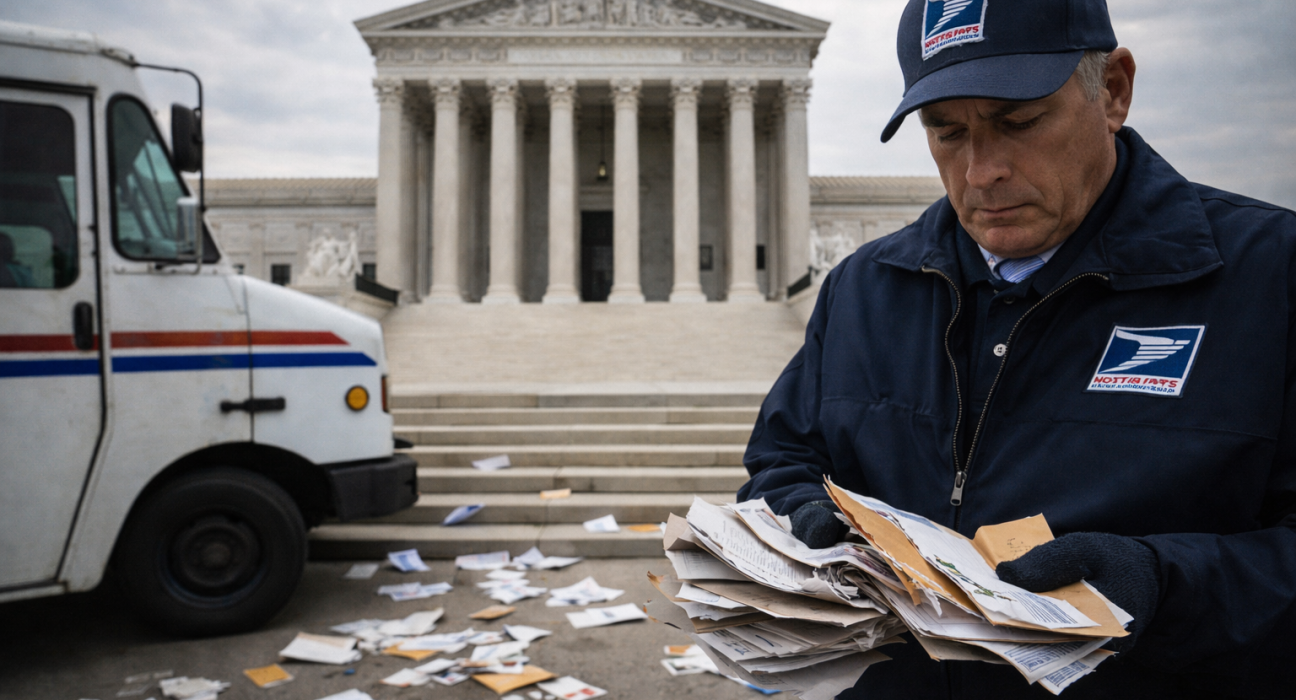
The U.S. Supreme Court ruled 5–4 that people generally cannot sue the U.S. Postal Service (and the United States under the Federal Tort Claims Act) for harms tied to mail that is not delivered—even when the allegation is that postal employees intentionally withheld delivery. The case, U.S. Postal Service v. Konan, arose from a dispute in Euless, Texas, where landlord Lebene Konan alleged her mail and her tenants’ mail was withheld or returned for roughly two years, causing financial and personal harm.
At the legal core is the Federal Tort Claims Act (FTCA), which waives federal sovereign immunity in some circumstances, but includes a “postal exception” preserving immunity for claims “arising out of the loss, miscarriage, or negligent transmission of letters or postal matter” (28 U.S.C. §2680(b)). Konan argued that intentional misconduct falls outside that exception. The Court disagreed, holding that “loss” and “miscarriage” can include mail that fails to reach its destination even if the failure was intentional, meaning the United States remains immune from these tort suits.
Justice Clarence Thomas wrote the majority opinion. A key theme in the ruling is that Congress designed the exception to prevent the government from facing an unmanageable volume of lawsuits tied to mail handling—an activity involving enormous scale and inevitable errors. The opinion emphasizes ordinary meaning at the time the FTCA was enacted (1946), concluding that the statutory words are broad enough to cover intentional nondelivery.
The dissent, authored by Justice Sonia Sotomayor and joined by Justices Elena Kagan, Neil Gorsuch, and Ketanji Brown Jackson, argued the majority grants the Postal Service more protection than Congress intended—particularly where wrongdoing is alleged to be malicious rather than negligent. In that view, the postal exception’s structure and phrasing should not be read to categorically bar accountability for intentional misconduct.
Practically, the decision means that when someone alleges USPS employees deliberately withheld or misdirected mail, traditional FTCA damages lawsuits are largely blocked if the harms “arise out of” nondelivery. The Court also signaled the ruling does not necessarily resolve every possible claim Konan might have, but it does foreclose the primary tort pathway she used for damages tied to mail nondelivery.
The ruling has broader implications because mail delivery failures can affect critical life functions—medications, legal notices, financial documents, and (in other contexts) election materials. Opponents worry the decision reduces deterrence against intentional misconduct; supporters (including the government’s position noted in coverage) argue the alternative could expose USPS to a costly wave of litigation and operational burden.
Pros (Evidence-based potential benefits)
- Operational and financial shielding for USPS: Limits a potentially large universe of lawsuits over delivery disputes, aligning with Congress’s intent to protect core mail operations from tort exposure.
- Clearer rule for courts and litigants: Resolves a split among federal appeals courts on whether intentional nondelivery fits inside the FTCA’s postal exception.
- Administrative channels remain: People can still pursue complaints through USPS processes and watchdog oversight (even if those do not provide damages in the same way).
Cons (Evidence-based risks and criticisms)
- Reduced civil remedies for intentional wrongdoing: The ruling bars many damages suits even when the alleged conduct is deliberate, leaving harmed individuals with fewer meaningful options.
- Weaker deterrence concerns: Critics argue immunity for intentional nondelivery could lessen accountability for bad actors inside the system.
- Equity and trust impacts: Allegations like Konan’s (including discriminatory motivation claims referenced in reporting) highlight that trust in a universal service can be undermined when delivery disputes persist without clear recourse.
Future Projections
- More pressure on non-tort oversight tools: Expect increased reliance on USPS internal investigations, the USPS Inspector General ecosystem, and congressional oversight to address alleged intentional nondelivery patterns.
- Narrower, alternative legal theories tested: Plaintiffs may attempt different legal routes (depending on facts), but the FTCA mail-nondelivery tort path is now substantially constrained.
- Legislative debate is plausible: If public concern grows about accountability gaps, Congress could consider clarifying amendments to the FTCA postal exception—though that would require political agreement and a clear policy design to avoid excessive litigation burden.
References & Links (separate section)
- AP News (case summary): https://apnews.com/article/supreme-court-postal-service-missing-mail-7ce97a5b7d56373cdeaa6ecc9a9132f5
- U.S. Supreme Court opinion PDF (U.S. Postal Service v. Konan, No. 24–351): https://www.supremecourt.gov/opinions/25pdf/24-351_7648.pdf
- SCOTUSblog analysis: https://www.scotusblog.com/2026/02/court-holds-that-u-s-postal-service-cant-be-sued-over-intentionally-misdelivered-mail/
- Los Angeles Times coverage: https://www.latimes.com/politics/story/2026-02-24/supreme-court-bars-suits-against-postal-service
- ABC News (AP syndication/summary): https://abcnews.com/Business/wireStory/supreme-court-rules-postal-service-sued-mail-intentionally-130452577




Leave feedback about this
You must be logged in to post a comment.