
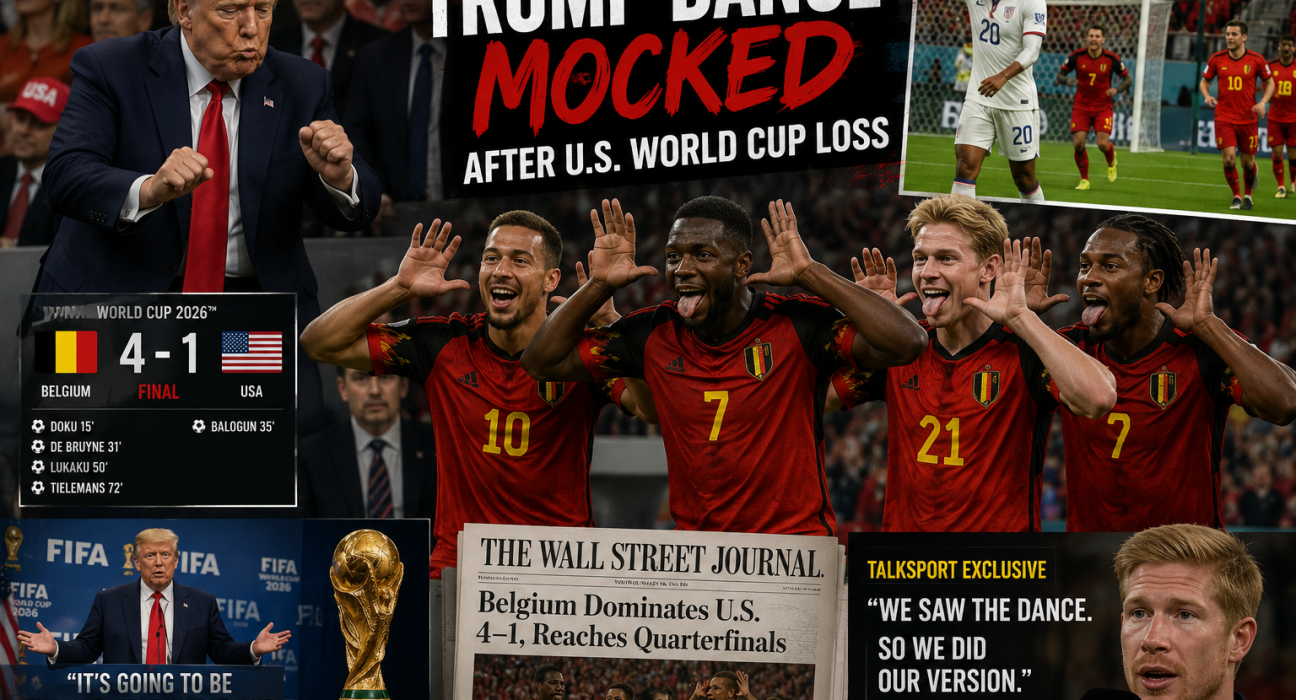
The 2026 FIFA World Cup produced one of its most unusual political moments when Belgium defeated the United States 4–1 in the Round of 16, and several Belgian players celebrated by mimicking President Donald Trump’s signature dance. The celebration quickly went viral, becoming one of the tournament’s defining images and illustrating how modern sports, politics, and social media increasingly intersect.
The incident followed controversy surrounding Trump’s reported intervention with FIFA over the suspension of U.S. striker Folarin Balogun. After Balogun’s red-card suspension was overturned before the Belgium match, critics questioned whether political influence had entered an international sporting competition. Belgium’s post-match celebration appeared to reference both the controversy and Trump’s highly recognizable campaign dance.
Although the dance itself carried no official political meaning, the event demonstrates how international sporting competitions increasingly serve as platforms for political symbolism and public messaging.
What Happened?
According to multiple reports, the controversy began after Trump reportedly contacted FIFA President Gianni Infantino regarding Balogun’s suspension.
Balogun had received a red card in a previous World Cup match, making him unavailable for the knockout game against Belgium. FIFA later overturned the suspension, allowing him to play. Reports described the reversal as highly unusual, with commentators debating whether political pressure played a role.
Despite Balogun’s return, Belgium defeated the United States convincingly by a score of 4–1. Following the victory, Belgian players, including Romelu Lukaku, celebrated by imitating Trump’s signature dance, while social media posts included phrases such as “Overturn this,” referencing the earlier suspension controversy.
Why the Celebration Drew Attention
Athletes have long used celebrations to communicate messages beyond the game itself.
Examples throughout sports history include:
- Political protests
- Social justice demonstrations
- National pride
- Friendly rivalries
- Responses to controversial officiating
Belgium’s celebration appears to fit into this broader tradition of symbolic expression.
Rather than directly addressing American politics, many observers interpreted the dance as a response to the FIFA suspension controversy and what Belgian players reportedly viewed as preferential treatment for the host nation.
Sports and Politics Have Become Increasingly Intertwined
The incident highlights a broader trend.
Major sporting events increasingly overlap with political issues involving:
- Diplomacy
- National identity
- International image
- Leadership
- Public relations
The 2026 World Cup, jointly hosted by the United States, Canada, and Mexico, has already featured discussions about:
- Immigration and visa policies
- International relations
- Security
- Political leadership
Trump himself has publicly praised the tournament’s attendance and popularity and said he was invited to present the World Cup trophy later in the competition.
The Sporting Reality
Lost beneath the political attention was the actual performance on the field.
Belgium outplayed the United States in nearly every phase of the match.
According to post-match reporting:
- Belgium controlled possession for long stretches.
- The U.S. defense struggled against Belgium’s attack.
- Lukaku and Belgium’s forwards capitalized on defensive mistakes.
- U.S. coach Mauricio Pochettino acknowledged his team was second-best on the day.
Many analysts emphasized that the result reflected Belgium’s overall quality rather than any single controversial decision.
Public Reaction
The viral celebration generated a wide range of responses.
Supporters of Belgium’s celebration argued:
- It was harmless sporting humor.
- Athletes have always celebrated emotionally.
- The dance referenced a widely recognized public figure rather than endorsing a political position.
Critics argued:
- International sports should avoid political messaging.
- Mocking heads of state risks inflaming unnecessary tensions.
- Social media amplified the moment beyond its original context.
The debate illustrates how even brief sporting celebrations can quickly become global political stories in today’s digital media environment.
The Bigger Picture: Celebrity Politics
The incident also reflects a broader reality about Trump’s public image.
Few political leaders possess symbols that are instantly recognizable worldwide.
Trump’s signature dance has become:
- A campaign trademark
- A meme
- A cultural reference point
- A recognizable symbol across international audiences
Political scientists increasingly note that modern leaders often function similarly to celebrities, where gestures, slogans, and visual symbols become part of global popular culture.
Belgium’s celebration demonstrated how those symbols can be reinterpreted outside their original political context.
Competing Interpretations
View 1: Harmless Sportsmanship
Many observers see the celebration as typical post-match banter.
Professional athletes frequently:
- Mimic opponents
- Reference public figures
- Celebrate emotionally after major victories
From this perspective, the dance was simply another memorable World Cup moment.
View 2: Politics Entering International Sport
Others argue the incident reflects a growing politicization of global sports.
They point to:
- The reported FIFA intervention
- International reactions
- Political symbolism
- Social media amplification
As evidence that major sporting events increasingly function as geopolitical stages.
Pros (Positive Takeaways)
• Demonstrates the global cultural influence of the FIFA World Cup
• Highlights the growing popularity of soccer in the United States
• Shows athletes’ freedom of expression within sporting culture
• Sparks international discussion about sports governance and fairness
• Reflects the increasing visibility of American soccer on the world stage
Cons (Concerns Raised)
• Blurs the line between politics and international sport
• May increase perceptions of political influence in governing bodies
• Social media can amplify symbolic moments beyond their original intent
• Risk of distracting from athletic performance and competition
• Can contribute to greater polarization around sporting events
Future Projections
1. Politics Will Continue Appearing at Major Sporting Events
International tournaments are likely to remain venues where political symbolism and sports intersect.
2. FIFA May Face Greater Scrutiny
Questions surrounding governance and disciplinary decisions may lead to calls for increased transparency.
3. Social Media Will Amplify Symbolic Moments
Brief celebrations or gestures can rapidly become global news stories within minutes.
4. Athlete Expression Will Continue to Evolve
Players may increasingly use celebrations to communicate cultural or political messages.
5. Sports Diplomacy Will Grow in Importance
As international sporting events attract global audiences, governments and political leaders will likely continue viewing them as opportunities for soft power and public engagement.
Conclusion
The controversy surrounding Belgium’s celebration following its victory over the United States illustrates how modern sports extend far beyond competition on the field. A soccer match became a global political conversation involving presidential influence, FIFA governance, athlete expression, and the power of social media.
While opinions differ on whether the celebration was harmless humor or unnecessary political symbolism, the episode underscores a broader reality: in an era of constant media attention, international sporting events increasingly serve as platforms where politics, culture, and entertainment intersect. The result is that moments lasting only seconds on the field can become lasting stories far beyond the final whistle.
References
Primary Source
- The Daily Beast – Trump mocked through signature dance after U.S. World Cup loss
Additional Sources
- People – Belgium players troll Trump after World Cup victory
- The Wall Street Journal – Belgium defeats U.S. 4–1 and advances to World Cup quarterfinals
- TalkSport – Belgium players explain celebration following controversial Balogun decision
- Reuters – Trump discusses the World Cup and FIFA before the tournament


Leave feedback about this
You must be logged in to post a comment.