
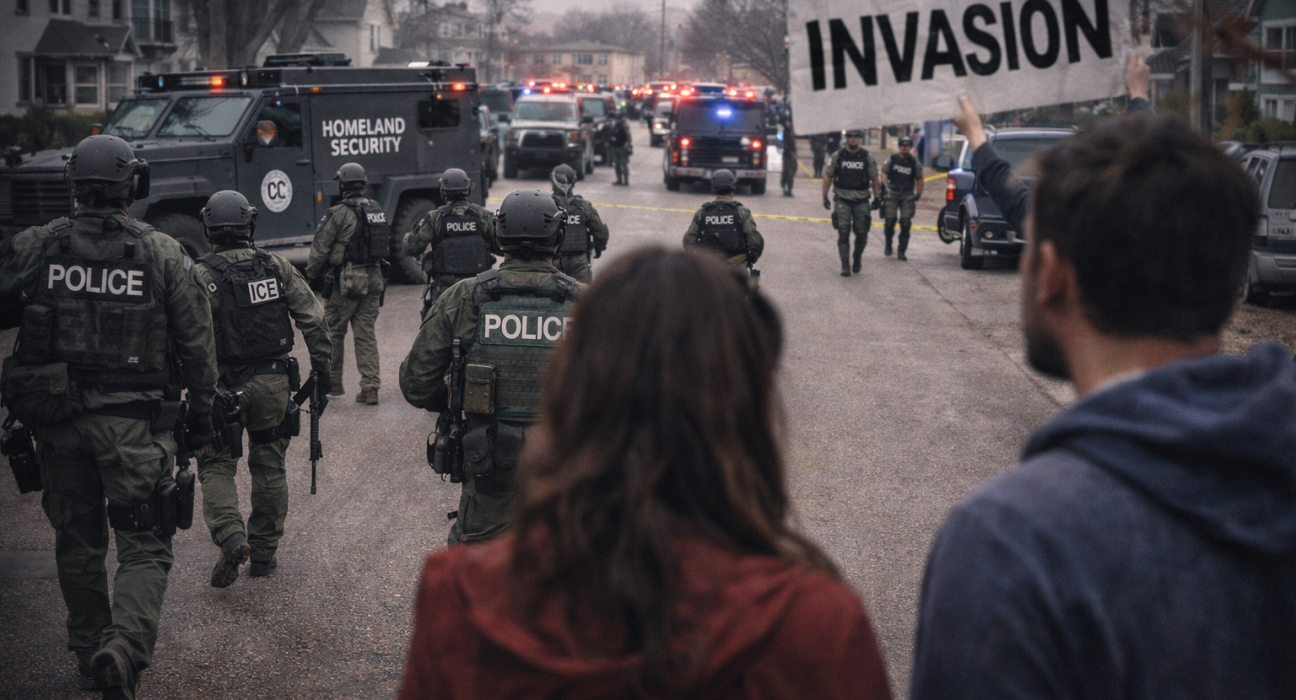
Residents and local officials in Minneapolis say the city feels like it is under an “invasion” following a sharp and visible increase in the presence of federal law enforcement agents, according to reporting by NBC News. Armored vehicles, heavily armed officers, and large-scale enforcement operations have appeared across neighborhoods, prompting fear, confusion, and anger among residents — and raising broader questions about what this escalation could mean for other cities and states across the country.
What Is Happening in Minneapolis
NBC News reports that federal agencies, including Immigration and Customs Enforcement (ICE) and other Department of Homeland Security (DHS) units, have flooded Minneapolis with agents in the wake of several high-profile incidents, including officer-involved shootings, fraud investigations, and heightened immigration enforcement. Residents described seeing officers in tactical gear conducting operations in residential areas, near schools, and in commercial districts.
Local leaders and community members say the scale and intensity of the federal presence is unlike anything they have previously experienced, even in a city long accustomed to protests, policing debates, and federal–local tension since the killing of George Floyd in 2020.
Federal officials, by contrast, argue that the surge is necessary to address public safety threats, immigration enforcement priorities, and alleged large-scale fraud, and they emphasize that agents are acting within federal authority.
Why Residents Are Alarmed
For many Minneapolis residents, the concern is not only about enforcement itself, but about how it is being carried out:
- Visibility and militarization: Heavily armed agents and tactical vehicles create the perception of a security operation rather than routine law enforcement.
- Lack of clarity: Residents report uncertainty over which agency is operating, what authority agents are exercising, and how long the surge will last.
- Community fear: Immigrant communities, in particular, say the presence has led people to avoid work, school, medical appointments, and public spaces.
Civil rights advocates argue that this atmosphere undermines trust between communities and government, while city officials say they were not adequately consulted or informed before the federal escalation.
Federal Authority vs. Local Control
The Minneapolis situation highlights a long-running tension in U.S. governance: the balance between federal enforcement powers and local autonomy.
Under U.S. law, federal agents have broad authority to enforce immigration and certain federal statutes anywhere in the country. However, cities and states traditionally manage day-to-day policing and public safety. When federal agencies dramatically expand their footprint without local coordination, conflicts can emerge over jurisdiction, accountability, and public messaging.
In Minneapolis, city leaders have criticized what they describe as a unilateral federal approach, while federal officials counter that local resistance or non-cooperation necessitates stronger federal action.
What This Could Mean for Other States
Analysts and local officials across the country are watching Minneapolis closely, viewing it as a potential model — or warning — for what could happen elsewhere.
1. Expansion to Other Cities
If federal authorities view the Minneapolis surge as effective or politically defensible, similar operations could appear in other cities with:
- Large immigrant populations
- Sanctuary-style policies limiting cooperation with ICE
- Ongoing federal investigations into fraud or public corruption
Cities such as Chicago, New York, Los Angeles, Denver, and Seattle are often cited as potential candidates for comparable federal deployments.
2. Increased Federal–State Tension
States with leadership opposed to aggressive immigration enforcement may face growing conflict with federal agencies. This could result in:
- Legal challenges over enforcement practices
- Refusals by local police to assist federal agents
- Political standoffs that complicate emergency response and public safety coordination
Conversely, states aligned with federal priorities may welcome expanded enforcement, deepening regional divides in how laws are applied.
3. Chilling Effects on Public Life
NBC News reporting indicates that in Minneapolis, some residents are altering daily routines due to fear of encounters with federal agents. If replicated elsewhere, this pattern could:
- Reduce school attendance
- Delay medical care
- Disrupt local economies, particularly in service and retail sectors
Public health experts warn that such disruptions can have downstream consequences beyond immigration enforcement itself.
4. Legal and Civil Rights Scrutiny
Aggressive federal operations often invite legal challenges related to:
- Fourth Amendment protections against unreasonable searches and seizures
- Due process rights
- Claims of racial profiling or excessive force
If courts rule against certain practices used in Minneapolis, it could constrain similar actions nationwide. Conversely, if courts uphold them, federal agencies may feel emboldened to expand operations further.
Arguments Supporting the Federal Surge
Supporters of the expanded federal presence argue that:
- Federal law must be enforced uniformly, regardless of local political preferences
- Increased enforcement deters crime, fraud, and unlawful immigration
- Local resistance leaves federal agencies with few alternatives
They also point to incidents where federal agents have been injured as evidence that operations are inherently dangerous and require strong force protection.
Arguments Against the Surge
Critics counter that:
- Militarized enforcement erodes civil liberties and community trust
- Lack of transparency fuels fear and misinformation
- Broad, visible operations risk punishing entire communities rather than targeting specific criminal activity
They argue that long-term public safety is better served through cooperation, clear communication, and narrowly tailored enforcement.
Future Projections
Short Term:
Other cities may see temporary federal surges, particularly where investigations or political tensions are already high. Protests and legal challenges are likely to follow.
Medium Term:
States may pass new laws clarifying limits on cooperation with federal agents or strengthening protections for residents during enforcement actions.
Long Term:
If federal surges become normalized, the U.S. could see a fundamental shift in how immigration and federal law enforcement operates — moving from targeted actions to more sustained, visible federal presence in local communities.
Conclusion
The situation in Minneapolis represents more than a local dispute; it is a test case for how far federal enforcement can expand into cities without local consent. Whether this approach becomes a nationwide template or triggers legal and political pushback will shape the future relationship between federal authority, state power, and community trust across the United States.
References & Further Reading
NBC News – Minneapolis residents say city feels like an “invasion” as federal agents flood the area
https://www.nbcnews.com/news/us-news/minneapolis-residents-say-feels-are-invasion-federal-agents-flood-city-rcna254061
Associated Press – Coverage of federal enforcement surges and local reactions
https://apnews.com/
Department of Homeland Security – Federal enforcement authority overview
https://www.dhs.gov/immigration-statistics
Brennan Center for Justice – Federalism, immigration enforcement, and civil liberties
https://www.brennancenter.org/issues/justice/immigration
Urban Institute – Community impacts of immigration enforcement
https://www.urban.org/topics/immigration





Leave feedback about this
You must be logged in to post a comment.