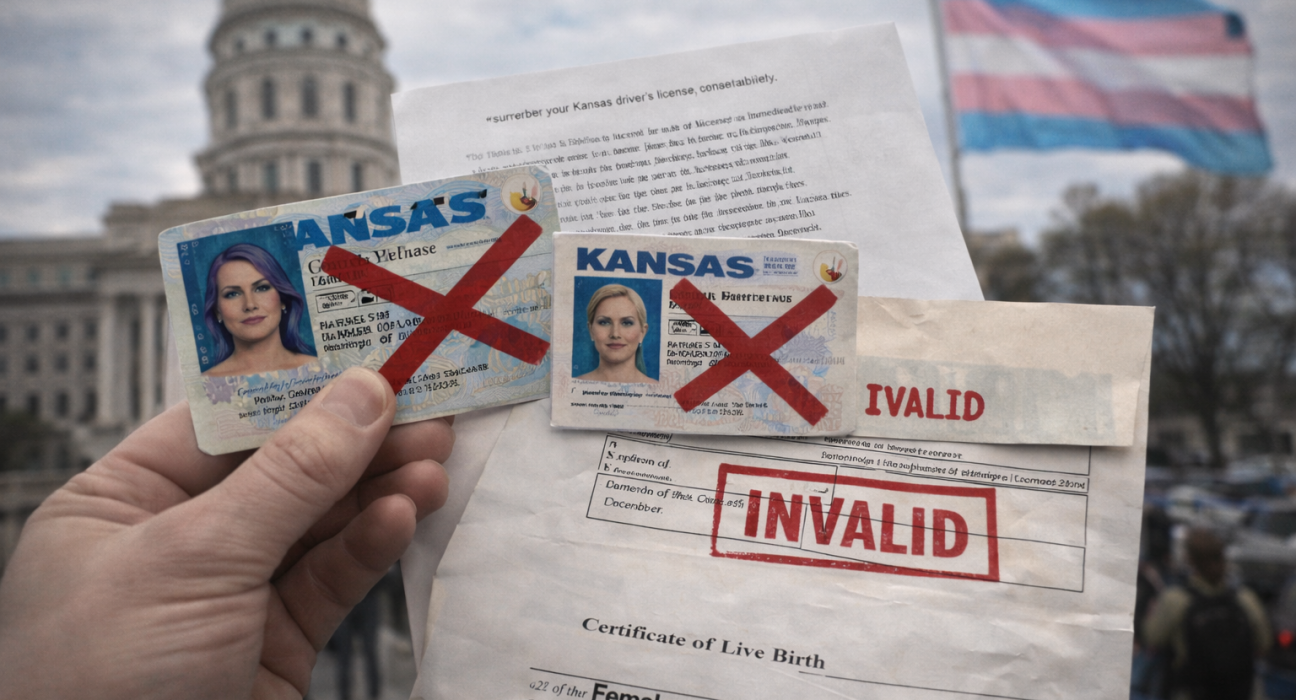
A new Kansas law enacted this month requires that all state issued driver’s licenses and birth certificates list only the sex assigned at birth, overriding previously updated documents for transgender residents. The law will invalidate approximately 1,700 current driver’s licenses and roughly 1,800 birth certificates that reflect gender identity rather than birth-assigned sex. The legislation takes immediate effect after the Republican-controlled legislature overrode a veto by Democratic Gov. Laura Kelly.
This move reverses legal outcomes from recent years in which transgender Kansans were able to change the gender markers on state ID documents following court rulings. In 2025, the **Kansas Supreme Court denied an appeal by Attorney General Kris Kobach, allowing a lower court’s decision that permitted gender marker changes on driver’s licenses to stand. At that time, the Kansas Department of Revenue was expected to resume issuing accurate gender markers.
But the new statute (often referenced alongside SB 180 and the subsequent enforcement bill SB 244) broadly defines legal identification processes in a way that overrides that judicial progress, requiring all state IDs to reflect sex at birth and barring any future changes. Kansas officials began notifying affected residents this week, with letters demanding they surrender their existing licenses and obtain new ones reflecting their birth-assigned sex. Individuals face penalties, including misdemeanor charges, if they do not comply.
Supporters argue the law clarifies and standardizes identity documentation, citing what they describe as “basic biological categories.” Legislative leaders defend the requirement as stabilizing ID standards and safeguarding administrative consistency. Opponents portray the law as a targeted rollback of transgender rights and protections, and one that may put affected individuals at risk.
Legal and Historical Context
Kansas has been a site of legal contention over transgender rights for several years. Under state law SB 180 — passed in 2023 — the definition of “sex” was codified based on biological markers at birth, which initially blocked transgender residents from changing gender markers on IDs. That law was challenged in court, leading to legal battles over whether transgender Kansans could update their licenses in line with their gender identity. Appeals courts in 2025 sided with transgender advocates, and the Kansas Supreme Court denied further review, which permitted changes at that time.
However, the legislature’s latest bill goes further by retroactively invalidating previously updated documents in addition to barring future changes. Because Kansas is a strict voter ID state, critics also express concern that these invalidated IDs could disenfranchise transgender voters should they be required to present accurate documentation at the polls.
Similar laws in other states, such as Florida and Tennessee, prohibit gender marker changes but do not retroactively reverse prior updates. Kansas is now unique in imposing reversions of existing IDs and certificates.
Affected Communities and Response
Transgender Kansans and advocacy groups have condemned the law as discriminatory, undermining personal dignity, public safety, and privacy. Critics argue that requiring documents that conflict with a person’s appearance or identity can increase the risk of harassment, discrimination, and even violence for transgender individuals in everyday situations. Some have described the policy as causing emotional and logistical strain that may push people to consider leaving the state altogether.
Advocates have also raised concerns about the costs borne by affected individuals because the law requires them to pay for new documentation with the updated birth-assigned marker — despite state policy changes forcing the reissuance. These costs and administrative hurdles are seen as an additional burden for a marginalized group that already faces significant economic disparities.
Civil rights organizations are expected to escalate legal challenges. The American Civil Liberties Union (ACLU) and its Kansas affiliate have previously intervened in litigation on behalf of transgender residents, and further litigation is anticipated. One court case known as Kansas v. Harper directly challenged attempts to enforce SB 180’s definitions in state ID issuance. Although that case resulted in procedural victories for transgender plaintiffs in 2025, the new law may reshape future challenges.
How the Law Works and Enforcement
Under the new policy, any state-issued ID — including driver’s licenses and birth certificates — that lists a gender different from the sex assigned at birth is now considered invalid. Notices have been sent to affected residents instructing them to surrender their invalidated licenses to the Division of Vehicles and obtain replacements that reflect birth-assigned sex markers. Residents who fail to surrender their licenses could face misdemeanors and penalties.
In addition to ID provisions, the legislation also strengthens “bathroom bills,” restricting transgender individuals’ access to facilities that match their gender identity. Penalties for violations — including fines and jail terms — have been referenced in enforcement guidance, raising concerns about civil liberties and public health impacts.
Pros (Evidence-Based)
• Clear standardized documentation: Supporters argue the law creates uniformity in how government IDs represent sex, reducing administrative complexity.
• Administrative clarity: Lawmakers claim it simplifies enforcement of certain rules tied to sex classification (such as segregated facilities).
• Policy alignment with proponents’ views: The bill reflects the policy priorities of Republican legislative majorities, affirming their interpretation of sex categories.
(These benefits are offered by supporters and not universally accepted.)
Cons (Evidence-Based)
• Risk of discrimination and safety concerns: Forced mismatches between ID and gender presentation may increase negative encounters, harassment, and violence risks for transgender individuals.
• Legal and civil rights backlash: The law is expected to trigger further legal challenges on constitutional grounds, including equal protection.
• Cost and logistical burden: Transgender residents must obtain new IDs at their own expense, and may face difficulties in compliance due to notice timing.
• Potential voter disenfranchisement: In a strict voter ID state, invalidated licenses could pose barriers to voting unless promptly reissued and recognized.
Future Projections
• Legal battles ahead: Civil rights groups are likely to file lawsuits challenging the law’s constitutionality and retroactive effects.
• Potential legislative changes: Future sessions may see refinement or expansion of transgender-related policies in Kansas or nationwide.
• Political mobilization: Transgender advocacy and civil rights coalitions may increase lobbying and legal activism.
• Public discourse impact: The law contributes to broader national debates on transgender rights, identity documentation, and civil liberties.
References
Primary Article
- The Independent – Kansas trans driver’s license rights rollback
https://www.independent.co.uk/news/world/americas/us-politics/kansas-transgender-license-driving-b2927883.html
Additional Coverage & Context
- Reuters – Kansas invalidates driver’s licenses, birth certificates over 1,000 transgender residents
https://www.reuters.com/legal/government/kansas-invalidates-drivers-licenses-birth-certificates-over-1000-transgender-2026-02-26/ - AP News – New law puts Kansas at vanguard of denying trans identities on IDs and birth certificates
https://apnews.com/article/transgender-rights-drivers-licenses-birth-certificates-bathrooms-3048b856b81d24553efd9da4aaa94bc7?utm_source=chatgpt.com - LGBTQ Nation – Kansas sends letters demanding surrender of licenses
https://www.lgbtqnation.com/2026/02/kansas-sends-letters-to-trans-people-demanding-they-surrender-their-drivers-licenses/ - Kansas Reflector / KCUR – Historical court fight over gender marker changes
https://www.kcur.org/politics-elections-and-government/2025-10-11/kansas-drivers-license-gender-marker-kobach - Wikipedia – LGBTQ rights in Kansas (historical context)
https://en.wikipedia.org/wiki/LGBTQ_rights_in_Kansas