
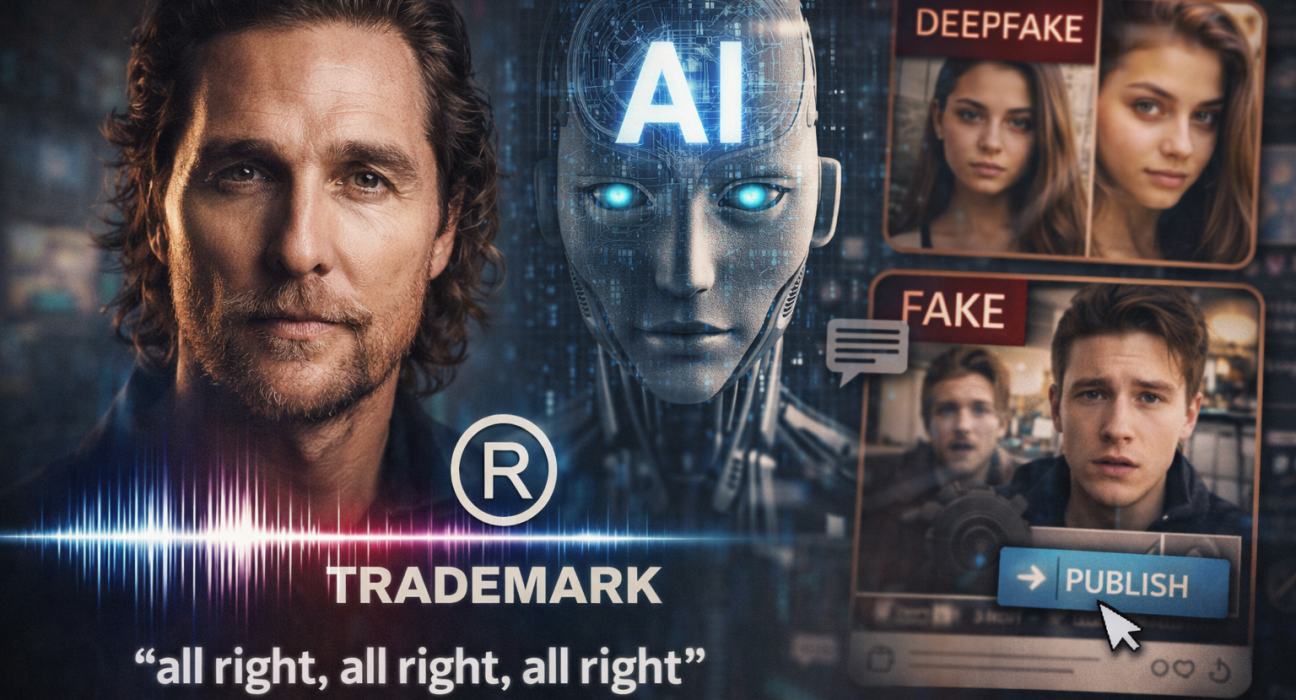
Growing concerns over artificial intelligence misuse are moving rapidly from abstract warnings into concrete legal, cultural, and safety challenges. Two recent developments — actor Matthew McConaughey’s move to trademark his famous catchphrase to protect it from AI misuse, and mounting warnings from UK authorities and researchers about AI-generated deepfakes — illustrate how generative AI is accelerating risks tied to identity theft, harassment, misinformation, and online bullying.
Together, these stories reflect a broader reckoning: as AI tools become more powerful and accessible, existing legal, social, and technological safeguards are struggling to keep pace.
Why Matthew McConaughey Is Taking Legal Action
Matthew McConaughey recently filed to trademark his iconic phrase “all right, all right, all right,” citing concerns that AI systems could increasingly replicate, monetize, or misattribute his voice and likeness without consent.
While the phrase has long been part of popular culture, the rise of generative AI has changed the risk profile. Voice-cloning models and text-to-speech systems can now convincingly mimic public figures, allowing phrases, performances, or endorsements to be fabricated at scale. Trademark protection offers one of the few proactive legal tools currently available to assert ownership and challenge unauthorized commercial use.
Legal experts note that such moves are becoming more common among public figures as copyright and “right of publicity” laws lag behind AI’s capabilities.
The Expanding Deepfake Problem
Parallel concerns are emerging in the UK and elsewhere, as reported by the BBC, where lawmakers, police, and educators warn that AI-generated deepfakes are increasingly used for harassment, fraud, and bullying — particularly targeting women, minors, and public figures.
Modern deepfakes no longer require advanced technical skills. Many are produced using:
- Open-source generative adversarial networks (GANs)
- Consumer-grade AI image and video generators
- Voice-cloning tools trained on minutes of publicly available audio
- Automated face-swap and lip-sync software
These tools can generate realistic fake videos, images, or audio in minutes, making it difficult for victims to disprove false content once it spreads online.
What Grok and Similar AI Models Are Capable Of
xAI’s AI model Grok, like other advanced large language models, illustrates both the promise and risk of next-generation AI systems.
At a high level, systems like Grok can:
- Analyze massive volumes of real-time data
- Generate human-like text and dialogue
- Interpret images and contextual information
- Assist in summarization, pattern detection, and content creation
While Grok itself is designed with safeguards, its underlying capabilities mirror those used in tools that enable impersonation, narrative manipulation, and social engineering. The concern raised by experts is not one platform in isolation, but the ecosystem effect: once powerful techniques exist, they are quickly replicated, modified, or stripped of safeguards in open or illicit environments.
How Deepfakes Are Being Used for Bullying and Abuse
AI-generated content is increasingly linked to new forms of bullying and coercion, including:
- Non-consensual sexualized deepfake imagery
- Fabricated audio or video used to damage reputations
- Impersonation of students, teachers, coworkers, or officials
- False evidence introduced into online disputes or harassment campaigns
Unlike traditional cyberbullying, deepfakes introduce plausible deniability for perpetrators and heightened psychological harm for victims, who must repeatedly prove that content depicting them is fake.
Educators and child-safety advocates warn that younger users are particularly vulnerable, as AI tools are embedded into platforms teens already use daily.
Internet Safety and the Erosion of Trust
A key long-term concern is the erosion of baseline trust in digital media. As AI-generated content becomes indistinguishable from authentic recordings:
- Video and audio evidence loses credibility
- Victims face higher burdens of proof
- Bad actors can dismiss real footage as “AI-generated”
This phenomenon, sometimes called the “liar’s dividend,” undermines journalism, justice systems, and interpersonal trust.
Pros of AI Advancement
Despite these risks, experts stress that AI development also brings real benefits:
- Improved accessibility tools for people with disabilities
- Enhanced content moderation and threat detection
- Creative empowerment for artists and educators
- Faster identification of fraud and misinformation when used responsibly
Many argue the solution is not halting AI development, but strengthening governance, transparency, and accountability.
Cons and Risks
However, current gaps remain significant:
- Weak or inconsistent regulation across countries
- Limited legal remedies for non-commercial harm
- Slow content removal processes
- Insufficient digital literacy education
Without intervention, these weaknesses may allow abuse to scale faster than enforcement.
Future Implications
Short Term:
More celebrities, journalists, and public figures are likely to pursue trademarks and legal protections. Schools and workplaces may face rising AI-related harassment cases.
Medium Term:
Governments may introduce stricter AI labeling, watermarking, and identity-protection laws. Platforms could be compelled to adopt faster takedown standards.
Long Term:
The internet may shift toward authentication-based media systems, where verified content carries cryptographic proof of origin — fundamentally changing how digital trust works.
Conclusion
The cases highlighted by Matthew McConaughey’s trademark move and growing deepfake abuse concerns reflect a pivotal moment. AI is no longer just a productivity tool — it is reshaping identity, safety, and credibility online. How societies respond now will determine whether the next phase of the internet amplifies creativity and connection, or deepens harm and distrust.
References & Further Reading
The Guardian – Matthew McConaughey trademarks catchphrase to combat AI fakes
https://www.theguardian.com/film/2026/jan/15/matthew-mcconaughey-trademarks-all-right-all-right-all-right-catchphrase-in-bid-to-beat-ai-fakes
BBC News – Warnings over AI deepfakes, harassment, and online abuse
https://www.bbc.com/news/articles/cp37erw0zwwo
UK Home Office – Online safety and deepfake risks
https://www.gov.uk/government/collections/online-safety
Electronic Frontier Foundation – Deepfakes and digital rights
https://www.eff.org/issues/deepfakes
OECD – Generative AI risks and governance
https://www.oecd.org/digital/artificial-intelligence/





Leave feedback about this
You must be logged in to post a comment.