
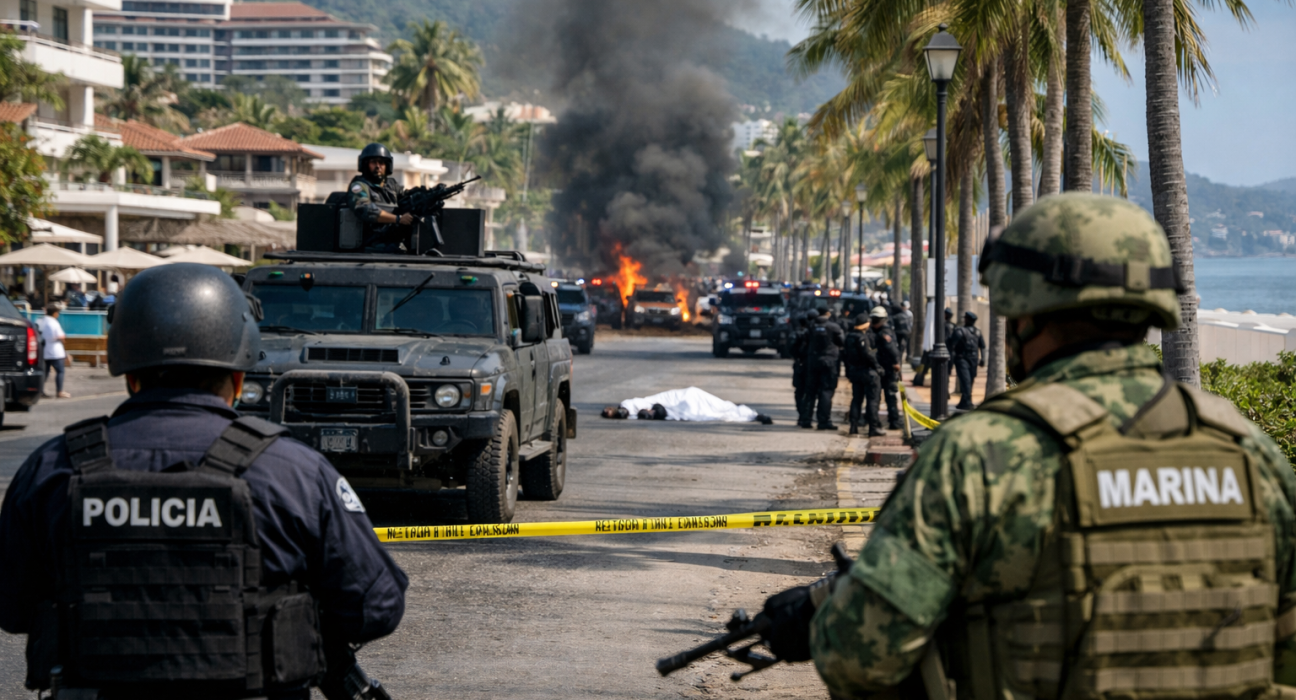
Recent reports indicate that violent unrest has erupted in Puerto Vallarta — a major Mexican tourist destination — and across several Mexican states following a high-profile military operation that resulted in the death of Nemesio Oseguera Cervantes, known as “El Mencho,” the leader of the powerful Jalisco New Generation Cartel (CJNG). The spine of the unrest stems from retaliation by cartel members and affiliates, creating a wave of arson, roadblocks, clashes with security forces, travel disruptions, and advisories for civilians and tourists to shelter in place.
El Mencho’s death occurred during an armed security operation in the western state of Jalisco, where government forces engaged cartel operatives, ultimately killing him and several cartel members. The operation was supported by intelligence from U.S. authorities and marked a significant development in Mexico’s long-running struggle with organized crime.
In the immediate aftermath, CJNG members reportedly responded with coordinated acts of violence across multiple regions, setting vehicles and buildings ablaze and erecting blocking points on highways — a tactic known as “narcobloqueos.” These actions were reported not only in Jalisco but also in adjacent states such as Colima, Michoacán, Guanajuato, Tamaulipas, Nayarit, Aguascalientes, Zacatecas, and Sinaloa. Blocks spanned urban and rural areas, complicating travel and public safety efforts.
Puerto Vallarta, a key destination for domestic and international tourists, experienced pronounced disruption. Images and social media reports showed burning vehicles, plumes of smoke, and limited movement in parts of the city, triggering advisories from the U.S. State Department and Canadian authorities urging their citizens to shelter in place and avoid unnecessary travel.
Flights were significantly impacted: airlines including Delta, United, Air Canada, WestJet, and others either canceled services or diverted flights in and out of Puerto Vallarta and nearby Guadalajara International Airport, primarily due to road closures and concerns about safe access to the airport terminals. Some carriers allowed passengers to rebook without penalties.
The travel disruptions have left tourists and residents temporarily stranded. Reports describe passengers stuck in resort areas with limited opportunities to depart, and movement restrictions on ground transport as local authorities and federal forces worked to manage the volatile situation.
Mexico’s federal and state officials, including President Claudia Sheinbaum, have sought to reassure the public and international visitors. Statements from authorities suggest that security forces have regained control in many areas and that conditions are stabilizing. Authorities also indicated that flights and public services are expected to resume normal operations in the coming days as blockades are cleared and security infrastructure is restored.
The CJNG is one of Mexico’s largest and most violent criminal organizations, heavily involved in the trafficking of drugs such as fentanyl, methamphetamine, and cocaine, and widely believed to have been responsible for numerous homicides and confrontations with Mexican and international law enforcement. The removal of its leader is seen as a significant achievement by security forces, but also highlights the cartel’s capacity for rapid, disruptive retaliation.
The unrest underscores the broader challenges the Mexican government faces in reducing cartel influence and ensuring public safety. Analysts note that while the elimination of a cartel leader may disrupt hierarchical command structures temporarily, it often creates vacuums that rival factions attempt to fill, thereby prolonging cycles of violence.
Pros – Potential Positive Outcomes
• Disruption of Major Cartel Leadership – The killing of El Mencho removes a long-standing figurehead of one of Mexico’s most powerful criminal organizations, which could weaken command structures and reduce the cartel’s consolidated power in the short term.
• Government Affirmation of Rule of Law – A successful military and law enforcement operation demonstrates the state’s capacity to act against deeply entrenched criminal figures, potentially strengthening public confidence and international cooperation.
• Reassertion of Control in Affected Regions – Statements from Mexican leaders about the restoration of order and resumption of travel and services suggest that authorities are working to stabilize impacted communities.
Cons – Risks and Negative Consequences
• Short-Term Public Safety Threats – The cartel’s violent reaction has directly threatened civilians, tourists, and commerce, leading to temporary shelter-in-place orders, arson, and roadblocks.
• Economic and Tourism Disruption – Flight cancellations, travel advisories, and general unease can harm local tourism and service industries that rely heavily on international visitors, with potentially lasting financial effects.
• Potential for Escalated Cartel Fragmentation – The removal of a central leader may lead to internal power struggles or splinter groups competing for control, potentially increasing overall violence if successors or rivals escalate conflict.
Future Projections
• Continued Security Operations and Retaliation Risks — Government forces are likely to maintain heightened presence and operations in affected states, which may suppress but also trigger additional confrontations in the short term. Successive attempts by rival factions to claim CJNG territory could fuel instability for months.
• Tourism Sector Impact — Travel warnings and disruption narratives could influence traveler perceptions and decisions, especially among foreign tourists, potentially reducing tourism flows until public confidence returns.
• Evolving Cartel Dynamics — Without a clear successor to El Mencho, CJNG might face internal power struggles or fragmentation. This could lead to localized spikes in violence as groups jockey for dominance, a pattern observed historically when high-ranking cartel figures are removed.
• Reinforced International Cooperation — The joint U.S.–Mexico operation may lead to continued intelligence sharing and collaborative law enforcement efforts targeting organized crime, with broader long-term implications for regional security strategy.
References & Links
News Reports
- Mexico hopes violence will calm in coming days, urges caution — https://ca.news.yahoo.com/mexico-hopes-violence-calm-coming-172144528.html
- Pregnant tourist stranded amid cartel violence — https://www.aol.com/articles/pregnant-tourist-second-trimester-trapped-150545303.html
- Mexican drug lord killing sparks revenge attacks — https://www.reuters.com/world/americas/mexican-drug-lord-killing-sparks-revenge-attacks-cars-businesses-set-ablaze-2026-02-23/
- Travelers stranded in Puerto Vallarta — https://uk.news.yahoo.com/b-c-travellers-stranded-puerto-012903224.html
- Ontarians flabbergasted as tensions escalate — https://uk.news.yahoo.com/ontarians-vacation-flabbergasted-tensions-mexico-000131044.html
Contextual Sources
- Report on El Mencho’s death — https://en.wikipedia.org/wiki/Nemesio_Oseguera_Cervantes
- Aftermath of the 2026 Jalisco operation — https://en.wikipedia.org/wiki/2026_Jalisco_operation
- Disturbances following El Mencho’s death — https://es.wikipedia.org/wiki/Disturbios_por_la_muerte_de_Nemesio_Oseguera_Cervantes_en_2026
- Study on cartel violence dynamics — https://arxiv.org/abs/2508.06509


Leave feedback about this
You must be logged in to post a comment.