
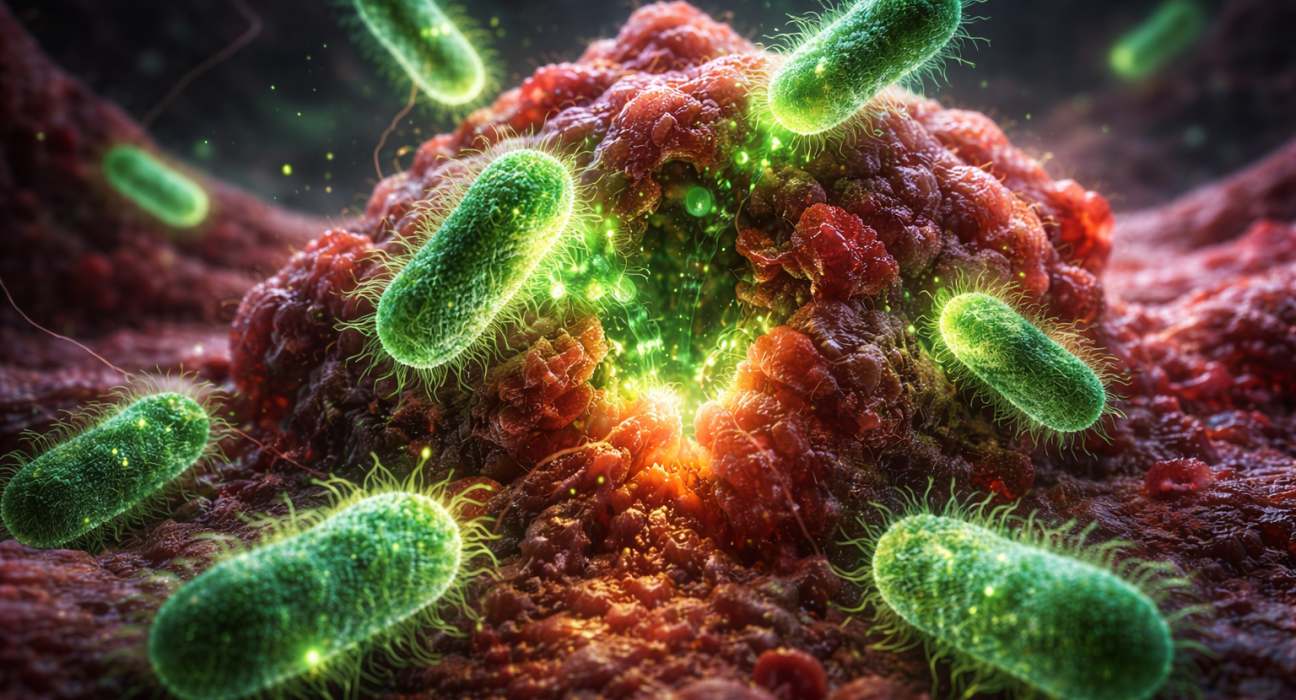
A new scientific development reported by SciTechDaily describes researchers engineering bacteria capable of targeting and destroying cancer cells from within tumors. Often referred to as “tumor-eating bacteria,” this approach represents a novel direction in cancer treatment—one that combines synthetic biology, immunotherapy, and precision medicine.
While still in experimental stages, the research highlights how living organisms can be programmed to act as therapeutic tools, potentially opening new pathways for treating difficult or resistant cancers.
What Scientists Developed
Researchers have engineered bacteria that can:
- Locate and infiltrate tumors
- Survive within the tumor microenvironment
- Release compounds that destroy cancer cells
- Potentially stimulate the immune system
Unlike traditional treatments such as chemotherapy or radiation—which can affect both healthy and cancerous cells—this approach aims to target tumors more precisely.
The bacteria are designed to thrive in the unique conditions found inside tumors, such as low oxygen levels, making them particularly suited for this application.
How “Tumor-Eating” Bacteria Work
1. Targeting the Tumor Environment
Tumors often create environments that are:
- Low in oxygen
- Nutrient-rich
- Difficult for immune cells to access
Certain bacteria naturally thrive in these conditions. Scientists have modified these bacteria to selectively accumulate in tumor tissue.
2. Delivering Therapeutic Effects
Once inside the tumor, the engineered bacteria can:
- Produce toxins that kill cancer cells
- Release molecules that trigger immune responses
- Break down tumor structures from within
This creates a localized treatment effect, potentially reducing harm to surrounding healthy tissue.
3. Controlled Activity
Researchers are also developing ways to:
- Control bacterial growth
- Limit activity to specific areas
- Ensure the bacteria can be safely eliminated after treatment
These controls are critical for safety and regulatory approval.
Why This Approach Is Significant
1. Addressing Treatment Resistance
Some cancers become resistant to conventional therapies. Bacteria-based treatments offer a completely different mechanism of action, which could be effective where other treatments fail.
2. Precision Medicine
The approach aligns with broader trends toward personalized and targeted therapies, aiming to treat cancer more effectively while minimizing side effects.
3. Immune System Activation
In addition to directly attacking tumors, the bacteria may help activate the body’s immune system, potentially leading to longer-term protection against cancer recurrence.
Historical Context: Bacteria in Cancer Treatment
The idea of using bacteria to treat cancer is not entirely new.
- Early experiments date back over a century
- Certain bacterial infections were observed to shrink tumors
- Modern research builds on these observations using genetic engineering
Advances in biotechnology now allow scientists to design bacteria with specific functions and safety controls, making the approach more viable than in the past.
Current Limitations
Despite its promise, the therapy is still in early stages.
Challenges include:
- Ensuring safety and preventing unintended infections
- Controlling bacterial behavior داخل the body
- Demonstrating effectiveness in human clinical trials
- Scaling production for widespread use
Most current results are based on preclinical studies, meaning further research is needed before clinical application.
Broader Industry Context
This development fits into a larger wave of innovation in cancer treatment, including:
- Immunotherapy (e.g., CAR-T cell therapy)
- Gene editing technologies
- Targeted drug delivery systems
The use of engineered bacteria represents a convergence of multiple scientific fields, including microbiology, oncology, and synthetic biology.
Pros (Potential Benefits)
• Highly targeted treatment: Focuses on tumor tissue, potentially reducing side effects
• New mechanism of action: Offers alternatives for treatment-resistant cancers
• Immune system support: May enhance the body’s natural defenses
• Innovative platform: Could be adapted for different types of cancer
Cons (Challenges and Risks)
• Safety concerns: Risk of infection or unintended effects
• Early-stage research: Limited data in human trials
• Regulatory hurdles: Complex approval process for biologically engineered therapies
• Uncertainty: Long-term outcomes remain unknown
Future Projections
1. Advancement to Clinical Trials
Researchers are likely to move toward human trials to test safety and effectiveness.
2. Combination Therapies
Bacteria-based treatments may be used alongside existing therapies for improved outcomes.
3. Customizable Treatments
Future approaches could tailor bacteria to specific cancer types or individual patients.
4. Expansion of Synthetic Biology in Medicine
Success in this area could accelerate the use of engineered organisms in other treatments.
5. Long-Term Integration Into Oncology
If proven safe and effective, this approach could become part of standard cancer care.
Conclusion
The development of tumor-targeting bacteria represents a promising and innovative step in cancer research. By leveraging the unique properties of living organisms, scientists are exploring new ways to attack cancer more precisely and effectively.
While significant challenges remain, the approach reflects a broader shift toward biologically engineered therapies that could transform how diseases are treated in the future.
References
Primary Source
- SciTechDaily – Scientists engineer tumor-eating bacteria
https://scitechdaily.com/scientists-engineer-tumor-eating-bacteria-that-devour-cancer-from-within/
Additional Context Sources
- Research on bacterial therapies in oncology
- Studies on tumor microenvironments and targeted treatments
- Developments in synthetic biology and immunotherapy






Leave feedback about this
You must be logged in to post a comment.