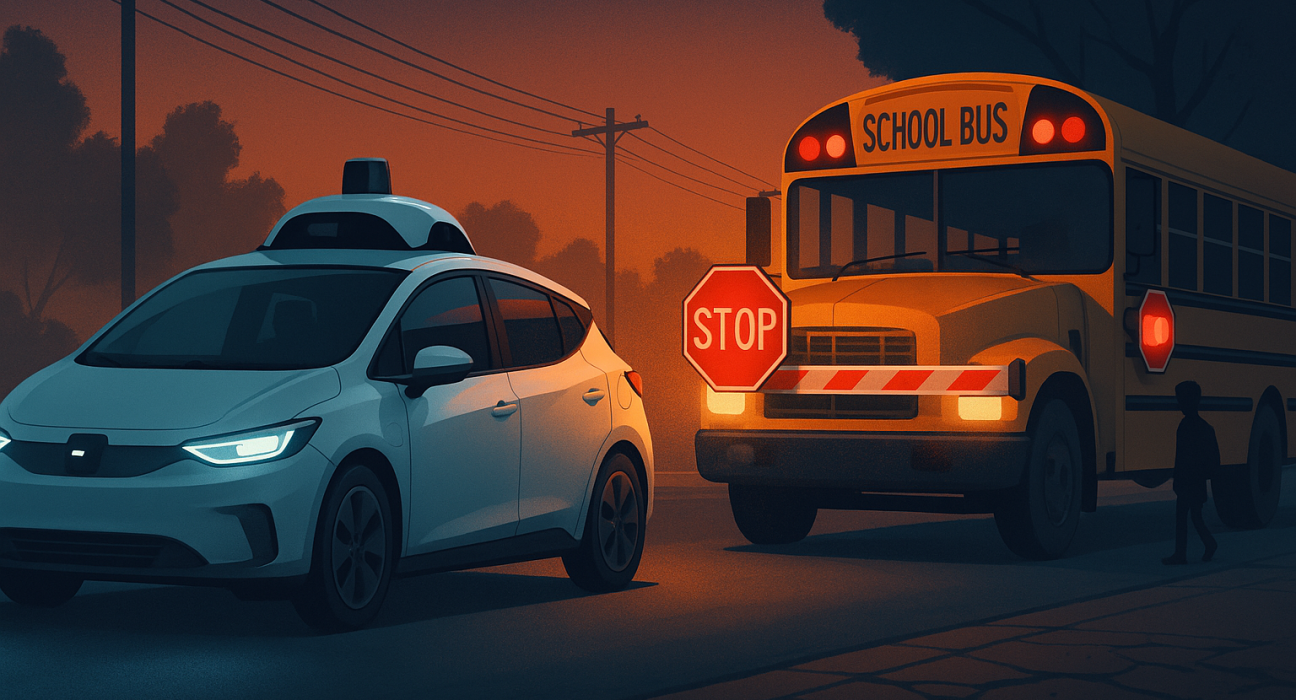
Waymo, Alphabet’s autonomous ride-hailing subsidiary, is preparing to file a voluntary software recall after a series of incidents in which its driverless taxis reportedly illegally passed stopped school buses. The move follows a growing federal investigation by the National Highway Traffic Safety Administration (NHTSA), which opened an inquiry in October after a media report showed a Waymo vehicle bypassing a school bus with activated red lights, a stop arm, and a crossing arm.
The first widely publicized incident emerged when WXIA-TV in Atlanta released footage in September showing a Waymo autonomous vehicle navigating around a stopped bus. Soon after, the Austin Independent School District submitted a formal complaint to NHTSA, documenting 19 separate incidents where Waymo’s AVs failed to stop as required by law. In one case, an autonomous vehicle passed the bus moments after a student crossed in front of it, while the child was still in the roadway.
In response, Waymo’s Chief Safety Officer Mauricio Peña acknowledged the issue in a statement to NPR. He emphasized that while the company maintains a strong safety record, it must “recognize when our behavior should be better.” Waymo concluded that a software issue contributed to the incidents and says updates already underway are expected to correct the behavior. The company will formally file the recall early next week, stressing that no injuries occurred in any of the reported events.
Despite the controversy, Waymo continues to highlight its broader safety performance. The company asserts that its autonomous vehicles experience far fewer major crashes than human drivers, including reductions of 91% in collisions causing serious injuries and 92% fewer pedestrian-related injuries in cities where the service operates. Independent analyses from Ars Technica and the newsletter Understanding AI support the claim that Waymo’s AVs outperform human drivers on overall safety metrics.
Still, NHTSA remains concerned. Waymo vehicles surpassed 100 million autonomous miles driven as of July and continue accumulating around 2 million miles weekly, giving regulators reason to believe more undocumented incidents may have occurred. NHTSA investigators recently sent a detailed questionnaire to Waymo requesting documentation of all similar episodes, corrective actions taken, and internal analyses of system behavior. The company has until January 20, 2026, to respond.
This investigation emerges during a broader national conversation about the regulation of autonomous vehicles. While technology companies highlight safety gains, federal regulators and local governments are increasingly scrutinizing AV behavior around vulnerable road users such as schoolchildren, pedestrians, cyclists, and emergency responders. These events echo earlier concerns raised about Cruise, Tesla’s Autopilot, and other AV systems that faced investigations for erratic behaviors in edge-case scenarios.
Waymo’s handling of this recall will likely serve as a test case for how AV developers and regulators collaborate — or clash — as the technology expands. Although AV crashes remain statistically rare compared to human-caused collisions, incidents involving children or school buses can create a disproportionate public backlash, influencing public trust and regulatory priorities.
Overall, the voluntary recall suggests Waymo is aiming to position itself as a self-regulating, responsible industry leader, but NHTSA’s investigation signals that more rigorous oversight is becoming the norm as autonomous vehicles transition from trials to widespread public deployment.
Pros
- Proactive Safety Response
Waymo is voluntarily recalling software before federal penalties or accidents occur, signaling internal accountability. - Strong Overall Safety Record
Independent analyses and Waymo’s internal data indicate significantly fewer serious injuries and pedestrian crashes than human drivers. - Large Data Pool for Improvements
With over 100 million autonomous miles logged, Waymo’s system has extensive operational data to identify rare or edge-case failures.
Cons
- Safety Concerns Around Children
Failure to stop for school buses is a legally and ethically serious lapse that can undermine public trust in AV technology. - Regulatory Scrutiny Increasing
NHTSA’s aggressive inquiry — including a broad request for documentation — suggests regulators believe systemic issues may exist. - Potential for Additional Incidents
NHTSA’s statement that “the likelihood of other prior similar incidents is high” raises concerns about undiscovered problems.
Future Projections
Short-Term:
- Expect a formal recall filing, further NHTSA communication, and possible public release of additional incident data.
- Waymo may temporarily limit operations in high-risk school zones during the software patch rollout.
Medium-Term:
- Increased federal oversight of AV school-bus interactions could become part of standard regulatory requirements.
- Other AV companies may preemptively revise algorithms to avoid similar scrutiny.
Long-Term:
- AV companies will likely integrate enhanced detection systems for school buses, crossing arms, and children.
- The industry could face broader “trust shocks” if incidents involving vulnerable road users continue, potentially slowing AV adoption.
- Successful transparency and correction from Waymo could strengthen long-term confidence in AV safety claims.
References & Further Reading
NPR – Waymo to file voluntary software recall after school bus incidents
https://www.npr.org/
Reuters – Federal regulators investigate Waymo safety behavior
https://www.reuters.com/technology/
Ars Technica – Analysis of Waymo’s AV safety performance
https://arstechnica.com/cars/
Understanding AI – Independent evaluation of autonomous driving safety
https://www.understandingai.org/
NHTSA – Autonomous vehicle investigations and recall database
https://www.nhtsa.gov/recalls
The Verge – Coverage of AV industry recalls and safety issues
https://www.theverge.com/transportation
New York Times – Public trust and regulation of autonomous vehicles
https://www.nytimes.com/section/technology