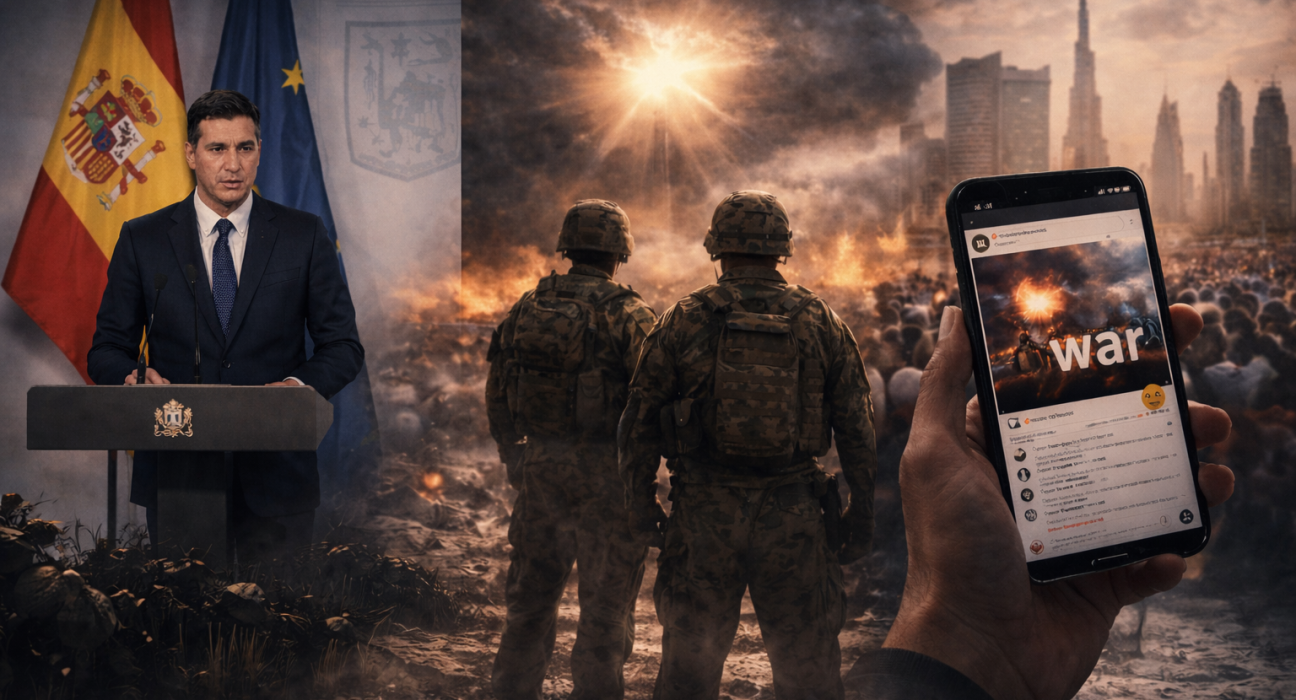
The rapidly expanding conflict involving the United States, Israel, and Iran has produced a wide range of international reactions and secondary effects — from geopolitical disputes among allies to warnings about wartime propaganda and the influence of religion in political rhetoric. Three recent reports from Associated Press, The Guardian, and Evening Standard highlight different aspects of the global response to the war.
Together, the articles show how the conflict is not only a military confrontation but also a diplomatic, ideological, and social media battleground.
Spain Breaks with Washington Over Military Bases
One of the most significant diplomatic disputes emerging from the war involves Pedro Sánchez and the Spanish government’s refusal to allow the United States to use joint military bases in Spain for operations against Iran.
According to AP reporting, Spain rejected requests to use the Rota naval base and Morón air base, both jointly operated with the U.S., for strikes related to the Iran conflict. Spain stated that such use would violate existing agreements and international law unless authorized through a multilateral framework such as the United Nations.
Sánchez publicly condemned the military operation, describing it as “dangerous and unjustifiable.” The Spanish leader warned the war could escalate into another prolonged Middle East conflict similar to Iraq or Afghanistan.
The dispute quickly escalated after Donald Trump threatened to cut off trade with Spain in retaliation for its refusal. Spain responded that such trade restrictions would be difficult to implement because the country is part of the European Union, which negotiates trade agreements collectively.
The disagreement highlights broader divisions among Western allies. While some NATO members support U.S. actions, others — particularly in Europe — have emphasized diplomacy and questioned the legality of the strikes.
Religious Rhetoric in Military Messaging
Another controversial development reported by The Guardian involves allegations that religious rhetoric has been used by some U.S. military commanders when discussing the war with troops.
A watchdog group, the Military Religious Freedom Foundation (MRFF), says it received over 200 complaints from service members alleging that officers framed the conflict as part of a biblical prophecy involving the “end times” or Armageddon.
According to the complaints, some troops were reportedly told that the war was “God’s divine plan” and that Trump had been “anointed by Jesus.”
The MRFF argues that such messaging could violate the U.S. Constitution’s principle of separation between church and state, particularly within the hierarchical structure of the military where personnel may feel pressure to accept ideological messaging from superiors.
The Pentagon has not directly confirmed the allegations but has not publicly addressed them in detail either.
Military analysts note that religion has historically influenced wartime rhetoric across many nations. However, explicit framing of a modern military campaign in apocalyptic religious terms is rare and controversial within professional armed forces.
Governments Warn Influencers Against War Commentary
Another unexpected dimension of the conflict involves social media regulation in the Middle East.
Authorities in Dubai have warned social media influencers and content creators that spreading misinformation or commentary about the Iran war could lead to arrest or imprisonment.
According to reporting from the Evening Standard, the warning comes from the UAE’s National Media Office, which reminded residents that publishing unverified or misleading information about military operations could violate national security laws.
The UAE maintains strict regulations on public communications during times of geopolitical tension. Officials say such measures are necessary to prevent disinformation, panic, or propaganda from spreading online.
The warning reflects a growing trend among governments worldwide to regulate digital narratives during conflicts. Analysts say modern wars now include a significant information warfare component, where governments attempt to control messaging, counter propaganda, and shape public perception.
Broader Strategic Context
The conflict stems from coordinated U.S.–Israeli strikes on Iranian targets in late February 2026, part of a campaign aimed at limiting Iran’s military capabilities and strategic influence in the region.
The strikes triggered retaliatory actions, diplomatic disputes, and global protests. Demonstrations have occurred in multiple countries, including the United States, where some groups oppose the military campaign while others support it.
Global reactions have varied:
• Some governments support the strikes as a response to Iranian military threats.
• Others warn the escalation risks triggering a wider regional war.
• International organizations continue urging de-escalation and diplomatic negotiation.
Pros (Arguments Supporting the Military Action)
• Strategic deterrence: Supporters argue that strikes against Iranian military infrastructure may reduce long-term security threats in the region.
• Alliance commitments: The operation reflects cooperation between the United States and Israel in addressing shared security concerns.
• Rapid response capability: Demonstrates the ability of allied forces to conduct coordinated operations against perceived threats.
(These views reflect arguments made by supporters of the operation.)
Cons (Concerns and Criticism)
• Risk of escalation: Military strikes could trigger a broader regional war involving multiple countries.
• Diplomatic fractures: Disputes like the U.S.–Spain conflict show that allies are divided over the operation.
• Religious politicization concerns: Allegations of religious rhetoric in military messaging raise constitutional and ethical questions.
• Information control debates: Restrictions on online discussion highlight tensions between national security and freedom of expression.
Future Projections
1. Growing Diplomatic Divisions
More disagreements among NATO and EU members could emerge if the war expands or continues for an extended period.
2. Information Warfare Intensifies
Governments are likely to continue monitoring social media narratives as the conflict evolves.
3. Military Campaign Duration
Israeli officials have indicated the conflict may continue for weeks or longer depending on Iran’s response.
4. Political Debate in the U.S.
Domestic political arguments about the legality and strategy of the war may intensify.
5. Risk of Regional Expansion
Any attacks on shipping routes or neighboring countries could broaden the conflict across the Middle East.
References
Primary Articles
- AP News – Spain denies cooperation with U.S. operations in Iran war
https://apnews.com/article/iran-trump-spain-war-sanchez-bases-26c3132777225c4e473f090b7ab07037 - The Guardian – U.S. troops told war on Iran was “God’s divine plan”
https://www.theguardian.com/world/2026/mar/03/us-israel-iran-war-christian-rhetoric - Evening Standard – Dubai influencers warned about posting Iran war content
https://www.standard.co.uk/news/world/dubai-influencers-prison-warning-posting-iran-war-b1273587.html