
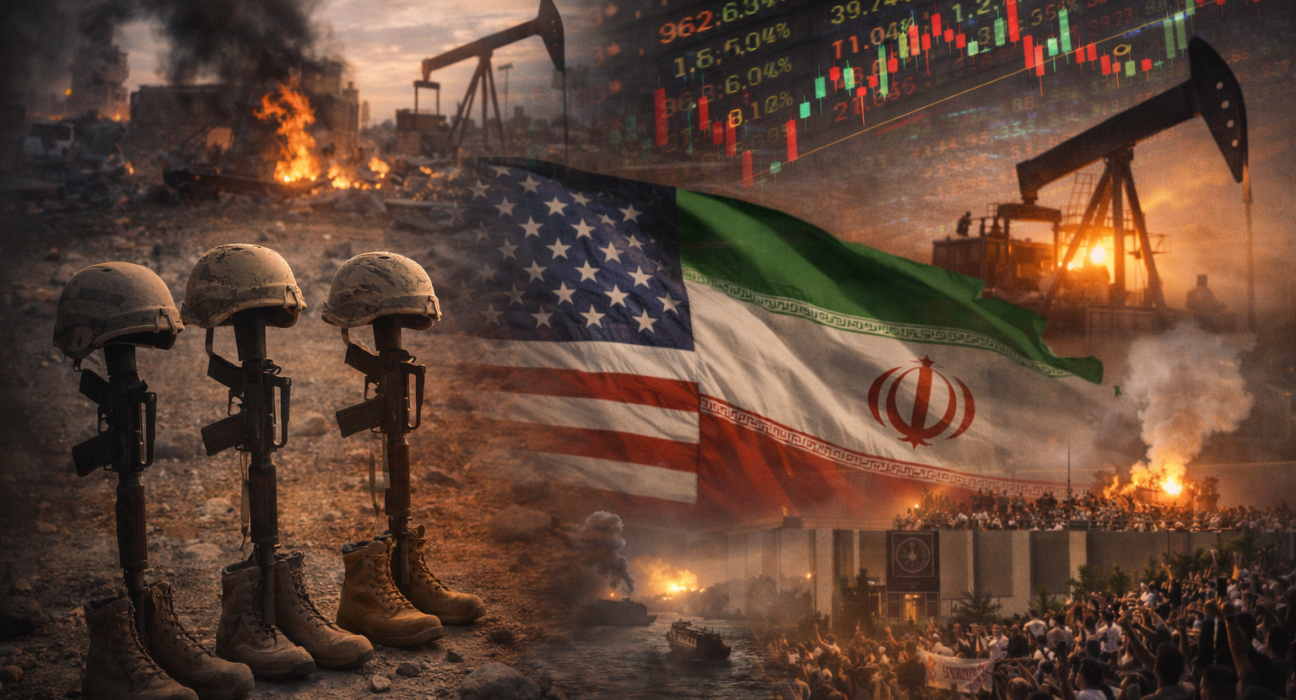
A fast-moving escalation involving the United States, Iran, and Israel is generating three overlapping storylines: (1) disputed justifications for the initial operation, (2) expanding regional and public backlash— including deadly unrest at a U.S. consulate in Pakistan— and (3) immediate spillover into global energy markets.
1) The “imminent threat” question and congressional briefings
Reuters reports that Pentagon officials told members of Congress in closed-door briefings they had no intelligence indicating Iran planned to attack U.S. forces first—a point that undercuts (or at minimum complicates) public-facing arguments framed around preemption. Reuters indicates officials emphasized broader Iranian capabilities and regional proxy forces, but not evidence of a planned first strike against U.S. forces.
This matters because it shapes how policymakers—and the public—evaluate:
- Legal and strategic rationale (preemptive vs. discretionary action)
- Congressional oversight and war-powers debates
- International coalition-building, which often hinges on credibility of threat assessments
Public opinion appears divided and sensitive to perceived justification: Reuters cites polling showing limited approval for the strikes in early snapshots.
2) The military situation and confirmed U.S. casualties
Reuters and other outlets describe a major U.S. operation with extensive strikes and a widening exchange of fire. Reuters reports U.S. Central Command confirmed U.S. combat fatalities and serious injuries in the opening phase of the conflict. The Guardian separately reports a fourth U.S. service member died from injuries.
A second Reuters piece provides additional operational context (including a timeline briefing attributed to the chairman of the Joint Chiefs). Taken together, the reporting depicts:
- a high tempo initial strike package
- retaliatory missile/drone attacks
- expectation of further casualties if the operation continues for weeks
Because casualty numbers and operational claims change quickly in live conflicts, the most reliable “hard facts” right now are the confirmed U.S. deaths/injuries and the existence of congressional briefings described by Reuters—while specific battlefield claims (damage totals, ship counts, etc.) should be treated as provisional unless independently verified.
3) Public backlash abroad: Karachi consulate violence
AP reports that protesters attempted to storm the U.S. consulate in Karachi, leading to deadly clashes with police and at least 22 deaths and more than 120 wounded, according to authorities cited by AP. AP frames the unrest as linked to anger over escalation and high-profile killings in the conflict’s wider arc.
This episode illustrates a familiar regional dynamic: when U.S.–Iran tensions spike, U.S. diplomatic facilities and perceived U.S.-aligned interests in neighboring countries can face rapid, high-mobilization protest risks—sometimes with opportunistic escalation by local factions.
4) Energy markets and the Strait of Hormuz risk premium
AP reports oil prices rose sharply as markets digested the possibility of broader regional disruption, including risks around Gulf infrastructure and shipping. NPR similarly reports oil prices rising and stocks falling amid fears the conflict could disrupt supply. Al Jazeera also notes sharp moves in crude benchmarks tied to perceived supply risk.
The key mechanism is the risk premium: even before physical supply is cut, traders price in the chance of disruptions—especially related to shipping lanes and port/refinery vulnerabilities in the Gulf region. AP’s follow-on reporting highlights tanker disruptions and facility impacts as specific market drivers.
Pros
- Deterrence signaling (claimed benefit): Supporters argue large-scale action can degrade adversary capabilities and deter future attacks, especially against regional bases and allies.
- Operational clarity for markets/partners (if objectives stabilize): A clearly defined endpoint can reduce uncertainty compared with open-ended escalation cycles.
- Heightened diplomatic urgency: Escalations often force accelerated backchannel diplomacy to prevent further widening.
Cons
- Credibility and oversight strain: If lawmakers were briefed that no “first strike” intel existed, public justification may face ongoing scrutiny and polarize domestic support.
- Regional blowback: The Karachi consulate violence shows how quickly anger can translate into lethal events around U.S. symbols and facilities.
- Energy shock risk: Oil-price spikes can transmit inflationary pressure globally and create secondary economic strain even far from the battlefield.
- Escalation uncertainty: Early casualties and warnings of more to come raise the risk of mission creep and expanding theaters.
Future projections
- Congressional scrutiny intensifies: Expect more classified briefings and public disputes over intelligence thresholds and war powers.
- Security posture hardens at diplomatic sites: Consulates and embassies in high-mobilization cities may raise alert levels; host governments may expand security perimeters.
- Oil stays headline-sensitive: Even absent confirmed supply loss, the “Hormuz risk premium” can persist; price volatility may remain elevated.
- Allies calibrate involvement: Expect continued “support but not participation” positioning from some partners, plus legal framing around “defensive” basing and intercept operations.
Reuters (Mar 2, 2026) – Pentagon tells Congress no sign Iran was going to attack US first
https://www.reuters.com/world/us/pentagon-tells-congress-no-sign-that-iran-was-going-attack-us-first-sources-say-2026-03-02/
Reuters (Mar 1, 2026) – US military says three of its service members killed in Iran operation
https://www.reuters.com/world/us-military-says-three-its-service-members-killed-iran-operation-2026-03-01/
Reuters (Mar 2, 2026) – Top U.S. general outlines initial timeline of U.S. military operation in Iran
https://www.reuters.com/business/aerospace-defense/top-us-general-outlines-initial-timeline-us-military-operation-iran-2026-03-02/
AP News – Protesters try to storm US Consulate in Karachi; authorities report at least 22 killed
https://apnews.com/article/pakistan-protesters-attacked-us-consulate-karachi-iran-a3cc0c3c6f126cc54a657f61d312a203
AP News – Oil prices rise sharply after US and Israeli attacks; Strait of Hormuz risk focus
https://apnews.com/article/iran-us-israel-war-oil-prices-energy-strait-of-hormuz-21e634acba4c35801d28dfdbcc53824a
NPR (via station page) – Oil prices surge and stocks fall amid fears over Iran war
https://www.vpm.org/npr-news/2026-03-02/oil-prices-surge-and-stocks-fall-amid-fears-over-iran-war
Al Jazeera – Oil prices rise sharply after US, Israeli attacks on Iran
https://www.aljazeera.com/news/2026/3/2/oil-prices-rise-sharply-after-us-israeli-attacks-on-iran
The Guardian – Fourth American service member killed in Iran operation
https://www.theguardian.com/world/2026/mar/02/iran-attack-fourth-us-service-member-killed
Washington Post – Israel targets Iranian security sites (context on widening conflict)
https://www.washingtonpost.com/world/2026/03/01/trump-iran-israel-khamenei-strikes-live-updates/
BBC link provided (could not be fetched from my environment due to an access error)
https://www.bbc.com/news/articles/cqj9g11p1ezo
Reddit thread (discussion; links to AP)
https://www.reddit.com/r/news/comments/1ridanw/australias_foreign_minister_rules_out_australia/




Leave feedback about this
You must be logged in to post a comment.