
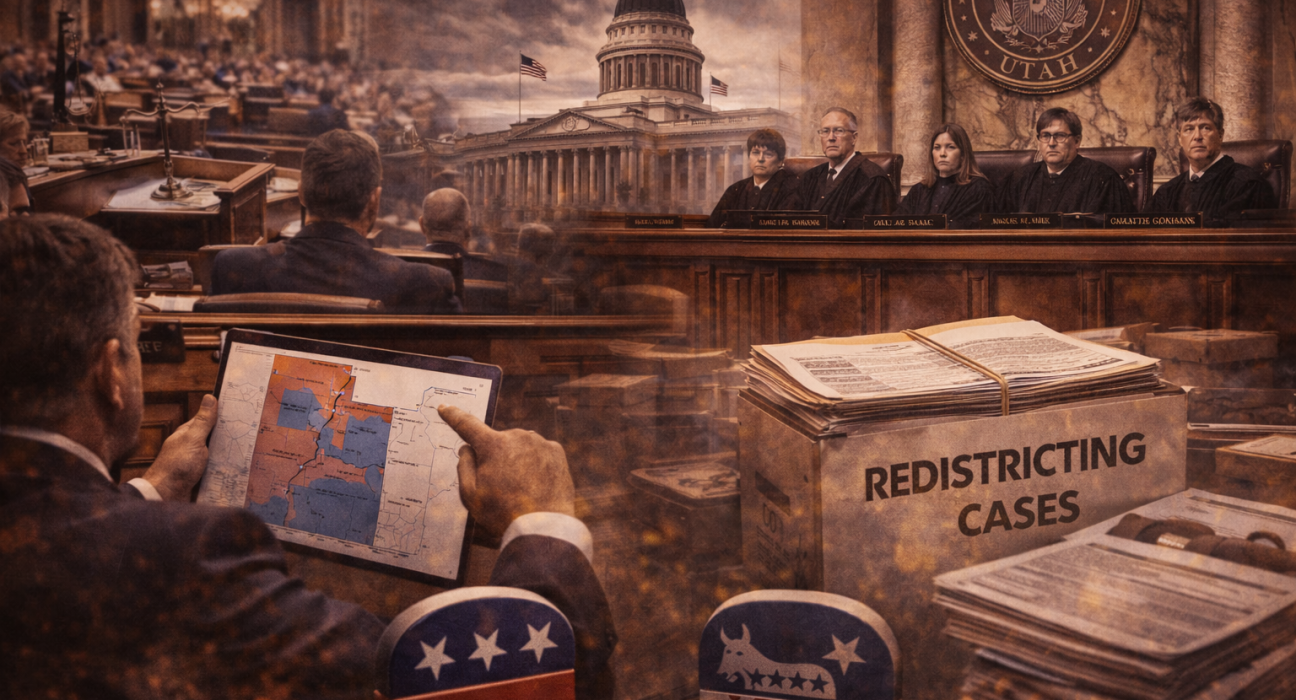
A proposal in Utah to expand the state Supreme Court amid an ongoing legal fight over redistricting has triggered intense debate about judicial independence, separation of powers, and election integrity. Supporters argue the move addresses workload and efficiency. Critics counter that the timing and context raise concerns about political interference with the courts—particularly as midterm elections approach.
What Is Being Proposed
Utah lawmakers are considering legislation to expand the Utah Supreme Court, increasing the number of justices beyond its current size. The proposal surfaced while the court is weighing cases related to redistricting, including challenges that could affect how legislative maps are drawn and how voter-approved reforms are interpreted.
While court expansion is not inherently unconstitutional, the timing—coinciding with politically consequential cases—has fueled allegations that the move could alter the balance of the court to influence outcomes.
Why Critics Say This Is Problematic
1. Judicial Independence
The core concern is that expanding the court during active litigation creates the appearance—if not the reality—of political pressure on judicial decision-making. Courts derive legitimacy from impartiality; changes that appear designed to affect case outcomes risk eroding public trust.
2. Separation of Powers
In the U.S. system, legislatures set court structures, but doing so in response to specific rulings or pending cases can blur the line between lawmaking and adjudication. Critics argue that altering the size of a court to influence legal interpretations undermines the judiciary’s role as a check on legislative power.
3. Redistricting Stakes
Redistricting cases often determine electoral outcomes for years. If a legislature changes court composition while maps are under review, opponents fear it could insulate gerrymandered districts from judicial scrutiny—affecting representation and competitive elections.
4. Precedent and Normalization
Even if lawful, such actions may set a precedent encouraging future legislatures to reshape courts whenever rulings threaten political interests, potentially leading to a cycle of retaliatory expansions or contractions.
What Might Be the Agenda or Political Angle
Supporters of the proposal emphasize administrative needs—arguing that population growth and caseloads justify more justices. They also note that lawmakers constitutionally control court structure.
Critics, however, point to several contextual factors that suggest a political angle:
- Timing: The proposal arrives while the court is considering redistricting disputes that could constrain legislative power.
- Electoral Incentives: Redistricting outcomes can influence midterm elections and party control.
- Policy Alignment: Expanding the court could allow the appointment of justices perceived as more aligned with the legislature’s interpretation of voter initiatives or constitutional limits.
Whether or not this is the intent, legal scholars emphasize that perception matters. Even well-intentioned reforms can appear strategic if they coincide with politically sensitive cases.
Has This Happened Before?
Yes—both at the federal and state levels.
Federal Example
- 1937 “Court-Packing” Plan: President Franklin D. Roosevelt proposed expanding the U.S. Supreme Court after it struck down New Deal laws. Though the plan failed, it is widely cited as a cautionary tale about politicizing judicial structure.
State-Level Examples
- Arizona (2016): Lawmakers debated expanding appellate courts amid disputes over voter initiatives.
- Georgia (2018): Judicial restructuring occurred alongside politically charged election litigation.
- North Carolina (various years): Changes to court composition and election methods followed adverse rulings on redistricting.
In each case, courts and scholars warned that structural changes tied to political disputes can undermine judicial credibility—even when technically lawful.
Legal and Democratic Implications
Short-Term
- Increased litigation challenging the constitutionality or intent of the expansion.
- Heightened scrutiny of judicial appointments and confirmation processes.
Medium-Term
- Potential chilling effect on courts reviewing election laws or voter initiatives.
- Greater polarization around the judiciary as an institution.
Long-Term
- Normalization of court restructuring as a political tool.
- Erosion of public confidence in courts as neutral arbiters—especially in election-related disputes.
Pros and Cons of Court Expansion
Pros
- May reduce caseload pressure.
- Legislatures have constitutional authority over court structure.
- Could modernize judicial administration.
Cons
- Risks politicizing the judiciary.
- Undermines confidence during active, high-stakes litigation.
- Sets a precedent for retaliatory or strategic court changes.
Conclusion
The proposed expansion of the Utah Supreme Court illustrates a recurring tension in American democracy: the lawful power of legislatures versus the need to preserve judicial independence. While court expansion is not inherently illegitimate, the context—particularly during redistricting disputes—raises concerns about motive, perception, and precedent. Whether or not the measure advances, the debate underscores how fragile public trust in democratic institutions can be when structural changes coincide with politically consequential cases.
References & Further Reading
AP News — Utah lawmakers consider expanding Supreme Court amid redistricting fight
https://apnews.com/article/utah-supreme-court-expansion-redistricting-midterms-b643460e59aebad01b3f9f8efbd1e482
National Conference of State Legislatures — Redistricting and judicial review
https://www.ncsl.org
Brennan Center for Justice — Court expansion and judicial independence
https://www.brennancenter.org
Congressional Research Service — Court structure and separation of powers
https://crsreports.congress.gov





Leave feedback about this
You must be logged in to post a comment.