
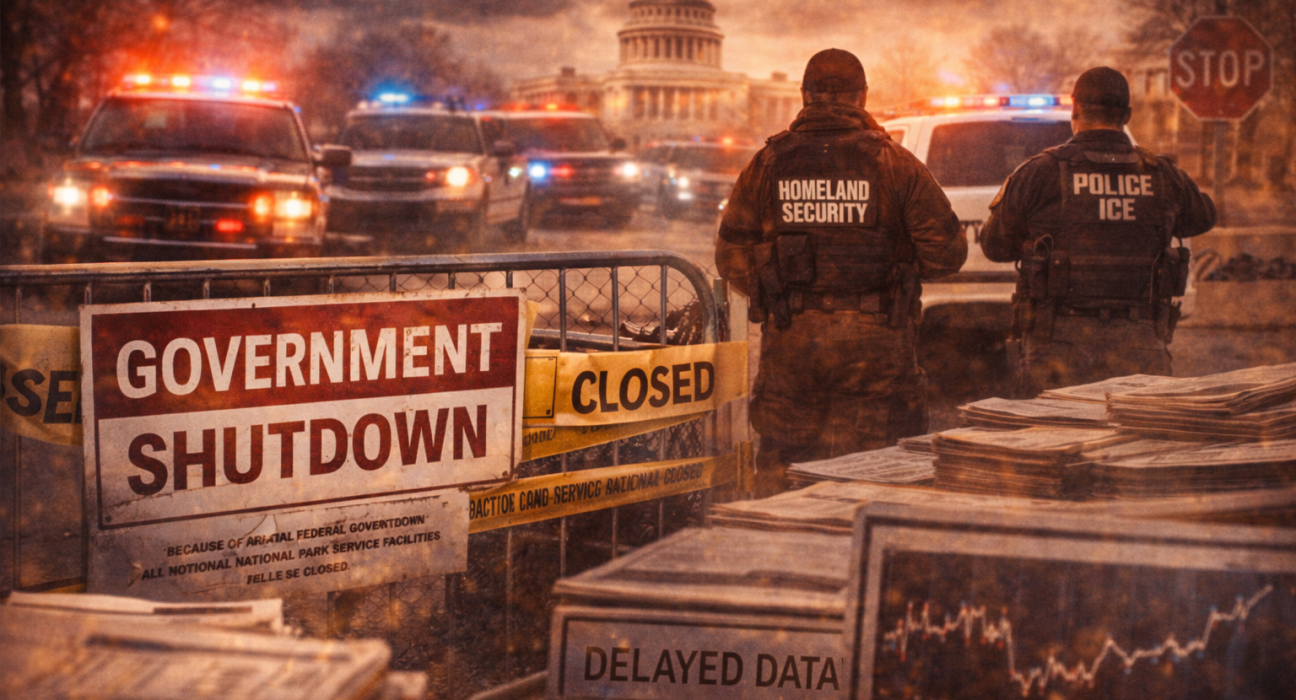
The U.S. entered a partial federal government shutdown over the weekend of Feb. 1–2, 2026, triggered by a funding lapse after Congress failed to finalize appropriations on time. Reporting indicates the immediate sticking point was a standoff over immigration enforcement policy and funding—especially the Department of Homeland Security (DHS) and ICE-related provisions—rather than a single broad disagreement over overall spending levels.
Although many essential functions continue, a shutdown still disrupts federal operations, delays data, and creates economic drag—especially if it lasts more than a few days.
Why the government is shut down
Based on reporting from Reuters and other outlets, the shutdown stems from:
- A budget deadline hit before the House acted
- The Senate passed a bipartisan approach to restore funding, but the House was not in session during the deadline window, leading to a lapse.
- A concentrated fight over DHS/ICE oversight
- Democrats have pushed for constraints and accountability measures tied to ICE operations (examples cited in coverage include ideas like body cameras and limits on certain enforcement practices).
- Republicans argue DHS/ICE should be funded without what they view as operational “handcuffs,” framing demands as undermining enforcement.
- A temporary “split” funding approach
- One compromise structure discussed in reporting: fund most of government for longer while giving DHS a shorter extension to keep negotiating enforcement reforms.
How this affects the economy
Shutdown impacts vary a lot by duration. Even short shutdowns can be noisy; longer ones become materially costly.
1) Lost output and delayed spending
Government spending is a component of GDP. When agencies pause “non-excepted” work, government output falls and contractors may stop or delay work. Some spending “catches up” after reopening, but lost labor hours are largely unrecoverable. Congressional research summaries of recent shutdown dynamics emphasize this split between temporary demand effects and more permanent lost output.
2) Federal workers and contractors: cashflow shock
- Some employees are furloughed; others work without immediate pay (depending on lapse plans).
- Contractors can be hit harder than federal employees because back pay rules may not cover them, and small contractors can face immediate cashflow constraints.
3) Economic data disruption
A big immediate economic consequence is missing official statistics:
- The Bureau of Labor Statistics delaying key releases (including the monthly jobs report) reduces visibility for markets, businesses, and the Federal Reserve.
4) Travel and logistics disruption risk
Even partial shutdowns can ripple into:
- aviation oversight, safety functions, and staffing stress (depending on which agencies are funded and which personnel are “excepted”)
- slower regulatory approvals, inspections, and administrative processing that affect commerce
(Severity depends on how long the shutdown lasts and which agencies are unfunded.)
5) Confidence and financing costs
Nonpartisan fiscal groups warn shutdowns can increase perceptions of U.S. governance risk, potentially nudging borrowing costs higher over time—especially when shutdowns recur frequently.
The arguments from both sides
Republican framing (as reflected in reporting)
- DHS/ICE should be funded promptly and “cleanly.”
- Operational restrictions (e.g., mandated tools/policies) are portrayed as undermining enforcement capacity.
- The shutdown is blamed on opposition demands tied to immigration enforcement.
Democratic framing (as reflected in reporting)
- Funding shouldn’t be extended without guardrails if enforcement is allegedly overreaching or harming civil liberties.
- They argue DHS/ICE reforms are urgent and that Congress has leverage only at funding deadlines.
What to watch next
- House vote timing: Reuters reporting indicates the House is taking up legislation and a vote is expected quickly, suggesting this could be short-lived.
- How long DHS is funded under any “split” arrangement and whether negotiations continue.
- Whether data releases remain delayed and how markets react to reduced visibility.
References & Further Reading
Reuters — House takes up deal to restore government funding; vote expected
https://www.reuters.com/world/us/us-house-takes-up-deal-restore-government-funding-tuesday-vote-expected-2026-02-02/
Reuters — Speaker Johnson says he has votes to end partial shutdown by Tuesday
https://www.reuters.com/world/us/house-speaker-johnson-says-confident-he-has-votes-end-partial-shutdown-by-least-2026-02-01/
Axios — Jobs report postponed due to government shutdown
https://www.axios.com/2026/02/02/jobs-report-postponed-shutdown
Business Insider — BLS delays jobs report due to shutdown
https://www.businessinsider.com/bls-delays-jobs-report-hiring-unemployment-data-partial-government-shutdown-2026-2
Congressional Research Service (Congress.gov) — Economic effects of shutdowns (FY2026 context)
https://www.congress.gov/crs-product/R48832
Bipartisan Policy Center — What happens during a government shutdown
https://bipartisanpolicy.org/explainer/what-happens-if-the-government-shuts-down-in-2023/
If you paste the key lines from the BBC piece (BBC’s site is blocked for me to open directly), I can mirror its framing precisely while still keeping the same neutral, multi-source approach.





Leave feedback about this
You must be logged in to post a comment.