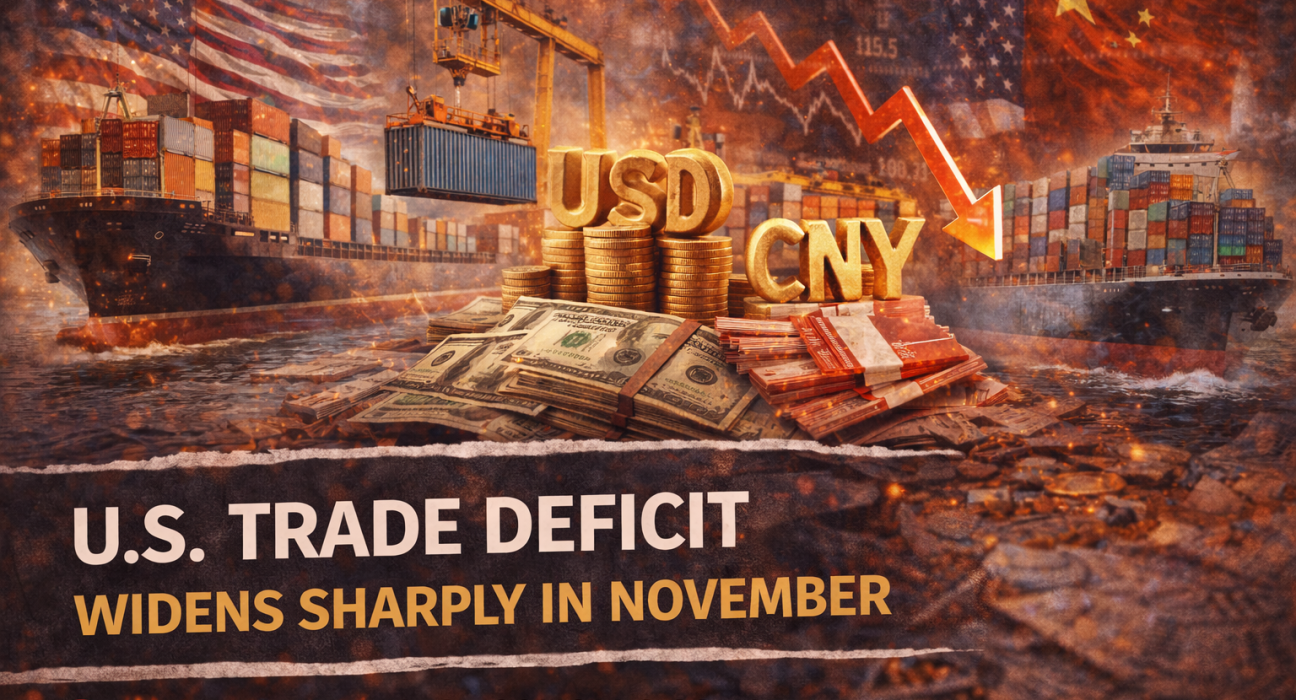
The U.S. trade deficit widened sharply in November, reaching its largest monthly increase in nearly 34 years, according to newly released data. The surge reflects a growing imbalance between what the United States imports and exports, raising renewed questions about inflation, supply chains, trade policy, and the longer-term resilience of the American economy.
While trade deficits are not inherently negative, the scale and timing of this expansion have amplified concerns about consumer prices, geopolitical risk, and whether recent political and economic choices are contributing to structural vulnerabilities.
What the Latest Trade Data Shows
The November figures indicate that U.S. imports rose significantly faster than exports, driven by:
- Increased purchases of consumer goods
- Higher imports of industrial supplies and energy
- Slower export growth amid weaker global demand and trade friction
Economists note that the magnitude of the widening — the steepest in more than three decades — suggests a sudden shift rather than a gradual trend. This raises questions about whether the imbalance reflects temporary factors (such as inventory restocking or seasonal demand) or deeper structural issues.
What This Means for Prices of Goods in America
Short-Term Price Effects
In the near term, a larger trade deficit can have mixed effects on prices:
- Downward pressure on some goods: Increased imports can temporarily hold down prices if retailers have ample supply.
- Upward pressure from currency effects: A persistent deficit can weaken the U.S. dollar, making imports more expensive over time.
- Higher logistics and financing costs: As global shipping and insurance costs fluctuate, imported goods can become more expensive even if supply is strong.
For consumers, this often translates into price volatility, where some goods remain affordable while others — especially electronics, energy-linked products, and imported food items — become more expensive.
Medium- to Long-Term Risks
If the deficit remains elevated:
- Import-dependent industries may pass higher costs to consumers
- Domestic producers may struggle to compete with cheaper foreign goods
- Inflationary pressures could re-emerge, especially if the dollar weakens further
Is the Trade Deficit a Result of the U.S. Political Climate?
Partially — but not exclusively.
Policy-Related Factors
Several political and policy dynamics have contributed to current trade conditions:
- Tariffs and trade uncertainty: Ongoing tariff policies and shifting trade relationships have disrupted traditional export markets while not fully reducing import reliance.
- Domestic industrial strategy: Efforts to reshore manufacturing take time; in the interim, imports often rise faster than domestic production.
- Fiscal policy and consumption: Strong government spending and consumer demand can increase imports faster than exports.
Global Factors Beyond U.S. Control
However, much of the widening deficit also reflects:
- Slower growth in key export markets
- Supply chain realignments following geopolitical tensions
- Energy and commodity price swings
Economists caution against attributing the entire deficit to domestic politics alone. Trade imbalances are shaped by global demand, currency dynamics, and comparative advantages — not just policy decisions.
Why Trade Deficits Matter Politically
Large trade deficits often become political flashpoints because they are highly visible and easily framed as losses. However, economists emphasize that a trade deficit also reflects:
- Strong consumer demand
- The U.S. dollar’s role as the global reserve currency
- Capital inflows that finance investment and government borrowing
That said, persistent deficits can increase dependence on foreign suppliers and expose the economy to geopolitical leverage — particularly during times of international tension.
What Recourse Do Americans Have?
While individual consumers cannot directly influence trade balances, there are practical and civic avenues for response:
As Consumers
- Supporting domestically produced goods where feasible
- Reducing reliance on discretionary imported items during price volatility
- Diversifying personal finances to hedge against inflation and currency risk
As Workers and Communities
- Advocating for workforce development and domestic manufacturing investment
- Supporting policies that strengthen supply chain resilience
- Engaging in local economic planning initiatives
As Citizens
- Voting and civic engagement around trade, industrial, and labor policy
- Supporting transparency in trade negotiations
- Encouraging long-term strategies over short-term political gains
Economists emphasize that structural solutions — such as investment in infrastructure, education, and innovation — are more effective than punitive trade measures alone.
Pros and Cons of the Current Trade Situation
Pros
- Imports help meet consumer demand
- Lower prices for some goods in the short term
- Reflects strong domestic consumption
Cons
- Long-term price instability
- Increased reliance on foreign suppliers
- Potential dollar weakness
- Heightened political and economic vulnerability
Looking Ahead
Short term:
Prices may remain uneven as imports flow freely but currency and logistics costs fluctuate.
Medium term:
If the deficit persists, pressure may build for policy intervention, including trade negotiations or industrial subsidies.
Long term:
Sustainable balance will likely depend on boosting exports, strengthening domestic production, and stabilizing global trade relationships — rather than attempting to eliminate deficits outright.
Conclusion
The sharp widening of the U.S. trade deficit signals more than a monthly data anomaly. It reflects the intersection of global economic forces, domestic demand, and political decision-making. While not an immediate crisis, the trend carries real implications for prices, economic resilience, and national strategy. Americans’ most effective recourse lies not in short-term fixes, but in sustained investment, informed civic engagement, and policies that align consumption with long-term economic strength.
References & Further Reading
Reuters — U.S. trade deficit widens by most in nearly 34 years
https://www.reuters.com/business/us-trade-deficit-widens-by-most-nearly-34-years-november-2026-01-29/
U.S. Bureau of Economic Analysis — Trade in goods and services
https://www.bea.gov
Congressional Research Service — Understanding trade deficits
https://crsreports.congress.gov
Peterson Institute for International Economics — Trade balances explained
https://www.piie.com
Federal Reserve Bank — Dollar strength, trade, and inflation
https://www.federalreserve.gov