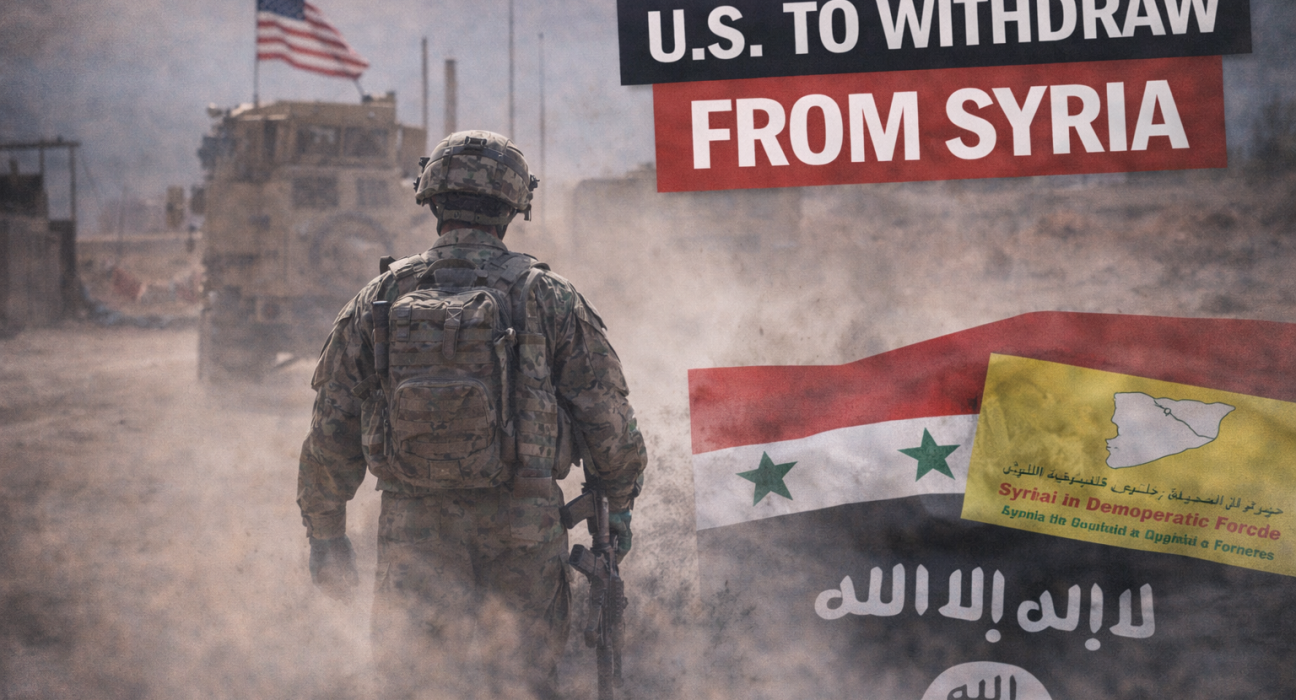
Reports that the United States is preparing to withdraw all remaining military forces from Syria signal a significant shift in American foreign policy. According to coverage citing The Wall Street Journal and reported by Reuters, U.S. officials are weighing a full military exit from the country after nearly a decade of involvement.
If implemented, this move would mark the end of one of the most complex and controversial chapters of post-9/11 military engagement in the Middle East.
Why the U.S. Was in Syria
The United States first entered Syria in 2014 during the height of ISIS’s territorial expansion. The mission had several primary objectives:
- Defeat ISIS and prevent its resurgence
- Support Kurdish-led Syrian Democratic Forces (SDF)
- Limit Iranian and Russian influence
- Maintain leverage in any post-war political settlement
At its peak, U.S. troop levels numbered in the thousands. In recent years, that presence has been reduced to a smaller contingent focused primarily on counterterrorism operations and maintaining stability in northeastern Syria.
Why Withdraw Now?
Several overlapping factors likely contribute to the decision:
1. Strategic Reprioritization
The United States is increasingly focused on global power competition with China and managing continued tensions involving Russia. Military resources are finite, and policymakers may see Syria as a secondary theater.
2. Domestic Political Pressure
After decades of Middle East conflict, public appetite for overseas military commitments has diminished. Calls to end “forever wars” have come from both major political parties.
3. Mission Fatigue and Ambiguity
While ISIS no longer controls significant territory, it has not been fully eradicated. However, some officials argue that local forces can now manage containment without a U.S. military footprint.
Immediate Regional Consequences
A full withdrawal would reshape the regional balance of power almost immediately.
Kurdish Forces (SDF)
The Kurdish-led Syrian Democratic Forces have relied heavily on U.S. support. A sudden exit could leave them vulnerable to pressure from:
- The Syrian government
- Turkey, which views Kurdish armed groups as linked to the PKK
- Russian-backed forces
This could force the SDF to negotiate with Damascus for protection or autonomy guarantees.
Syria’s Government
President Bashar al-Assad’s government, backed by Russia and Iran, would likely view U.S. withdrawal as a strategic victory. It would strengthen Damascus’s claim to sovereignty over territory currently outside its full control.
Iran
Iranian-aligned militias could expand influence in eastern Syria, potentially increasing regional tension with Israel.
Russia
Russia would likely consolidate diplomatic and military influence in Syria, reinforcing its broader Middle East presence.
Security Concerns
One of the central questions is whether ISIS could reconstitute itself.
While ISIS no longer holds large cities, sleeper cells remain active. The U.S. presence has played a key role in:
- Intelligence sharing
- Coordinating raids
- Providing air support
Without U.S. involvement, counterterrorism operations may weaken, raising the possibility of localized instability.
However, supporters of withdrawal argue that maintaining a small U.S. force indefinitely does not guarantee long-term stability and that regional actors must ultimately manage their own security challenges.
Global Political Implications
Signal to Allies
Allies in the Middle East and Europe may question long-term U.S. commitment to regional security partnerships.
Signal to Rivals
Russia and Iran could interpret withdrawal as a retreat from influence, though others argue it reflects strategic reallocation rather than weakness.
NATO Considerations
Turkey, a NATO member, has frequently clashed diplomatically with the U.S. over Kurdish support. A withdrawal may ease some bilateral tensions.
Economic and Energy Impact
Syria itself is not a major global oil producer, but the region remains geopolitically important. The withdrawal is unlikely to dramatically impact global energy prices directly. However:
- Increased instability could affect nearby transit routes
- Regional power shifts could influence broader Middle East dynamics
Markets typically respond more to escalation than de-escalation, so the economic impact may remain limited unless instability increases significantly.
Arguments Supporting Withdrawal
- Ends prolonged military engagement with unclear long-term goals
- Reduces risk to U.S. troops
- Frees resources for other global priorities
- Aligns with public fatigue over overseas conflicts
Arguments Opposing Withdrawal
- Risks resurgence of ISIS
- Abandons Kurdish allies who partnered with U.S. forces
- Strengthens Russia and Iran
- Reduces U.S. diplomatic leverage in Syria’s political future
Lessons from Past Withdrawals
The U.S. withdrawal from Iraq in 2011 is often cited in these discussions. Critics argue that ISIS’s later rise partly filled a power vacuum left behind. Supporters counter that local political failures, not withdrawal alone, were responsible.
The Afghanistan withdrawal in 2021 also shapes public perception. Rapid collapse there heightened concerns about unintended consequences of military exits.
Syria presents a different landscape — fragmented, multi-actor, and already heavily influenced by Russia and Iran — making predictions more complex.
What Happens Next?
If the withdrawal proceeds:
- Timelines and coordination with Kurdish forces will be critical
- Diplomatic engagement with regional actors may intensify
- Congress may debate oversight and authorization authority
If delayed or scaled back, it may signal internal debate within defense and intelligence agencies.
Broader Strategic Question
The underlying issue is whether U.S. global leadership depends on maintaining forward deployments in unstable regions, or whether strategic restraint better serves long-term interests.
Withdrawal does not necessarily mean disengagement. The U.S. could continue:
- Intelligence cooperation
- Air operations from nearby bases
- Diplomatic efforts
But the symbolism of a full exit would be significant.
Conclusion
A full U.S. withdrawal from Syria would represent a pivotal moment in Middle East policy. It reflects broader debates about American global strategy, military fatigue, and shifting geopolitical priorities.
Whether this decision stabilizes the region by forcing local actors to negotiate — or destabilizes it by creating power vacuums — will depend heavily on execution, coordination, and regional response.
As with many foreign policy shifts, the long-term consequences may not become clear for years.