
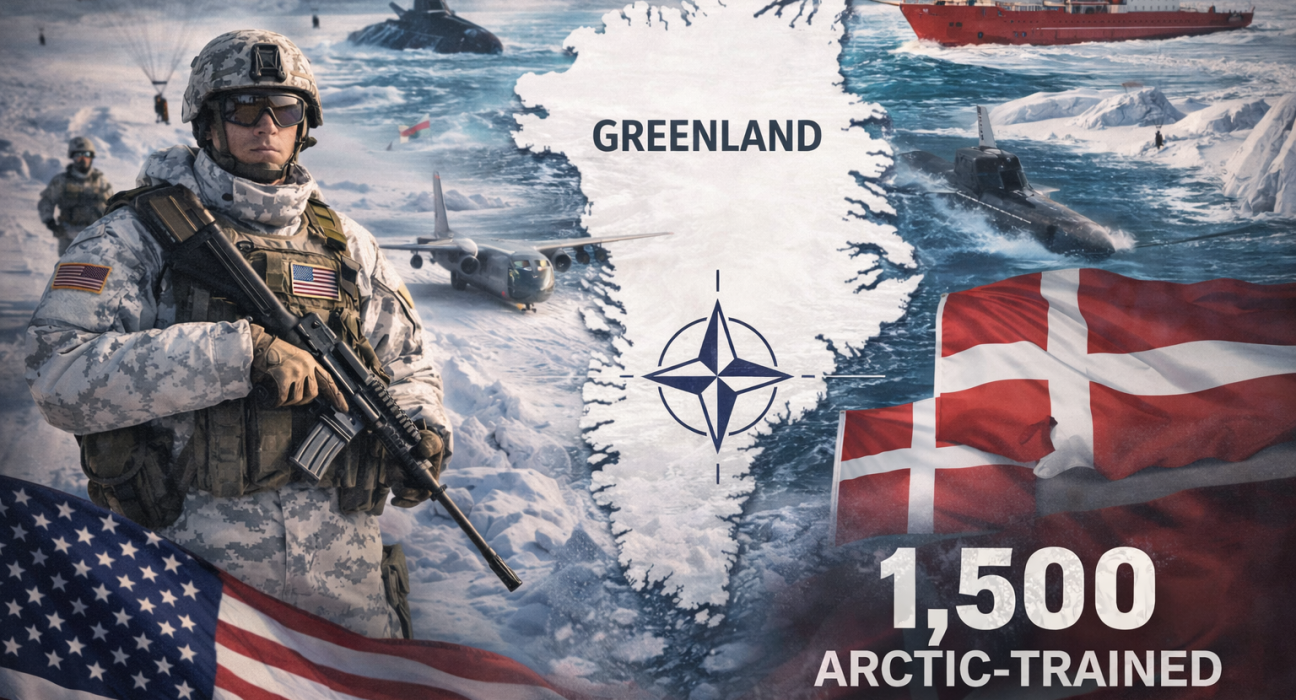
Recent reports that the U.S. Department of Defense has placed 1,500 Arctic-trained airborne troops on standby amid escalating tensions involving Greenland have reignited global debate over Arctic security, sovereignty, and great-power competition. While the move does not indicate an imminent invasion, it underscores Greenland’s growing strategic importance and highlights how climate change, resource access, and geopolitical rivalry are reshaping global power dynamics.
Why Greenland Is Strategically Important
Greenland occupies a critical position in the Arctic between North America and Europe. Though it is an autonomous territory within the Kingdom of Denmark, its location places it at the center of emerging military, economic, and environmental interests.
Several factors explain why Greenland has become a focal point:
- Geographic positioning: Greenland sits along key air and sea routes between North America and Europe. Control or influence over these corridors has long been central to transatlantic defense planning.
- Arctic access: As Arctic ice recedes, new shipping lanes are opening, shortening transit times between Asia, Europe, and North America.
- Natural resources: Greenland is believed to hold significant deposits of rare earth elements, critical minerals, and hydrocarbons, which are increasingly important for energy transitions and advanced technologies.
- Military infrastructure: The U.S. operates Pituffik Space Base (formerly Thule Air Base) in northern Greenland, a cornerstone of missile warning, space surveillance, and Arctic operations.
Why the U.S. Is Increasing Its Military Readiness
According to Defense News, the Pentagon’s decision to place Arctic-trained airborne troops on standby reflects concern over rising geopolitical friction in the Arctic rather than plans for territorial conquest.
United States Department of Defense officials emphasize that the move is about deterrence and readiness, not invasion. Several developments have driven this posture:
- Russian military activity: Russia has expanded Arctic bases, icebreaker fleets, and air patrols, framing the Arctic as vital to its national security.
- Chinese interest: China has declared itself a “near-Arctic state,” investing in polar research, infrastructure, and potential resource extraction.
- Alliance signaling: Increased readiness reassures NATO allies, particularly Denmark, that the U.S. remains committed to Arctic defense amid broader global tensions.
Is the U.S. Trying to “Invade” Greenland?
There is no evidence that the U.S. intends to invade or seize Greenland. International law, NATO alliances, and Denmark’s sovereignty make such an action both illegal and politically implausible.
However, the perception of militarization can blur distinctions between defensive positioning and aggressive intent, particularly in a region with rising strategic competition. Past rhetoric — including former U.S. interest in purchasing Greenland — has contributed to public suspicion and diplomatic sensitivity.
Global Political Implications
The Arctic is rapidly becoming a new arena of global competition, and U.S. actions in Greenland resonate far beyond the region.
1. NATO and Transatlantic Relations
The move reinforces NATO’s Arctic focus and signals solidarity with Denmark. However, it also requires careful coordination to avoid appearing unilateral or dismissive of Greenlandic self-governance.
2. Relations With Russia and China
Military readiness in Greenland may be viewed by Moscow and Beijing as containment or escalation, potentially prompting reciprocal actions. This risks an arms-race dynamic in a region historically governed by cooperation and low tension.
3. International Norms and Sovereignty
Arctic states have long promoted the region as a zone of peaceful cooperation. Increased militarization challenges that norm and raises questions about whether the Arctic will follow the trajectory of other contested regions.
4. Climate and Indigenous Concerns
Greenland’s Inuit population and environmental advocates worry that militarization could overshadow local priorities, including climate resilience, economic development, and self-determination.
Pros of the U.S. Posture
- Deterrence: Signals that the U.S. and its allies are prepared to defend Arctic interests.
- Stability through readiness: Military preparedness can discourage opportunistic moves by rivals.
- Alliance reassurance: Strengthens confidence among NATO partners.
- Protection of global trade routes: Helps safeguard emerging Arctic shipping lanes.
Cons and Risks
- Escalation: Increased military presence may provoke countermeasures.
- Diplomatic strain: Risks alienating Greenlandic and Danish political leaders if not carefully managed.
- Environmental impact: Military operations in fragile Arctic ecosystems carry long-term risks.
- Global perception: Could reinforce narratives of U.S. overreach or militarization of climate change–driven regions.
Future Outlook
Short Term:
Expect continued military exercises, surveillance, and diplomatic engagement in the Arctic, rather than direct confrontation.
Medium Term:
Competition over Arctic governance, resources, and infrastructure is likely to intensify, with Greenland playing a pivotal role.
Long Term:
The Arctic may become a defining theater of 21st-century geopolitics, where climate change, security, and global power intersect. How states manage this transition will shape international stability.
Conclusion
The Pentagon’s decision to place Arctic-trained troops on standby near Greenland reflects a broader strategic shift rather than an intent to invade. Greenland’s growing importance highlights how climate change and great-power rivalry are transforming once-remote regions into geopolitical flashpoints. Whether this leads to cooperation or confrontation will depend on diplomacy, respect for sovereignty, and restraint by all major powers.
References & Further Reading
Defense News – Pentagon places Arctic-trained troops on standby as Greenland dispute escalates
https://www.thedefensenews.com/news-details/Pentagon-Places-1500-Arctic-Trained-Airborne-Troops-on-Standby-as-Greenland-Dispute-Escalates/
U.S. Department of Defense – Arctic Strategy
https://www.defense.gov/Spotlights/Arctic-Strategy/
NATO – Security challenges in the Arctic
https://www.nato.int/cps/en/natohq/topics_170047.htm
Arctic Council – Governance and cooperation in the Arctic
https://arctic-council.org
Council on Foreign Relations – Arctic geopolitics and climate change
https://www.cfr.org/arctic





Leave feedback about this
You must be logged in to post a comment.