
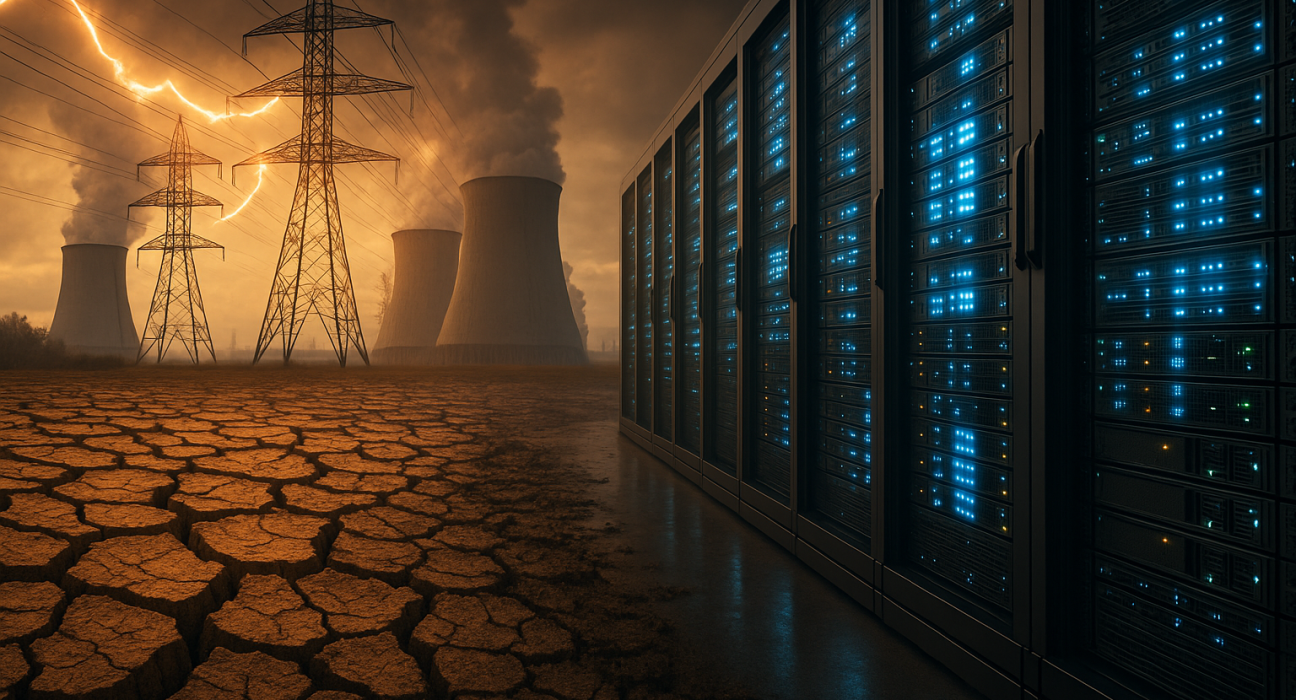
A coalition of more than 230 environmental organizations has called for a national moratorium on new datacenters in the United States, reflecting intensifying concern over the rapid expansion of artificial intelligence infrastructure. Groups like Greenpeace, Friends of the Earth, and Food & Water Watch argue that datacenters — essential for AI, cloud computing, and cryptocurrencies — are placing severe stress on the country’s electric grids, water resources, and climate goals. Their letter urges Congress to halt new approvals until stronger regulations address emissions, water use, siting, and local utility burdens.
Datacenters, especially those powering large-scale AI models, require enormous electricity and water inputs. Many operate 24/7, drawing energy equivalent to small cities and consuming millions of gallons of water yearly for cooling. As companies including Meta, Google, and OpenAI announce hundreds of billions in AI-related investments, more communities are pushing back. At least 16 datacenter projects worth $64 billion have been delayed or blocked due to rising electricity costs and water concerns.
Public frustration over energy bills has become politically potent. In recent elections in Virginia, New Jersey, and Georgia, candidates campaigning on lowering electricity costs and curbing datacenter expansion outperformed expectations. Analysts note that the politics of electricity pricing are transforming, as roughly 80 million Americans struggle to pay their power and gas bills. Voters across party lines increasingly blame datacenters for higher bills.
President Donald Trump — who simultaneously champions rapid AI growth while branding himself “the affordability president” — faces growing scrutiny as household electricity prices have risen 13% during his administration. His dismissal of affordability concerns as a “fake narrative” has not quelled voter anxiety. Electricity cost inflation, aging grid infrastructure, extreme weather damage, and surging industrial demand all contribute to higher rates, but datacenters have become the symbolic flashpoint.
Electricity consumption from AI-related datacenters is projected to nearly triple within the next decade, potentially requiring power equivalent to 190 million additional homes. This surge could add 44 million tons of CO₂ emissions by 2030 — similar to adding 10 million cars to U.S. roads. For environmentalists, that trajectory represents a significant threat to climate mitigation strategies.
Water consumption is another central issue. Many datacenters consume millions of gallons of water daily for cooling, posing challenges in drought-prone regions. Public backlash has been especially strong in states already suffering from water scarcity.
Environmental groups also emphasize a broader systemic concern: datacenters deepen U.S. dependence on fossil-fuel-based grids at a time when climate science strongly recommends rapid decarbonization.
Why Environmentalists Want This to End
Environmentalists highlight several specific threats:
- Climate Impact – Large datacenters draw massive energy loads, often from natural gas and coal plants, increasing greenhouse gas emissions.
- Water Stress – Facilities in desert or drought-stricken regions (Arizona, Nevada, parts of Texas and California) accelerate local water shortages.
- Grid Instability & Inequity – Datacenters can force utilities to expand infrastructure, and consumers often bear those costs through higher rates.
- Land Use & Noise Pollution – Datacenters require large footprints, industrial zoning, cooling towers, and power substations that can disrupt local habitats and communities.
Environmentalists argue the industry is expanding faster than regulators, utilities, and ecosystems can handle — and that a temporary national moratorium is necessary to reset planning, transparency, and environmental safeguards.
Historical Parallels: Profit vs Environmental Risk
The U.S. has a long record of allowing high-profit projects to proceed despite significant environmental concerns. Examples include:
- Fracking Boom (2008–present): Expanded despite groundwater contamination concerns because of huge energy profits and geopolitical demand.
- Keystone and Dakota Access Pipeline Approvals: Moved forward despite major environmental and tribal objections due to economic and political pressure.
- Mountaintop Removal Coal Mining: Continued for decades despite ecological destruction.
- Amazon Warehouse and Logistics Buildout: Approved rapidly nationwide despite air quality and traffic impacts due to job creation incentives.
- Colorado River Overuse: Cities and agricultural interests continued heavy withdrawals for decades despite ecological warnings, driven by economic dependency.
Datacenters now occupy a similar space: extremely profitable, essential to a booming industry, and politically complex.
Pros
- Economic Growth & Jobs
Datacenters attract investment, construction, and local tax revenue. AI-related facilities have become central to U.S. technological leadership. - Technological Advancement
AI research, cloud services, and cybersecurity rely heavily on datacenter capacity. Halting growth could slow innovation. - Potential for Grid Modernization
Large power demands may incentivize utilities to upgrade transmission lines and expand renewable energy capacity.
Cons
- Rising Electricity Prices
Utilities often pass infrastructure costs to ratepayers, worsening affordability issues for consumers. - Environmental Degradation
High emissions, water depletion, and land impacts concern scientists and environmental groups. - Local Community Burdens
Noise, land use changes, and increased industrialization can negatively impact nearby neighborhoods. - Regulatory Gaps
The industry expanded faster than environmental or planning laws can address.
Future Projections
- Short-Term: More local moratoriums, political battles, and delays as states and municipalities reevaluate energy capacity. Expect increasing regulation on siting, emissions, cooling methods, and renewable power sourcing.
- Medium-Term: Utilities will likely accelerate renewable energy buildouts, but fossil-fuel generation may also expand to meet near-term demand unless strict policy changes occur.
- Long-Term: AI datacenters may become the largest single driver of U.S. electricity demand growth. Debates over whether AI’s social and economic benefits justify its environmental costs will intensify.
- Political Impact: Electricity affordability may become a defining election issue for both parties in 2026 and 2028.
References & Further Reading
The Guardian – Environmental groups call for national moratorium on U.S. datacenters
https://www.theguardian.com/environment/2025/jan/xx/datacenters-moratorium-environmental-groups
AP News – U.S. electricity price trends and utility cost pressures
https://apnews.com/hub/energy
U.S. Energy Information Administration – Long-term electricity demand and grid projections
https://www.eia.gov/outlooks/
Lawrence Berkeley National Laboratory – Datacenter energy & water impacts
https://eta.lbl.gov/publications?f%5B0%5D=field_research_area%3A15
Bloomberg – AI growth, datacenter expansion, and community pushback
https://www.bloomberg.com/topics/data-centers
Reuters – Local opposition delaying U.S. datacenter projects
https://www.reuters.com/world/us/
Politico – Datacenter siting fights in Virginia, Georgia, and nationwide
https://www.politico.com/news/technology
New York Times – AI infrastructure strain on water & electricity systems
https://www.nytimes.com/section/climate
MIT Technology Review – Environmental footprint of AI computing
https://www.technologyreview.com/topic/artificial-intelligence/
Wired – Water consumption and cooling demands of datacenters
https://www.wired.com/tag/data-centers/
Environmental Working Group – Historical cases of high-profit industries advancing despite environmental risks
https://www.ewg.org/
Sierra Club – Industrial load growth, fossil-fuel reliance, and community resistance
https://www.sierraclub.org/
Brookings Institution – AI, electricity markets, and infrastructure vulnerabilities
https://www.brookings.edu/topic/artificial-intelligence/
National Academy of Sciences (PNAS) – Grid instability under rapid industrial load growth
https://www.pnas.org/






Leave feedback about this
You must be logged in to post a comment.