
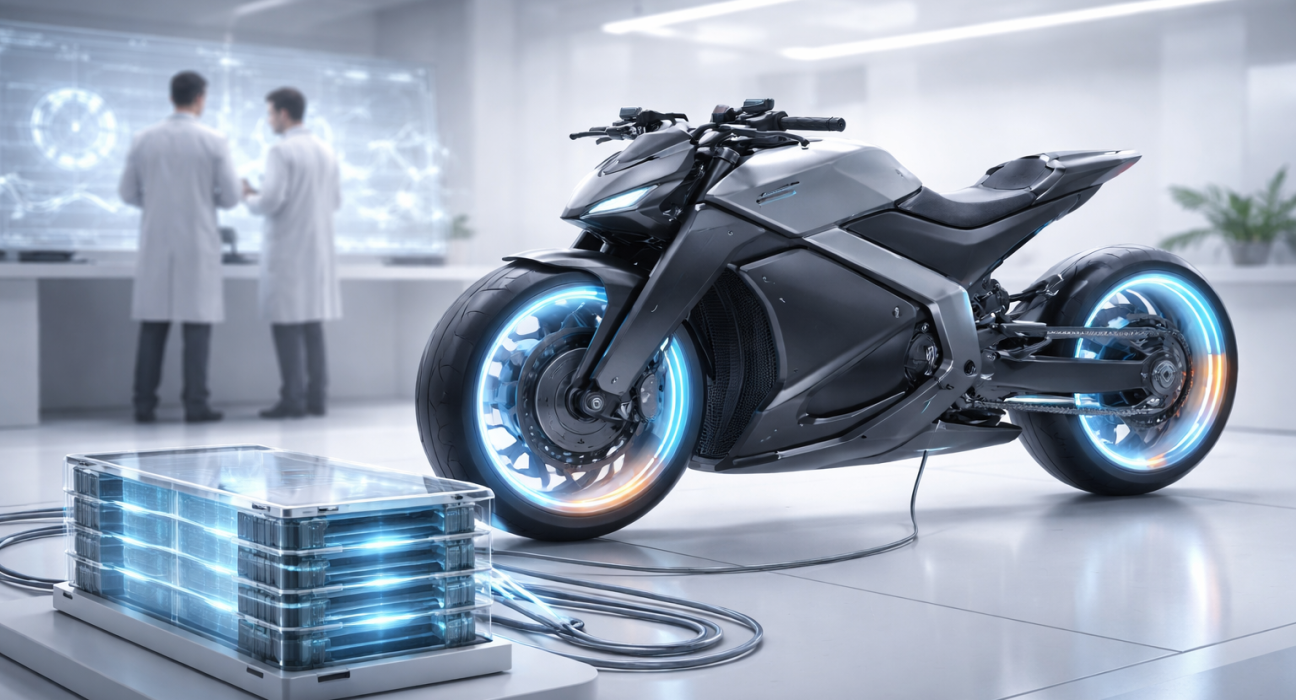
A new development in battery technology from Donut Lab—highlighted in reporting by Electrek—suggests that solid-state batteries may be moving closer to real-world deployment. The company, working alongside Verge Motorcycles, has reportedly tested a solid-state battery pack that could significantly outperform traditional lithium-ion systems.
If scalable, this advancement has implications far beyond electric vehicles—it could reshape nearly every device or system that relies on stored energy.
What Donut Lab Is Claiming
According to Donut Lab and coverage from Electrek, the company has developed a solid-state battery architecture designed to deliver:
- Higher energy density (more power in less space)
- Faster charging speeds
- Improved safety (reduced fire risk)
- Longer lifespan compared to conventional lithium-ion batteries
The battery has reportedly been tested in a working environment with Verge Motorcycles, suggesting it is moving beyond purely theoretical or lab-stage development.
What Makes Solid-State Batteries Different
Traditional lithium-ion batteries use a liquid electrolyte to transport ions between electrodes. This design has several limitations:
- Risk of overheating or fire
- Limited energy density
- Degradation over repeated charge cycles
Solid-state batteries replace the liquid electrolyte with a solid material, which enables:
1. Higher Energy Density
More energy can be stored in a smaller volume, allowing devices to run longer without increasing size.
2. Faster Charging
Solid electrolytes can support quicker ion movement, potentially enabling ultra-fast charging.
3. Improved Safety
Without flammable liquid components, the risk of thermal runaway (battery fires) is significantly reduced.
Real-World Testing: Why It Matters
One of the most important aspects of Donut Lab’s announcement is that the battery has reportedly been tested in a real product environment—specifically in electric motorcycles.
Many solid-state battery claims in the past have remained in laboratory conditions. Moving into functional testing within vehicles is a key step toward commercialization.
This suggests:
- The technology may be closer to market readiness
- Engineering challenges (heat, durability, integration) are being addressed
- Industry adoption could begin sooner than expected
Immediate Applications
1. Electric Vehicles (EVs)
The most obvious impact is on electric transportation.
Potential benefits include:
- Longer driving range
- Faster charging times (possibly minutes instead of hours)
- Lighter vehicles due to smaller battery packs
- Improved safety and reliability
If widely adopted, solid-state batteries could accelerate EV adoption globally.
2. Consumer Electronics
Devices like smartphones, laptops, and wearables could see:
- Multi-day battery life
- Faster charging cycles
- Smaller and lighter designs
This could fundamentally change how often users need to charge everyday devices.
3. Aerospace and Drones
High energy density and reduced weight are critical for:
- Drones
- Electric aircraft
- Satellites
Solid-state batteries could enable longer flight times and expanded capabilities.
4. Energy Storage Systems
Grid-scale storage could benefit from:
- Increased efficiency
- Longer operational life
- Reduced maintenance and safety risks
This is particularly important for renewable energy systems like solar and wind.
Broader Industry Context
The race to develop solid-state batteries has been underway for years, with major companies involved, including:
- Toyota
- QuantumScape
- Samsung
Despite significant investment, commercialization has been slow due to challenges such as:
- Manufacturing scalability
- Material stability
- Cost efficiency
Donut Lab’s progress suggests that smaller or more specialized companies may play a key role in bringing the technology to market.
Pros (Potential Benefits)
• Higher performance: Increased energy density and faster charging
• Improved safety: Reduced risk of fires compared to lithium-ion
• Longer lifespan: Fewer degradation issues over time
• Cross-industry impact: Applicable to transportation, electronics, and energy systems
Cons (Challenges and Uncertainty)
• Scalability concerns: Mass production remains a major hurdle
• Cost barriers: New materials and manufacturing processes may be expensive
• Early-stage testing: Limited real-world data compared to established technologies
• Industry competition: Multiple competing approaches may delay standardization
Future Projections
1. Gradual Commercial Rollout
Solid-state batteries may first appear in premium or specialized products before becoming mainstream.
2. EV Market Transformation
If scalable, the technology could significantly accelerate the transition away from internal combustion engines.
3. Consumer Electronics Evolution
Devices may shift toward longer battery life and faster charging as standard features.
4. Energy Infrastructure Impact
Renewable energy storage systems could become more efficient and reliable.
5. Competitive Innovation Race
Major corporations and startups will continue investing heavily in next-generation battery technologies.
Conclusion
Donut Lab’s reported progress in solid-state battery development represents a potentially important step toward a long-anticipated shift in energy storage technology. While challenges remain, the move from laboratory research to real-world testing suggests the technology may be approaching a more practical phase.
If successfully scaled, solid-state batteries could reshape industries ranging from transportation to consumer electronics—making energy storage more efficient, safer, and more adaptable to the demands of a rapidly electrifying world.
References
Primary Sources
- Donut Lab – Official website and product overview
https://www.donutlab.com/ - Electrek – Solid-state battery pack testing with Verge Motorcycles
https://electrek.co/2026/03/16/donut-lab-solid-state-battery-pack-test-verge-motorcycles/
Additional Context Sources
- Industry analysis on solid-state battery development
- Reports from automotive and battery technology companies
- Research on energy storage systems and EV infrastructure






Leave feedback about this
You must be logged in to post a comment.