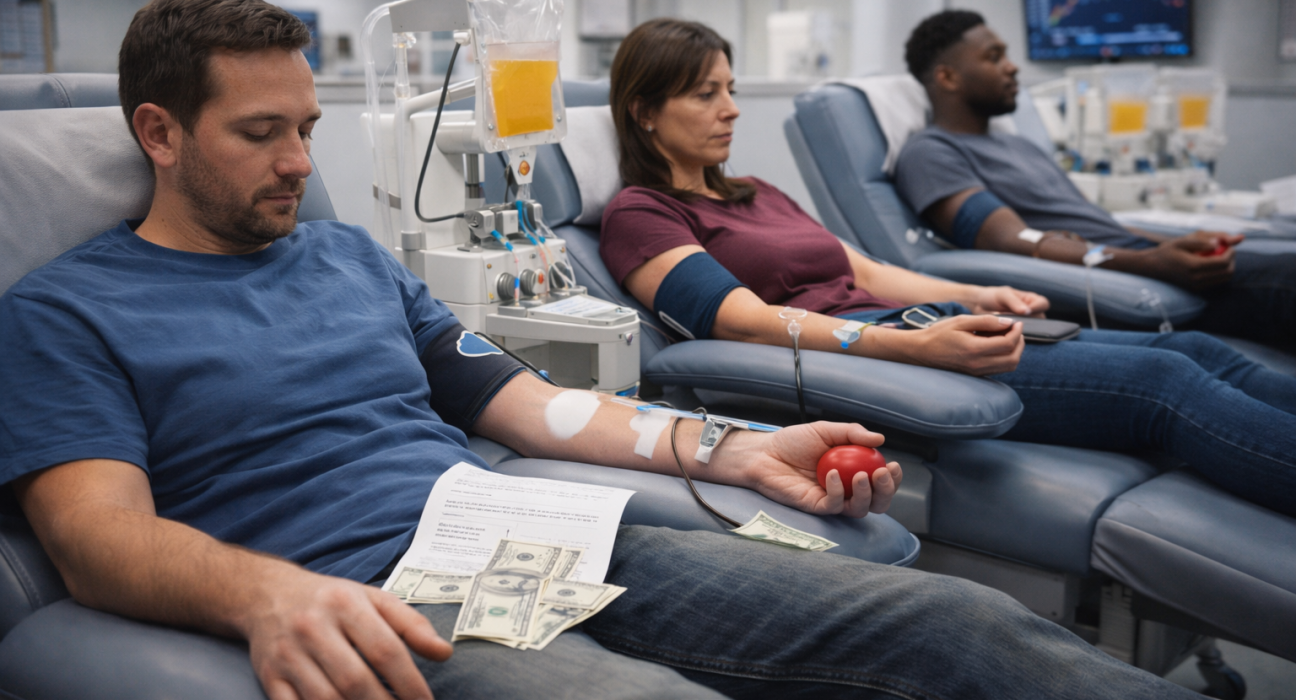
A recent NBC News report highlights a growing trend: more Americans are turning to plasma donation as a source of supplemental income amid rising living costs. While plasma centers have long existed in the U.S., the article suggests participation has increased as inflation pressures squeeze household budgets, particularly among working- and middle-class families.
The development is not new in concept — but its scale and normalization in public discourse reflect broader economic signals.
What Does This Symbolize About the U.S. Economy?
1. Wage Stagnation vs. Cost Growth
Inflation over the past several years has outpaced wage growth in many sectors. While official inflation rates have cooled compared to peak levels in 2022–2023, prices for essentials such as:
- Housing
- Groceries
- Utilities
- Insurance
- Childcare
remain elevated relative to pre-pandemic baselines.
For households whose wages have not fully adjusted, plasma donation becomes a short-term liquidity solution — not a career move, but a stopgap.
2. Asset-Poor but Cash-Needing Households
Unlike borrowing or selling physical assets, plasma donation offers immediate cash without debt accumulation. In that sense, it symbolizes a shift from asset-based stability to bodily monetization — an economic pattern that often appears when savings rates are low and emergency funds are depleted.
The U.S. personal savings rate has fluctuated significantly since 2020, and credit card balances have risen to record highs. Turning to plasma can reflect:
- Lack of emergency savings
- Increased reliance on gig-style supplemental income
- Limited access to affordable credit
3. The Commodification of the Body
The United States is one of the few countries where plasma donation is legally compensated at scale. The global plasma supply depends heavily on American donors. That reality underscores how U.S. healthcare economics intersects with individual financial strain.
When middle-class earners — not just students or low-income individuals — participate more visibly, it signals broader affordability concerns rather than isolated hardship.
Will We See More “Quick Cash” Outlets?
Economic stress historically expands participation in monetized biological or short-term income markets. Potential growth areas include:
1. Sperm Donation
Already compensated in the U.S., with payments ranging from $50–$150 per donation. Economic downturns can increase participation, though screening requirements limit eligibility.
2. Egg Donation
More lucrative than sperm donation — often $5,000–$15,000 per cycle — but medically intensive and not as easily scalable. It requires hormonal treatments and carries health considerations.
3. Clinical Trial Participation
Medical research trials frequently compensate participants. Economic stress can increase enrollment interest.
4. Gig Microtasks
Short-term app-based labor (delivery, freelance, rideshare) often spikes during downturns.
5. Resale and Pawn Markets
Second-hand goods sales, resale apps, and pawn services tend to see higher volume when consumer liquidity tightens.
Is This Unique to the United States?
Not entirely — but the structure differs.
Europe
Most European countries do not allow paid plasma donation, instead relying on voluntary systems. As a result, they often import plasma-derived medicines from the U.S. Economic strain in Europe more commonly leads to:
- Increased gig work
- Informal labor
- Short-term contract employment
rather than biological compensation markets.
Latin America
In some countries, informal labor markets expand significantly during inflationary cycles, but direct biological compensation industries are more limited due to regulation.
Asia
Gig platforms and online micro-earnings surge during downturns, though compensated plasma donation remains uncommon.
Is This a Sign of Economic Decline?
Interpretations vary.
Arguments That It Reflects Economic Stress
- Increased reliance on bodily compensation suggests liquidity strain.
- Middle-class participation indicates cost-of-living pressures beyond low-income populations.
- High consumer debt and declining real purchasing power reinforce this narrative.
Arguments That It Reflects Flexible Market Adaptation
- Plasma donation has long existed; awareness and normalization may simply be higher.
- Some donors use compensation strategically for discretionary spending rather than necessity.
- The U.S. labor market remains relatively strong in unemployment terms.
Broader Economic Indicators to Watch
If plasma participation continues rising, analysts will monitor:
- Consumer confidence indexes
- Household savings rates
- Credit card delinquency rates
- Wage growth relative to housing costs
- Healthcare and insurance inflation
When secondary income sources normalize as essential income streams, it often reflects affordability misalignment.
Cultural and Psychological Implications
Beyond economics, this trend also shapes social perception.
Historically, selling plasma was stigmatized as something only financially desperate individuals did. As economic pressure broadens participation, stigma may decline — but normalization may also reinforce a perception that basic wages no longer fully sustain basic living standards.
The symbolic shift matters: when the body becomes part of the economic toolkit for stability, it signals adaptation to structural pressures.
Conclusion
The increase in Americans selling plasma reflects a combination of:
- Persistent cost-of-living pressures
- Wage-inflation imbalance
- Rising household debt
- Expansion of supplemental income culture
It does not necessarily indicate economic collapse — but it does suggest that a growing segment of the population seeks flexible, immediate cash streams to bridge financial gaps.
If inflation persists or wage growth slows, similar “quick liquidity” markets — including medical participation and gig labor — may continue expanding. Other developed nations face economic strain as well, but the U.S. remains unique in its scale of compensated plasma infrastructure.
Whether this represents resilience or vulnerability depends on one’s lens — but it undeniably highlights the evolving relationship between personal finance and physical capital in modern America.
References & Further Reading
NBC News — Americans sell plasma to cope with inflation and middle-class expenses
https://www.nbcnews.com/news/us-news/americans-sell-plasma-inflation-middle-class-expenses-economy-rcna258390
Federal Reserve — U.S. Household Debt and Savings Data
https://www.federalreserve.gov
OECD — Comparative labor market data
https://www.oecd.org
European Medicines Agency — Plasma supply overview
https://www.ema.europa.eu