
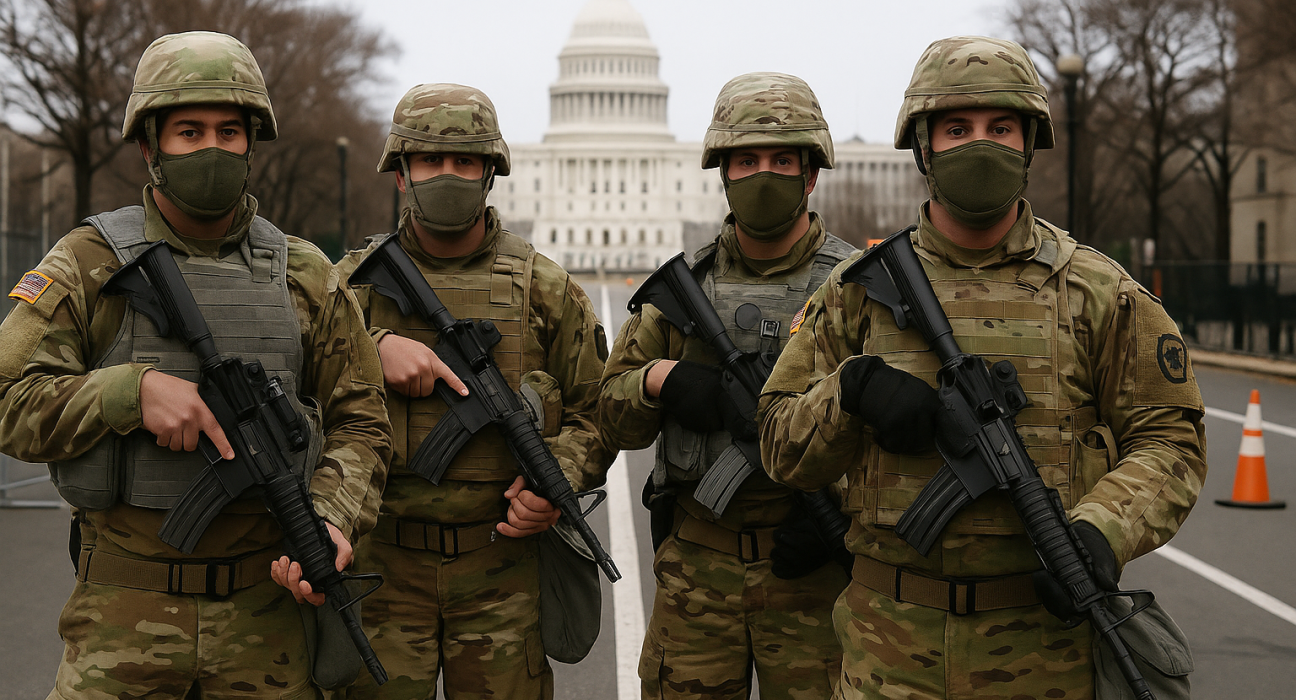
The Pentagon’s decision to arm every national guard member deployed in Washington DC marks one of the most aggressive escalations of domestic military posture in modern U.S. history. Announced just days after an ambush shooting near the White House that left one guard member dead and another critically wounded, the directive represents a shift toward broad militarization in the nation’s capital. According to defense officials, more than 2,300 troops already stationed in DC — with an additional 500 incoming — are now carrying live weapons while conducting joint armed patrols alongside the city’s Metropolitan Police Department.
Pentagon press secretary Kingsley Wilson described the move as an essential response to what he called an “urgent threat” to American cities. However, the breadth of the deployment, the speed of the arming order, and the lack of clarity about the threat level have raised deep concerns about operational readiness, legal authority, escalation risks, and the precedent this sets for domestic military engagement.
A major risk factor lies in the uneven training and proficiency among guard members. While all guardsmen receive basic weapons training, many belong to support or administrative units whose skills are not aligned with frontline policing or rapid-response urban operations. Arming thousands of reservists — some of whom train with live weapons only a few times a year — introduces a heightened risk of misuse, accidental discharge, or escalation during civilian encounters. These concerns are magnified by the ongoing legal uncertainty surrounding the deployment: a federal order recently ruled the DC national guard activation unlawful, though enforcement of that ruling is now paused pending appeal.
The threat landscape surrounding the deployment remains undefined. While last week’s ambush, allegedly committed by Rahmanullah Lakanwal — an Afghan national admitted under Operation Allies Welcome — was cited by the administration as justification, the broader framing suggests a more expansive mission. Officials have repeatedly emphasized not just Washington, but cities such as Chicago and Los Angeles, indicating an intention to use national guard units for sustained, multi-city policing operations. This raises fundamental constitutional questions about the role of the military in domestic law enforcement and the potential erosion of long-standing norms that strictly limit armed federal forces from policing civilians.
Compounding the security concerns are the political implications. The Trump administration has used the shooting to launch a large-scale immigration review, halting processing for Afghan nationals and signaling a potential expansion targeting all asylum approvals under the previous administration. This creates a link — whether justified or not — between immigration policy and domestic military posture, increasing the likelihood that future security decisions may be driven by political narratives rather than evidence-based threat assessments.
The escalation also intersects with global geopolitical tensions. The accused shooter’s prior service in Afghanistan’s CIA-backed Zero Unit has been leveraged to justify broader scrutiny of individuals admitted under U.S. war-affiliated immigration programs. This contributes to a narrative that American allies or partners in conflict zones may present security risks when resettled — a framing that could have international ramifications for future military partnerships and refugee protections.
From a climate and infrastructure perspective, the militarization of urban environments introduces additional considerations. Large-scale domestic deployments require significant fuel consumption, logistical support, and infrastructure strain — all of which carry environmental impacts. Earlier discussions surrounding armed drone patrols, military vehicle staging, and rapid troop movement already highlighted increased emissions and operational footprints. As deployments widen to multiple cities, emissions from the mobilization of guard units, transportation equipment, generators, and tactical operations would grow substantially.
Moreover, heightened national security postures historically shift political focus away from climate policy. Emergency framing tends to deprioritize long-term climate goals, redirect funding from environmental programs into security initiatives, and justify expanded fossil fuel reliance to support military readiness. Should this escalation persist, climate adaptation and mitigation efforts could experience resource shortages or policy stagnation. The broader geopolitical climate — including tensions with Russia, China, and destabilization in the Middle East — already places strain on global climate cooperation frameworks; domestic military expansions could add yet another obstacle.
Taken together, the Pentagon’s decision represents a pivotal moment in U.S. civil–military relations. The combination of an undefined threat, rapid escalation, immigration policy overlap, and the entry of military forces into daily policing creates a volatile environment with potential long-term consequences. While officials insist the measures are temporary and necessary, the precedent being set — and the risks that come with it — will likely shape debates over domestic militarization, public safety, immigration policy, and climate governance for years to come.



Leave feedback about this
You must be logged in to post a comment.