
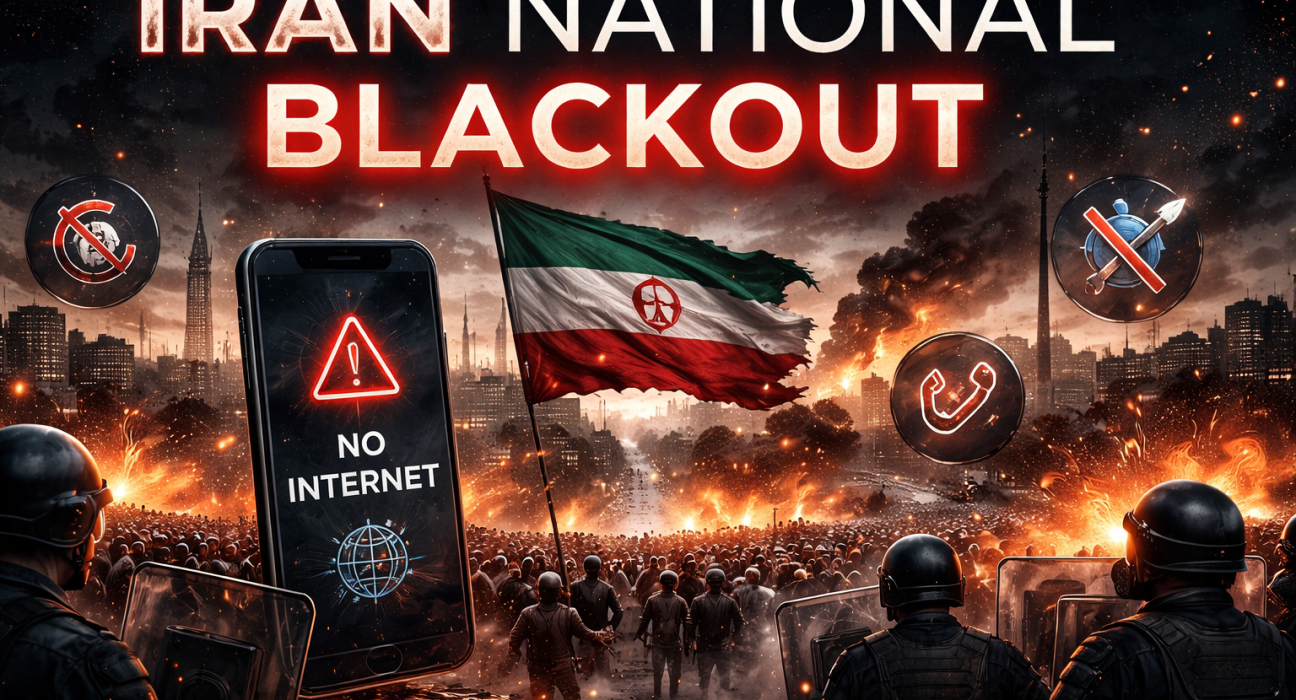
In early January 2026, Iran imposed one of its most severe national communication blackouts in recent history, cutting off internet access, mobile data, voice calls, and most links to the outside world. The blackout, occurring amid escalating anti-government protests and a brutal internal security crackdown, has profound implications for both domestic security and international relations.
According to reports from Iran International and independent monitors, nationwide connectivity dropped to approximately 1% of normal levels, effectively plunging tens of millions of people into digital silence. Authorities have also reportedly targeted satellite internet alternatives like Starlink, using military-grade jamming technology to hamper even those connections that might have offered a lifeline to the outside world.
Why the Blackout Was Implemented
The blackout is widely interpreted as a deliberate strategy by Iranian authorities to suppress information and impede coordination among protesters, as well as to obscure reports of escalating violence by state forces. Human rights groups have documented credible evidence of killings, arrests, and serious rights violations occurring amid the blackout, but the shutdown makes independent verification extremely difficult.
Iran’s government, however, frames its actions differently. State officials often describe extensive communication restrictions, including internet shutdowns and jamming of foreign services, as necessary security measures to combat terrorism, foreign interference, and digital threats to national stability. This narrative positions the blackout as a defensive tactic against what Tehran perceives as external destabilization efforts.
Impact on Internal Security and Daily Life
Social coordination and protest organization:
The blackout has severely degraded protestors’ ability to communicate internally and coordinate nationwide actions. Precedents from prior Iranian blackouts suggest that such measures are often used to disrupt opposition momentum during critical moments of dissent.
Public safety and crisis response:
Without reliable communications, ordinary citizens cannot access emergency information, check on loved ones, or organize basic survival strategies like food purchases or travel. Local reports indicate that domestic services—like banks, ATMs, and online payments—have also been disrupted, further worsening living conditions.
Information blackout and violence concealment:
Human Rights Watch and other civil society groups warn that the communications shutdown is being used to conceal reported abuses by security forces, including killings, torture, and mass arrests. These concerns are compounded by official rhetoric that accuses protesters of being “terrorists” or “enemies of God,” a charge that carries the death penalty under Iranian law.
Regional and Global Security Impacts
The Iranian blackout does not occur in a vacuum. It is entwined with broader geopolitical tensions, particularly between Iran and the United States. Washington has publicly expressed support for Iranian protesters and condemned harsh crackdowns, while Tehran has warned that U.S. interference is unacceptable and could prompt retaliation. Russia, a key Iranian ally, has explicitly criticized U.S. threats of military strikes and described external interference as a dangerous escalation.
U.S. involvement in the region—ranging from support for Israel in its conflicts with Iran to political endorsements of protest movements—has been cited by Tehran as justification for tighter domestic control and heightened security measures. Iran’s leaders argue that external pressure, including sanctions and diplomatic isolation, exacerbates internal instability and can be used politically to legitimize extreme internal responses, including communications blackouts.
Why America’s Involvement Matters
While the U.S. has stopped short of direct military intervention, its vocal political backing for Iranian protesters and pressure on Tehran over human rights issues have complicated diplomatic relations and heightened Tehran’s sense of encirclement. Statements by U.S. leaders supporting the Iranian people have been framed by Iranian authorities as external interference, which they claim justifies aggressive domestic security responses, including information suppression.
In addition, Iran’s blackout has economic consequences that ripple beyond its borders. The disruption of financial systems and communication channels in a country with a population of nearly 90 million affects international businesses, diaspora networks, and global markets connected to Iranian trade. The blackout imposes an estimated cost of millions of dollars per hour to Iran’s economy and sharp losses for enterprises relying on connectivity.
Repercussions of Political Overstepping
Erosion of human rights and transparency:
The blackout undermines fundamental rights to freedom of expression and access to information, drawing condemnation from international rights organizations. Critics argue that blocking communications to hide human rights violations amounts to a strategy of repression rather than legitimate security policy.
Diplomatic tension escalation:
Iran’s blackout and the surrounding regional tensions with the U.S., Israel, Russia, and other actors feed into a broader cycle of mistrust and could increase the risk of miscalculation or confrontation. External actors may feel compelled to respond to rights abuses, but overt interference could also trigger harsher tactics from Tehran.
Economic damage and isolation:
Longer blackouts not only disrupt daily life but weaken investment confidence and country stability. Isolation from global information flows and financial systems can deepen economic decline and drive further unrest.
Pros and Cons
Pros (As Framed by Security Advocates):
- Limits protest coordination and reduces real-time information flow that might accelerate nationwide unrest.
- Restricts external influence perceived by Tehran as supporting dissent.
- Gives security forces tactical control over misinformation and hostile communication.
Cons (According to Rights Groups and External Observers):
- Suppresses civil liberties and violates global norms on freedom of speech and access to information.
- Conceals human rights violations, hampering independent verification and accountability.
- Harms ordinary citizens’ safety and economic stability.
- Exacerbates geopolitical tensions that could lead to broader conflict.
Future Projections
Short-Term:
The blackout will likely continue as long as protests remain widespread and Iranian authorities seek to control narratives and suppress dissent. International pressure from the U.S., Europe, and rights groups may grow in response to reports of repression and deaths, potentially prompting sanctions or diplomatic actions.
Medium-Term:
Tehran may intensify technical restrictions, including expanded jamming of satellite links such as Starlink. Continued disruption of global communication channels could deepen Iran’s digital isolation and increase regional instability.
Long-Term:
Enduring blackouts could accelerate Iran’s investment in alternative, state-controlled networks (like its National Information Network). Broader geopolitical rifts—especially between Iran and the U.S.—could harden, impacting regional security, energy markets, and global diplomatic alignments.
References & Further Reading
Iran International – Blackout and concealment of violence
https://www.iranintl.com/en/202601130145
Reuters – Iranians tap Starlink to skirt internet blackout
https://www.reuters.com/business/media-telecom/iranians-tap-musks-starlink-skirt-internet-blackout-sources-say-2026-01-12/
The Guardian – Smuggled tech holds Iran’s last link to the outside
https://www.theguardian.com/world/2026/jan/13/ecosystem-smuggled-tech-iran-last-link-outside-world-internet
Human Rights Watch – Internet blackout concealing atrocities
https://www.hrw.org/news/2026/01/12/irans-internet-blackout-concealing-atrocities
Euronews – US intervention warnings & blackout impact
https://www.euronews.com/2026/01/11/iran-cracks-down-on-protests-and-threatens-us-and-israel-of-retaliation-in-case-of-interve
NetBlocks/CADE – Extended nationwide internet blackout detailed
https://cadeproject.org/updates/iran-experiences-extended-nationwide-internet-blackout
ARTICLE 19 – Iran blackout and human rights response
https://www.article19.org/resources/iran-bloodshed-unfolding-amid-communications-blackout






Leave feedback about this
You must be logged in to post a comment.