
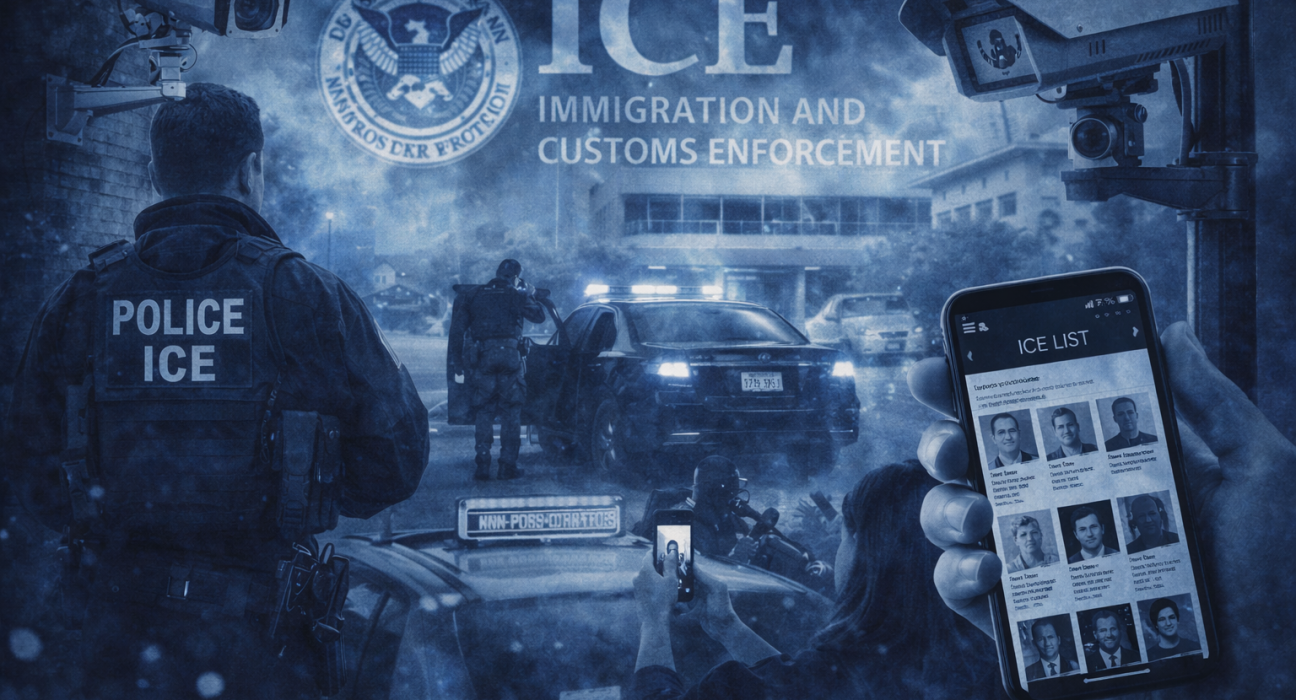
Recent reporting reveals an expanding nationwide trend involving U.S. Immigration and Customs Enforcement (ICE) that has intensified debates over government surveillance, civil liberties, and public safety. Three major developments — police use of school cameras for immigration enforcement, federal crackdowns on people who attempt to observe ICE operations, and an online project exposing ICE agents — have all drawn attention to how immigration enforcement is being carried out and monitored.
Here’s a breakdown of the key developments, the legal and ethical implications, and what these actions mean for everyday citizens.
1. Police and ICE Using School Cameras and License Plate Readers
Investigative reporting shows that local police departments across the United States are accessing national license plate reader databases originally tied to school district security cameras and using that information to support immigration enforcement activities. These cameras, often installed for campus safety, record vehicle plates that are then searchable by a network of law enforcement agencies — including those assisting federal immigration officials.
According to logs spanning a one-month period, police agencies conducted over 733,000 searches on devices linked to a single Texas school district, and in several hundred cases, immigration‐related reasons were cited, including for ICE and U.S. Border Patrol investigations. The cameras themselves are often part of systems from private companies (such as Flock Safety), but once data enters a national database accessible to law enforcement, local agencies can query plates across jurisdictions.
Why this matters:
- Surveillance Expansion: Technology originally intended for student safety is being repurposed for immigration enforcement, raising concerns about consent and scope.
- Privacy Risk: School districts may be unaware that their data can be used to assist federal authorities, including ICE and DHS.
- Community Impact: Parents, students, and residents may find themselves implicated in federal investigations without clear local policy oversight.
Advocates argue this broad sharing of license plate data — especially through a system nominally purchased for local campus safety — raises serious privacy and civil liberties questions. Some legal experts have questioned whether this practice violates federal student privacy protections or local consent norms.
2. ICE Cracking Down on People Who Follow Them or Observe Their Actions
Another controversial pattern uncovered by Reuters reporting is that ICE has increasingly charged and detained citizens and activists who attempt to observe or document its movements, especially by following agents in vehicles.
In one high-profile case, a Minnesota mother named Becky Ringstrom was arrested after following a federal immigration enforcement vehicle from her neighborhood. ICE agents boxed in her car, detained her, and cited her for violating a federal statute (18 U.S.C. § 111), which prohibits “impeding” or “interfering with” law enforcement.
This reflects a broader pattern in 2025–26, where federal prosecutors have charged hundreds of individuals under obstruction statutes for actions that critics say amount to mere observation, peaceful following, or documenting ICE operations.
Multiple video accounts show ICE agents responding with weapons drawn or detaining individuals following them in vehicles, prompting alarm among civil liberties advocates. DHS officials argue they are enforcing federal law and protecting agents, while critics say these actions distort the application of obstruction statutes and chill constitutional rights like public observation and documentation of government activity.
Public sentiment — including from social media discussions and legal observers — suggests a significant divide. Some users view ICE’s actions as authoritarian or abusive, equating them with suppression of oversight and free expression, while others defend the agency’s authority to enforce laws and maintain officer safety.
3. A European Website Exposing ICE Agents: Transparency or Controversy?
In response to growing public scrutiny of ICE’s tactics, an independent Europe-based project called “ICE List” has gained traction. Designed and maintained by volunteers, this website aggregates names, job titles, and photos of ICE agents drawn from publicly available sources (such as LinkedIn profiles), aiming to publicly identify otherwise anonymous federal officers.
The site’s founder argues the project promotes public accountability for immigration agents operating without visible name tags or clear identification — a practice that some critics say impairs transparency. ICE officers are often masked or in unmarked vehicles, unlike typical identifying law enforcement uniforms, contributing to the perception of anonymity and unaccountability.
Supporters of the project compare it to historical efforts that publicly identified members of controversial organizations for social accountability, while critics — including some government officials — have framed the project as potentially harmful or inappropriate. The platform’s organizers emphasize that identifying information is sourced from voluntary public disclosure, not doxing private data.
Legal and Ethical Implications
These developments raise acute questions about government transparency, civil liberties, and the balance between law enforcement and public oversight:
Surveillance and Consent
- School camera data and license plate readers pulling from a national database blur the line between local safety tools and federal enforcement infrastructures.
- Parents and citizens may unintentionally provide data to federal agencies without informed consent.
Protections for Observers
- Charging people who attempt to observe enforcement actions with obstruction offenses raises concerns about the proper definition of interference and citizens’ rights to record or watch public officials.
- Legal experts have argued that simply following at a safe distance or documenting actions should not legally constitute obstruction in the absence of clear interference.
Era of Masked Agents and Surveillance Technology
- Human Rights Watch has stated that broad use of masks, unmarked cars, and anonymous law enforcement undermines accountability and can chill public engagement with their government, especially when identifying officers becomes difficult.
Public and Community Responses
- Many community members and civil liberties advocates argue that these enforcement and surveillance tactics erode trust between communities and law enforcement, particularly in neighborhoods with high immigrant populations.
- Discussions on social platforms show strong public interest in social accountability, with users labeling some ICE actions as overreach or oppressive, while others defend the agency’s role and express strong support for enforcement authority.
- Tech and activist projects aiming to map or monitor ICE activity — from public camera trackers to stop-ICE mobile apps — reflect a broader movement toward community surveillance and counter-surveillance strategies.
Conclusion
ICE’s expanding use of surveillance technology and aggressive enforcement tactics has drawn national debate. The use of school camera data and license plate readers, the detention of observers, and anonymous operations prompt questions about privacy, constitutional rights, and how far government agencies should be able to pursue enforcement without transparent identification.
Supporters of ICE argue they are carrying out lawful operations to protect public safety and enforce immigration laws. Critics counter that the practices stretch legal boundaries, chill civil liberties, and lack sufficient oversight. As these practices continue to unfold — and as new technologies and grassroots accountability efforts emerge — the discussion over the limits of state power and the protections of individual rights remains sharply contested.
References & Further Reading
Reuters — ICE is cracking down on people who follow them in their cars
https://www.reuters.com/world/us/ice-is-cracking-down-people-who-follow-them-their-cars-2026-02-10/
The Guardian — Local police aid ICE by tapping school cameras…
https://www.theguardian.com/us-news/2026/feb/10/ice-school-cameras-police-license-plates
The Guardian — ICE List: the small European website exposing US immigration agents
https://www.theguardian.com/us-news/2026/feb/10/ice-list-small-european-website-exposing-us-immigration-agents
Human Rights Watch — Masked federal agents undermine rule of law
https://www.hrw.org/news/2025/12/18/us-masked-federal-agents-undermine-rule-of-law
Forbes — Tech projects fight back against ICE surveillance
Phys.org — Filming ICE is legal but exposes you to digital tracking





Leave feedback about this
You must be logged in to post a comment.