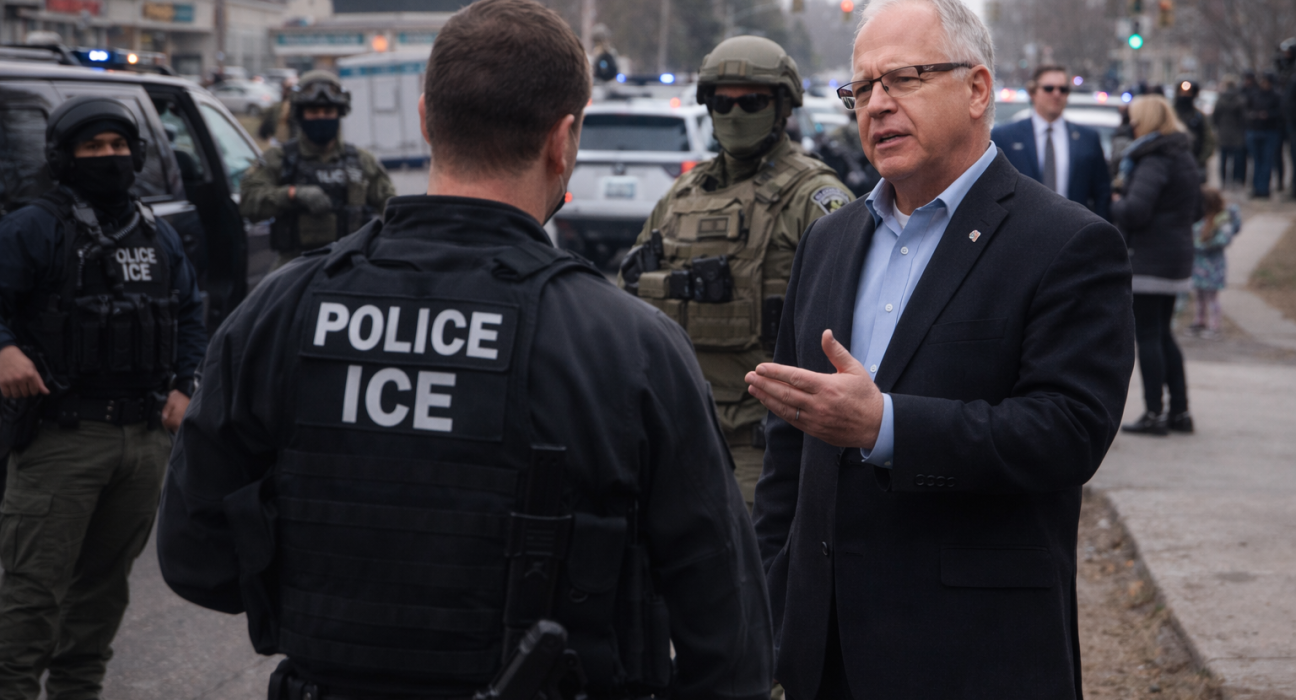
Minnesota Governor Tim Walz announced that he expects the federal immigration enforcement operation in his state to wind down “in days, not weeks and months,” following talks with senior Trump administration officials including border czar Tom Homan and White House Chief of Staff Susie Wiles. The presence of federal immigration agents has been a source of intense controversy, particularly after fatal shootings by federal officers and growing tension between federal and local authorities.
The crackdown — often referred to by opponents as a federal “occupation” — brought thousands of Immigration and Customs Enforcement (ICE) and other federal agents to Minnesota, far above normal enforcement levels. Even after an initial withdrawal of roughly 700 agents, more than 2,000 remained on the ground as of early February 2026.
Walz expressed cautious optimism that the surge will be curtailed soon, but emphasized that Minnesota officials will watch closely to ensure federal commitments are followed. He also noted continuing friction over investigations into fatal shootings involving federal officers, and lingering fear in local communities about persistent enforcement.
Backlash, Fatal Shootings, and Local Impact
The Minnesota deployment drew sharp criticism after two U.S. citizens — Renee Good and Alex Pretti — were fatally shot by federal officers during enforcement actions in Minneapolis, sparking widespread protests and concern from civil rights groups, local officials, and everyday residents.
Critics have said the federal presence interfered with public safety and undermined trust in law enforcement, pointing to:
- Fear among immigrants and their families about seeking medical care or interacting with the justice system
- Economic impacts on local businesses whose employees and customers stayed away due to the crackdown
- Strained relationships between state and federal investigators, especially regarding access to evidence in officer-involved shooting cases
- Interruption of state court processes when ICE agents made highly visible arrests in local courthouses, which local prosecutors said disrupted justice and intimidated witnesses.
At the same time, supporters of the federal action — including some conservative commentators and Republican officials — pointed to arrests of hundreds of undocumented immigrants tied to serious criminal offenses during the surge, framing the effort as a legitimate enforcement of immigration laws. (Community-sourced discussions reflect this perspective as well.)
Political Fallout and Public Opinion
Public support for broad immigration enforcement policies has dropped sharply in the wake of these events. According to recent polling, nearly half of Americans now strongly disapprove of the Trump administration’s immigration approach, up significantly from earlier in the year, and a majority say immigration enforcement needs reform or even abolition in its current form.
Critics have highlighted not only the shootings but also accusations that ICE and other federal agents have operated with limited transparency, such as being masked, using high-visibility tactics, and running operations that appear uncoordinated with local authorities. These perceptions have fed calls from some elected officials and activists for oversight, accountability, and structural change within federal immigration enforcement.
In Congress, both criticism and defense of the crackdown have emerged across partisan lines, with some Republican lawmakers acknowledging training and operational issues while maintaining support for strong border and immigration enforcement.
Legal and Institutional Issues
The Minnesota situation revealed deeper issues in how federal immigration operations interact with local legal systems:
- Minnesota’s federal and state courts have been strained by a surge in immigration docket filings, leading to backlogs and frustration among judges and prosecutors alike. Federal immigration detainers and arrest actions in state courthouses have been challenged as disrupting judicial processes.
- Joint investigations into fatal shootings have been hampered by lack of cooperation between federal agencies and state law enforcement, leading to accusations from state officials that federal authorities are not sharing evidence.
- Immigration enforcement actions in local courthouses have raised constitutional questions about separation of powers and the integrity of state criminal proceedings. Local prosecutors argue that bringing federal arrests into state judicial spaces compromises due process and public safety.
These dynamics have reinforced calls from civil liberties advocates for stronger oversight, clearer legal boundaries, and reforms to prevent similar confrontations in the future.
Human Impact and Community Fear
One of the most significant consequences of the crackdown has been its chilling effect on everyday life — beyond just the targeted immigration communities:
- Workers, customers, and residents in Minneapolis and surrounding areas have reported heightened anxiety about everyday activities, from going to work and school to visiting public spaces.
- Business owners and employees in hospitality and retail pointed to reduced foot traffic and economic downturns directly linked to the presence of federal enforcement teams.
- Popular discourse on social platforms shows polarized narratives: some defend the crackdown as necessary while others describe it as disproportionate and harmful to community cohesion. (Reddit discussions reflect this spectrum of opinion.)
Why Ending the Crackdown Matters
Walz’s announcement that the crackdown may soon conclude could signal a tactical retreat by federal authorities amid political and legal pushback. For many residents and officials, ending the surge would:
- Relieve stress on local policing and courts
- Reduce fear among immigrant and mixed-status families
- Improve state-federal cooperation on investigations and public safety
- Reopen space for normal economic activity in affected neighborhoods
However, it also leaves unresolved questions about how future federal immigration efforts will be structured and coordinated with local authorities to avoid similar conflicts.
Conclusion
The situation in Minnesota exhibits the tensions inherent in aggressive federal immigration enforcement within U.S. communities — raising questions about civil liberties, public trust, intergovernmental cooperation, and the proper role of federal authority.
Governors, local officials, legal experts, and national commentators alike are watching how the Trump administration responds as federal activity in Minnesota winds down. The outcome may influence how future immigration policy enforcement is carried out across the United States — especially in jurisdictions that resist federal involvement or prioritize community-based policing.