
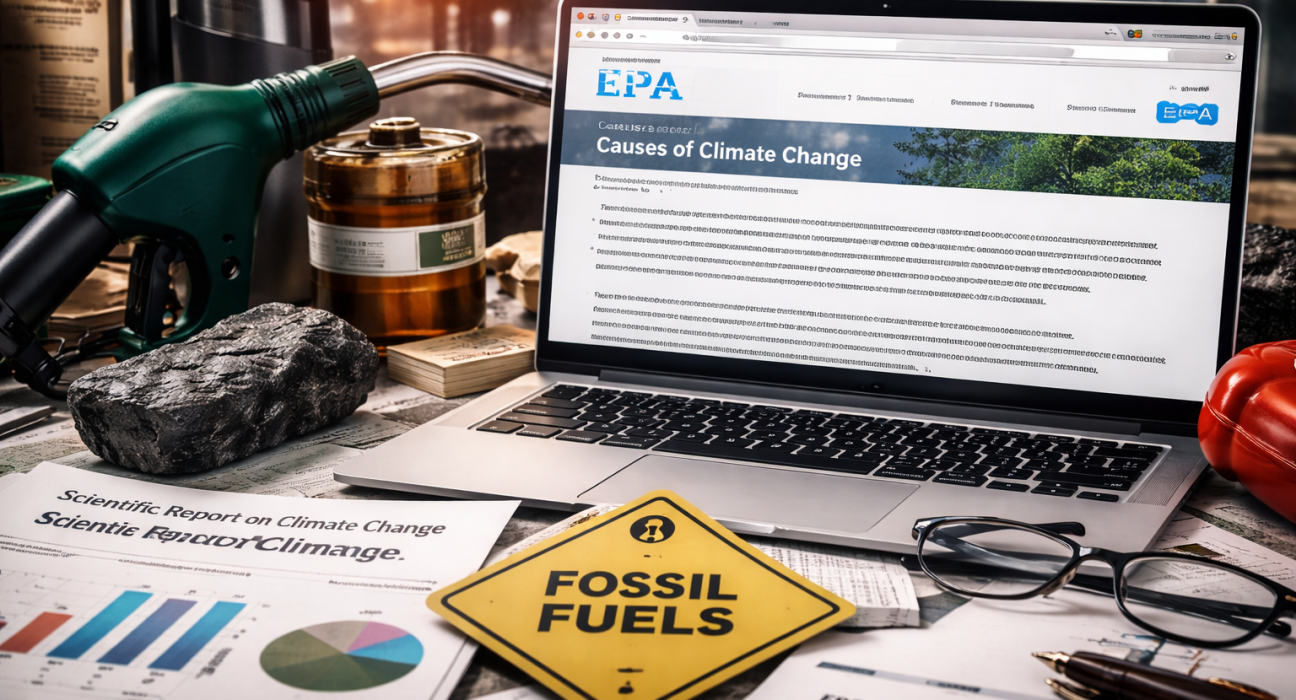
The Environmental Protection Agency’s quiet revision of its climate change webpages has ignited sharp criticism from scientists, former agency leaders, and environmental advocates, who say the changes misrepresent decades of established climate science and undermine public understanding of global warming.
In recent weeks, the EPA removed explicit references to fossil fuels—the burning of coal, oil, and natural gas—from its popular online explanation of climate change causes. The revised page now emphasizes natural factors such as changes in Earth’s orbit, solar activity, volcanic eruptions, and natural carbon dioxide fluctuations, while omitting fossil fuel combustion, which climate scientists overwhelmingly identify as the primary driver of modern warming.
Experts say the changes are misleading. Nearly 100% of the warming observed since the Industrial Revolution is attributed to human activity, primarily greenhouse gas emissions from fossil fuels. Multiple assessments by the National Academies of Sciences, Engineering, and Medicine, the Intergovernmental Panel on Climate Change (IPCC), and the U.S. National Climate Assessment have consistently concluded that natural factors alone cannot explain current temperature increases.
Archived versions of the EPA site confirm that the agency previously acknowledged this consensus. An October version explicitly stated that while natural processes influence climate, they “do not explain the warming that we have observed over the last century.” That language has now been removed or softened, prompting accusations that the agency is obscuring scientific clarity rather than updating it.
How the Administration Justifies De-Emphasizing Fossil Fuels
Supporters of the changes within the administration argue that the revisions reflect a shift away from what they describe as “politicized climate narratives.” EPA officials say archived materials remain publicly accessible and maintain that recent climate changes “cannot be explained by natural causes alone,” even if fossil fuels are not named explicitly.
More broadly, the administration has framed fossil fuels as essential to economic growth, energy independence, and national security. Citing research showing that energy prices influence inflation, employment, and industrial output, officials argue that regulatory constraints on fossil fuels could harm economic recovery and disproportionately impact working-class households.
However, scientists counter that acknowledging fossil fuels as the primary cause of climate change does not preclude economic planning—it informs it. Research from NASA, NOAA, and peer-reviewed climate journals shows that delaying emissions reductions increases long-term economic costs due to climate-driven disasters, healthcare impacts, infrastructure damage, and agricultural losses.
Potential Policies That Could Cause National and International Issues
Critics warn that downplaying fossil fuels on official government platforms may foreshadow broader policy shifts, including:
- Rolling back emissions regulations, which could increase air pollution and public health risks, particularly in low-income and industrial communities.
- Weakening environmental review processes, accelerating fossil fuel extraction and infrastructure projects without fully assessing long-term climate impacts.
- Reducing federal climate research and data transparency, limiting public access to scientific information used by educators, policymakers, and emergency planners.
- Straining international relations, as U.S. credibility in global climate negotiations declines. Many U.S. allies treat climate change as a central security and economic issue, and divergence could weaken cooperation on trade, disaster response, and geopolitical stability.
Former EPA leaders note that other nations are moving toward renewable energy not only for environmental reasons, but to avoid economic vulnerability tied to fossil fuel volatility.
What Citizens Can Do to Have Their Voices Heard
While federal agencies shape policy, citizens are not powerless. Experts recommend several avenues for public engagement:
- Public comments and rulemaking participation: Federal agencies are required to accept public input on proposed regulatory changes.
- State and local action: Many climate, energy, and environmental decisions are made at the state and municipal level, where citizen advocacy can have direct impact.
- Congressional pressure: Contacting elected representatives, supporting oversight hearings, and voting in primary and general elections remain powerful tools.
- Legal challenges and advocacy organizations: Nonprofit groups and state governments often challenge federal actions in court, relying on public support and participation.
- Information sharing: Educators, journalists, and citizens can counter misinformation by sharing peer-reviewed research and archived government data.
Scientists emphasize that access to accurate information is foundational to democracy. As former EPA officials have noted, removing or obscuring scientific facts does not eliminate climate change—it only reduces society’s ability to respond effectively.
In Context
The EPA website revisions follow the earlier removal of the National Climate Assessment from government websites, signaling a broader shift in how climate science is presented to the public. While the administration argues it is re-prioritizing economic growth, critics warn that sidelining fossil fuels in official explanations risks undermining public trust, global credibility, and long-term national resilience.
As former EPA Administrator Christie Todd Whitman put it, refusing to acknowledge climate reality “doesn’t make it go away.” The scientific evidence remains unchanged—and so do the consequences of ignoring it.
Sources
- The EPA removed mention of fossil fuels from its climate change causes page, now focusing on natural factors—a move scientists and former EPA officials call misleading. AP News+1
Scientific Consensus on Human-Caused Climate Change
- NASA and scientific organizations state that ~97% of climate scientists agree that human activity, especially fossil fuel burning, is the main cause of recent global warming. NASA Science+1
- Peer-reviewed literature shows over 99% of climate papers support human-caused climate change driven by greenhouse gases from fossil fuel combustion. Cornell Chronicle
- Intergovernmental Panel on Climate Change (IPCC) reports confirm that human activities—mainly fossil fuel emissions—are the dominant cause of global warming. IPCC+1
- Wikipedia’s summary of scientific consensus notes that climate change is “unequivocally” driven by human actions such as fossil fuel combustion. Wikipedia
Supporting Research on Fossil Fuel Impacts
National Academies studies reaffirm that human-caused greenhouse gas emissions endanger health and welfare, reinforcing fossil fuel impacts over time. Environmental Defense Fund
Scientific assessments emphasize that fossil fuel emissions are responsible for increased atmospheric CO₂, trapping heat and driving global temperature rise. Royal Society






Leave feedback about this
You must be logged in to post a comment.