
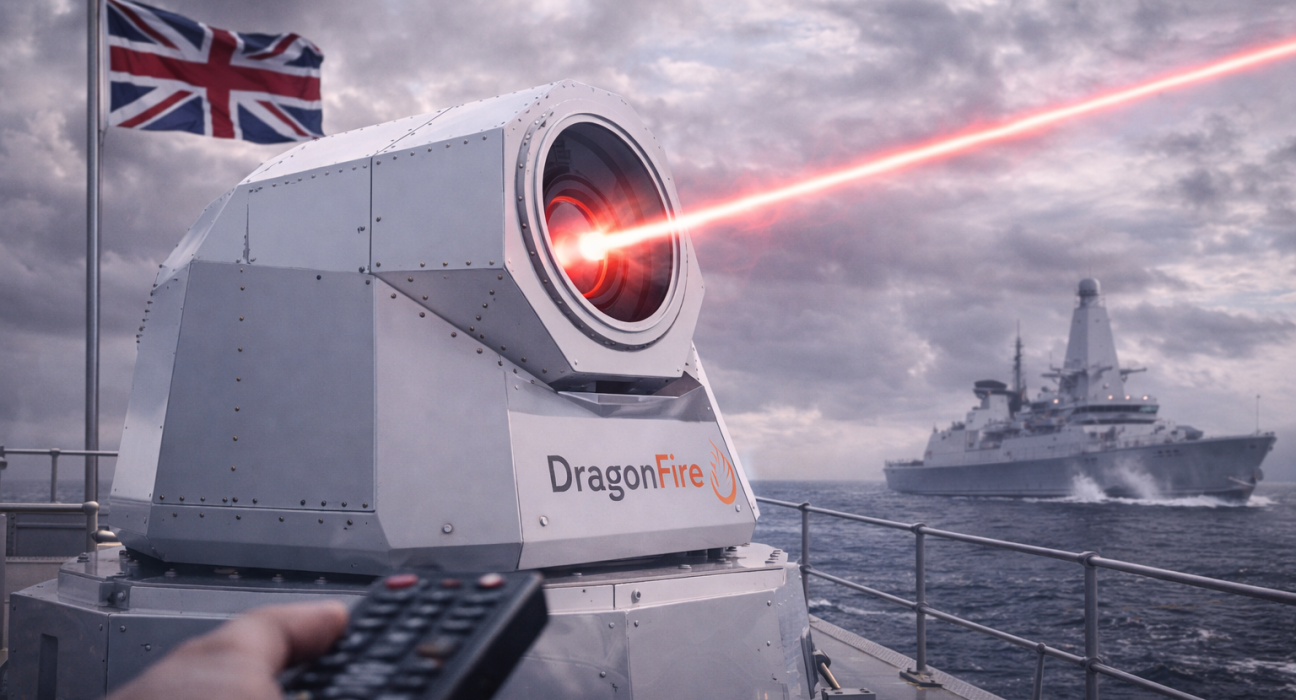
The United Kingdom has confirmed plans to deploy a new laser-based weapon system known as DragonFire, marking a significant step toward operational directed energy weapons (DEWs) in modern military use. According to reporting from Tom’s Hardware and supporting technical context from Leonardo UK, the system is expected to be installed on Royal Navy destroyers by 2027.
DragonFire represents a broader shift in military technology, where energy-based weapons may begin to complement—or in some cases replace—traditional missile and projectile systems.
What DragonFire Is
DragonFire laser weapon is a high-energy laser system designed to engage and destroy aerial threats such as:
- Drones
- Missiles
- Aircraft
Unlike conventional weapons, DragonFire uses focused laser beams rather than physical projectiles to disable or destroy targets.
Key reported characteristics include:
- Extremely high accuracy (capable of hitting a coin-sized target at long range)
- Silent and invisible operation
- Near-instantaneous engagement speed (speed of light)
- Low cost per shot compared to missiles
How Laser Weapons Work
Directed energy weapons like DragonFire operate by:
- Generating high-energy laser beams
- Focusing the beam on a target
- Heating the target’s surface to the point of failure or destruction
This process can:
- Melt structural components
- Disable sensors or electronics
- Ignite fuel or ammunition
Unlike traditional weapons, which rely on kinetic force or explosives, laser systems deliver continuous energy to a precise point.
Why Militaries Are Investing in Laser Weapons
1. Cost Efficiency
One of the most significant advantages is cost.
- A single missile interception can cost hundreds of thousands or millions of dollars
- A laser shot may cost only a few dollars in energy
This makes laser systems particularly effective against low-cost, high-volume threats like drones.
2. Speed and Precision
Laser weapons operate at the speed of light, meaning:
- No travel time delay
- Immediate target engagement
- High accuracy with minimal collateral damage
3. Defense Against Modern Threats
Modern warfare increasingly involves:
- Swarms of drones
- Hypersonic and fast-moving projectiles
- Electronic warfare systems
Laser weapons offer a potential solution for rapid-response defense against these threats.
Real-World Deployment: Royal Navy Timeline
The UK government has confirmed that DragonFire will be deployed on Royal Navy destroyers by 2027.
Initial testing has reportedly demonstrated:
- Successful engagement of aerial targets
- Operational reliability in controlled conditions
The deployment will mark one of the first times a laser weapon system is integrated into frontline naval operations.
Broader Global Context
The UK is not alone in pursuing laser weapon technology.
Other countries investing in DEWs include:
- United States Department of Defense
- People’s Liberation Army
- Russian Armed Forces
Programs in these countries focus on:
- Air defense systems
- Anti-drone technology
- Missile interception
This suggests that laser weapons could become a standard component of military arsenals in the coming decades.
Limitations and Challenges
Despite their advantages, laser weapons face several technical and operational challenges:
1. Power Requirements
High-energy lasers require significant power, which can limit deployment on smaller platforms.
2. Weather Conditions
Rain, fog, and atmospheric interference can reduce effectiveness.
3. Range Limitations
While precise, laser effectiveness can diminish over long distances.
4. Thermal Management
Systems must manage heat generated during operation to maintain performance.
Pros (Advantages of DragonFire and Laser Weapons)
• Low cost per shot: Significant savings compared to missile systems
• High precision: Reduced collateral damage
• Rapid response: Instantaneous engagement
• Scalability: Effective against large numbers of low-cost threats
Cons (Risks and Limitations)
• Environmental sensitivity: Performance affected by weather
• Energy demands: Requires substantial power infrastructure
• Limited range in some conditions: Not a complete replacement for traditional weapons
• Emerging technology: Still undergoing testing and refinement
Future Projections
1. Integration Into Standard Defense Systems
Laser weapons may become a regular component of naval and air defense platforms.
2. Expansion to Land and Air Use
Future systems could be deployed on vehicles, aircraft, and fixed installations.
3. Hybrid Warfare Models
Militaries may combine laser systems with traditional weapons for layered defense.
4. Cost Reduction in Defense
Lower operational costs could reshape military budgeting and procurement strategies.
5. Technological Arms Race
Increased investment by global powers could accelerate development and deployment.
Conclusion
The DragonFire laser weapon represents a significant step forward in the evolution of military technology. While not without limitations, its potential to deliver precise, cost-effective, and rapid defense capabilities positions it as a transformative tool in modern warfare.
As directed energy weapons move from experimental systems to operational deployment, they may fundamentally change how conflicts are fought—shifting emphasis from traditional munitions to energy-based solutions.
References
Primary Sources
- Tom’s Hardware – UK confirms DragonFire laser weapon deployment by 2027
https://www.tomshardware.com/tech-industry/uk-confirms-dragonfire-laser-weapon-for-royal-navy-destroyers-by-2027 - Leonardo UK – DragonFire project overview
https://uk.leonardo.com/en/innovation/dragonfire - Wikipedia – DragonFire weapon system background
https://en.wikipedia.org/wiki/DragonFire_(weapon)
Additional Context Sources
- U.S. Department of Defense directed energy programs
- Research on laser weapon systems and military applications
- Global defense technology reports






Leave feedback about this
You must be logged in to post a comment.