
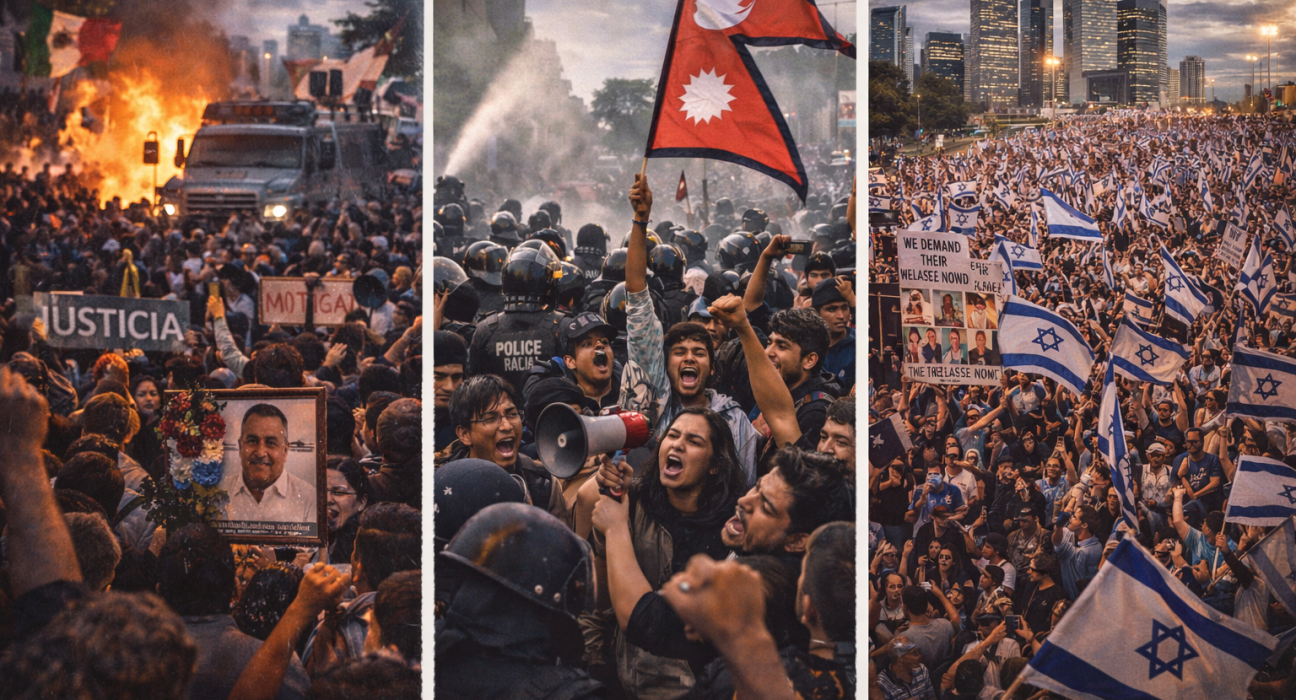
Across late 2025 and early 2026, major protest movements in Mexico, Nepal, and Israel (centered in Tel Aviv) have drawn international attention for different reasons—organized crime and state capacity, governance and censorship, and war/hostage policy and political leadership. Taken together, they illustrate a shared global pattern: when people lose confidence that institutions can deliver basic safety, fairness, or representation, street politics rapidly becomes the pressure valve.
Mexico: Assassination as a Catalyst for Public Anger
In Mexico’s Michoacán state, protests intensified after the Day of the Dead assassination of Uruapan’s mayor, Carlos Alberto Manzo Rodríguez, during a public celebration. Reporting described widespread grief and fury, with demonstrators demanding justice and accusing political authorities of failing to protect local leaders and residents in cartel-contested regions.
The killing resonated because it reinforced a long-running reality: municipal officials are often on the front lines of organized crime pressure, and violence can signal that even public office offers limited protection. Coverage also highlighted the economic backdrop—Michoacán’s illicit and licit profit streams (including agriculture in regions where cartels extort producers) create high-stakes incentives for armed groups.
In response, Reuters reported Mexico’s federal government launched a major security initiative in Michoacán, pairing troop deployments and surveillance resources with broader development aims. The move underscores a strategic debate: whether security crackdowns alone can work, or whether they must be paired with governance and economic stabilization to reduce cartel leverage.
Nepal: Protests Fueled by Corruption Anger and Social Media Restrictions
Nepal’s upheaval follows a different trigger: youth-led (Gen Z) demonstrations against corruption, governance failures, and restrictions on social platforms. Reuters and the AP reported mass protests and deadly confrontations with police, linked to anger over social media restrictions and broader frustration with the political system.
Local reporting in The Kathmandu Post described how protests spread well beyond Kathmandu, naming numerous cities and districts that saw mobilizations and, in some places, curfews. This matters because it indicates a movement that wasn’t confined to one urban elite center—it spread across the country’s civic infrastructure.
AP also reported more recent unrest in Birgunj, where tensions between communities escalated after a mosque vandalism incident, prompting curfews. That episode reflects how fragile conditions can allow localized triggers to explode once public trust is already strained.
Tel Aviv and Israel: “Nationwide” Protests and the Politics of War
In Israel, demonstrations have repeatedly surged in Tel Aviv and other cities, often tied to the hostage crisis, war strategy, and confidence in political leadership. Multiple reports describe large crowds mobilizing in Tel Aviv with parallel rallies in other locations (Jerusalem, Haifa, Beersheba, and more), framing the protests as a national contest over policy direction and accountability.
An Al Jazeera mapping project (covering an earlier period) also illustrates how recurring protest activity can concentrate in key hubs like Tel Aviv while still radiating across many regions—useful context for understanding how sustained protest ecosystems form.
Why You May Feel U.S. Media “Underplays” These Stories
It’s hard to prove intentional “suppression” as a single coordinated decision, but research and media-analysis frameworks offer several non-conspiratorial explanations:
- Shrinking foreign bureaus and resources can reduce sustained coverage of complex overseas movements.
- Agenda-setting dynamics mean editors prioritize what they believe U.S. audiences will click, understand quickly, or see as directly relevant.
- The protest paradigm suggests coverage may focus on conflict visuals or official statements, or sometimes under-cover protests altogether unless they reach exceptional scale or intersect with U.S. interests.
- Competition with domestic news: U.S. news cycles can be saturated by elections, lawsuits, disasters, and economic headlines—crowding out foreign protest narratives.
You also asked to “check TikTok especially.” I can’t access TikTok’s main site directly in this environment (it blocks automated access), so I can’t responsibly claim what’s trending there. However, mainstream reporting has noted that TikTok has played an organizing/communication role in some contexts, including Nepal’s protests.
What If the U.S. “Followed Suit”?
If similar multi-city protest waves intensified in the U.S., the likely outcomes would depend on organization, goals, and state response:
- A fast shift toward localized “pressure politics” (city councils, state agencies, utilities, policing policy, immigration enforcement) rather than only federal elections.
- Higher stakes around information integrity (mis/disinformation, selective video clips, AI-altered content, and disputes over what “really happened”).
- Institutional stress tests: court systems, jails, permitting rules, and emergency orders (curfews, dispersal tactics) become central battlegrounds.
Pros and Cons
Pros
- Public accountability pressure can force reforms when institutions stall.
- Visibility for ignored harms (violence, corruption, rights violations) increases.
- Coalition-building across regions and demographics can strengthen civic capacity.
Cons
- Risk of escalation into violence or crackdowns, especially where policing is politicized.
- Information warfare: rumor and manipulation can spread faster than verification.
- Policy whiplash: rapid changes under pressure may be poorly designed or unevenly implemented.
Future Projections
- More protests, more often: economic stress, distrust, and algorithm-driven mobilization make rapid protest formation easier.
- Security vs legitimacy will remain the central trade-off: governments that rely mostly on force may regain temporary control but deepen long-term distrust.
- U.S. relevance will increase when movements intersect with migration, trade, or alliances—meaning these stories may become “domestic” faster than they appear.
References & Further Reading
- The Guardian — Mexican mayor killed during Day of the Dead celebrations: https://www.theguardian.com/world/2025/nov/02/mexican-mayor-killed-during-day-of-the-dead-celebrations
- Reuters — Mexico launches security operation in Michoacán after assassination: https://www.reuters.com/world/americas/mexico-unveils-security-operation-violent-michoacan-state-after-brazen-2025-11-09/
- Los Angeles Times — Mayor who fought cartels slain on Day of the Dead: https://www.latimes.com/world-nation/story/2025-11-02/mexico-mayor-who-fought-cartels-is-killed
- AP News — Nepal: police open fire on social media policy protests: https://apnews.com/article/1ac9efd7d2f28783cc9f2be60edfa1da
- Reuters — Nepal lifts social media ban after deadly protests: https://www.reuters.com/world/asia-pacific/nepal-lifts-social-media-ban-after-anti-corruption-protests-leave-19-dead-curfew-2025-09-09/
- The Kathmandu Post — Protests spread across Nepal (cities listed): https://kathmandupost.com/national/2025/09/09/gen-z-protests-against-corruption-and-social-media-ban-spread-across-country
- AP News — Nepal Birgunj curfew after mosque vandalism protests: https://apnews.com/article/fa681bd2e66845b63ac4e88803f67f11
- Al Jazeera — Mapping Israeli protests since Oct 7 (locations and counts): https://www.aljazeera.com/news/2024/9/6/mapping-israeli-protests-since-october-7
- Al Jazeera — Nationwide Israeli protests tied to war/hostage deal: https://www.aljazeera.com/news/2025/8/17/israelis-hold-nationwide-protest-to-end-gaza-war-bring-back-the-hostages
- Anadolu Agency — Demonstrations held in multiple Israeli cities (overview): https://www.aa.com.tr/en/middle-east/thousands-of-israelis-demonstrate-nationwide-to-demand-prisoner-swap-deal/3661550


Leave feedback about this
You must be logged in to post a comment.