
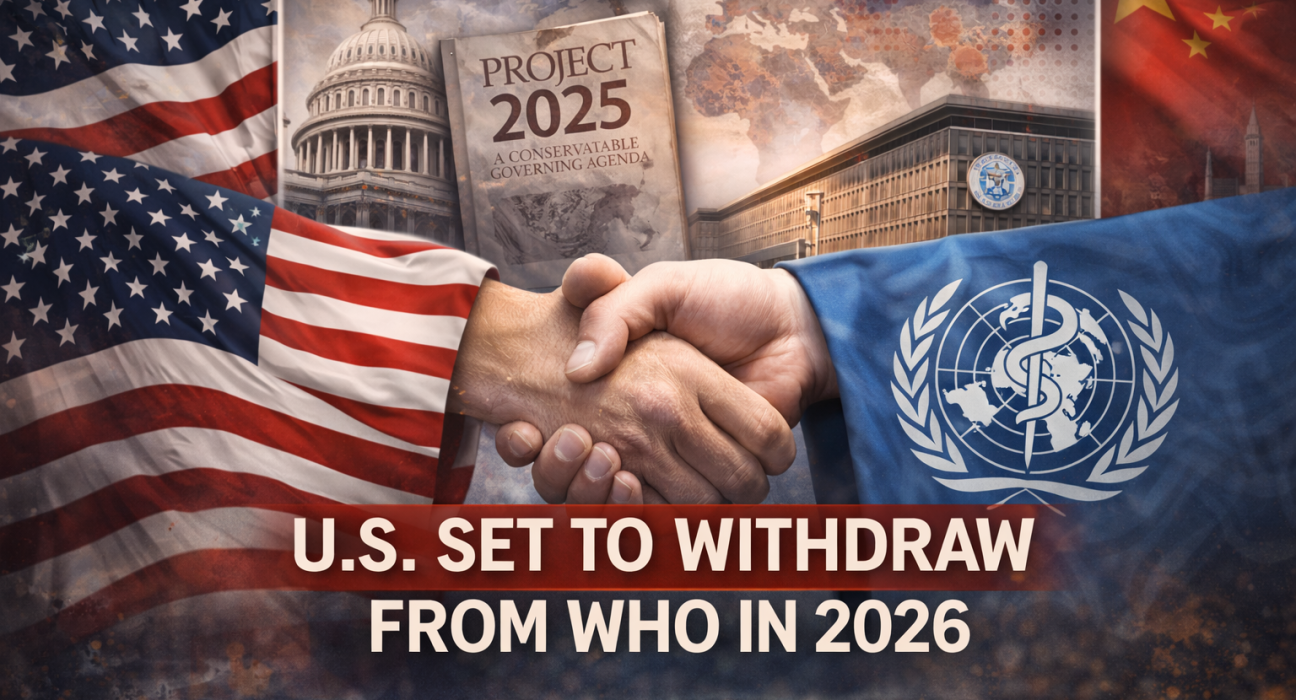
The United States is set to withdraw from the World Health Organization (WHO) in 2026, according to reporting by Reuters. The decision marks a major shift in U.S. global health policy and has prompted renewed debate over international cooperation, domestic public health preparedness, and the country’s long-term geopolitical standing. The move also aligns closely with policy frameworks outlined in Project 2025, a conservative transition blueprint that advocates for a reduced U.S. role in multilateral institutions.
Why the U.S. Is Leaving the WHO
Reuters reports that the planned withdrawal follows longstanding criticism from U.S. officials who argue that the WHO is inefficient, overly influenced by certain member states, and misaligned with American interests. Critics contend that the U.S., as the organization’s largest historical funder, has not received proportional influence over decision-making and that WHO responses to global health crises—most notably the Covid-19 pandemic—were slow or flawed.
Supporters of withdrawal argue that exiting the WHO allows the U.S. to redirect funding toward domestic health priorities or bilateral partnerships where oversight and accountability are more direct. They also frame the move as part of a broader effort to reassert national sovereignty over public health decisions.
What the WHO Does—and What the U.S. Risks Losing
The WHO plays a central role in:
- Coordinating global disease surveillance
- Sharing data on emerging health threats
- Setting international health guidelines
- Supporting vaccination and outbreak response in low-income countries
While the WHO does not have enforcement power over U.S. policy, its data-sharing networks and early-warning systems are widely viewed as critical to detecting pandemics before they reach U.S. borders. Public health experts warn that withdrawal could limit U.S. access to timely global health intelligence, forcing American agencies to rebuild or replace systems that currently rely on international coordination.
How This Relates to Project 2025
Project 2025, developed by the Heritage Foundation and allied groups, calls for a fundamental restructuring of the federal government and a sharp reduction in U.S. participation in multilateral organizations.
Project 2025 explicitly criticizes international bodies like the WHO, arguing they:
- Undermine U.S. sovereignty
- Promote policies inconsistent with domestic priorities
- Expand bureaucratic influence without democratic accountability
Within this framework, exiting the WHO is not an isolated decision but part of a broader strategy to shift toward unilateral or bilateral engagement and to centralize public health authority within national institutions.
Domestic Implications for the U.S.
Public Health Preparedness:
Opponents of withdrawal argue that pandemics do not respect borders, and that stepping away from global coordination could weaken U.S. readiness for future outbreaks. They note that even with strong domestic agencies, global surveillance gaps increase risk.
Healthcare and Research:
The U.S. benefits from WHO-coordinated research standards, clinical trial frameworks, and shared data. Withdrawal could complicate collaboration for American scientists and pharmaceutical companies operating internationally.
Costs and Capacity:
Supporters counter that the U.S. has sufficient expertise through agencies like the CDC and NIH, and that funds previously sent to the WHO could strengthen domestic capacity if reinvested effectively.
Geopolitical and Global Standing
The decision may also have diplomatic consequences. As the U.S. steps back, other powers—particularly China and the European Union—may gain greater influence over global health governance. Analysts warn that reduced U.S. presence could shape international norms in ways less aligned with American values and interests.
From a soft-power perspective, withdrawal may signal a retreat from global leadership at a time when health crises are increasingly linked to national security, economic stability, and humanitarian response.
Pros and Cons
Potential Advantages:
- Greater national control over health policy
- Reduced funding to international bureaucracy
- Ability to pursue bilateral health partnerships
- Alignment with sovereignty-focused governance
Potential Risks:
- Reduced access to global disease intelligence
- Weakened pandemic preparedness
- Loss of influence in setting global health standards
- Increased fragmentation in international health response
What to Expect Going Forward
Short Term:
Federal agencies are likely to prepare contingency plans to replace WHO-dependent systems, including expanded surveillance partnerships and data-sharing agreements.
Medium Term:
Congress may debate alternative international health frameworks or partial re-engagement mechanisms. Legal challenges or funding disputes could arise if states or institutions seek to maintain ties independently.
Long Term:
If the U.S. remains outside the WHO, global health governance could become more multipolar, with diminished U.S. leadership and greater reliance on regional alliances. Domestically, public health outcomes will depend heavily on whether resources saved from withdrawal are effectively reinvested.
Conclusion
The U.S. decision to leave the World Health Organization represents a profound shift in how the country approaches global health and international cooperation. Closely aligned with Project 2025’s vision, the move prioritizes sovereignty and domestic control but carries significant trade-offs in preparedness, influence, and global coordination. Whether this course strengthens or weakens the nation will depend less on the act of withdrawal itself and more on what replaces the systems the WHO currently provides.
References & Further Reading
Reuters — U.S. set to quit World Health Organization in 2026
https://www.reuters.com/business/healthcare-pharmaceuticals/us-set-quit-world-health-organization-2026-01-22/
World Health Organization — About WHO and global health coordination
https://www.who.int/about
Heritage Foundation — Project 2025 overview and policy goals
https://www.project2025.org/
Centers for Disease Control and Prevention — Global health security
https://www.cdc.gov/globalhealth
Council on Foreign Relations — U.S. role in global health governance
https://www.cfr.org/global-health


Leave feedback about this
You must be logged in to post a comment.