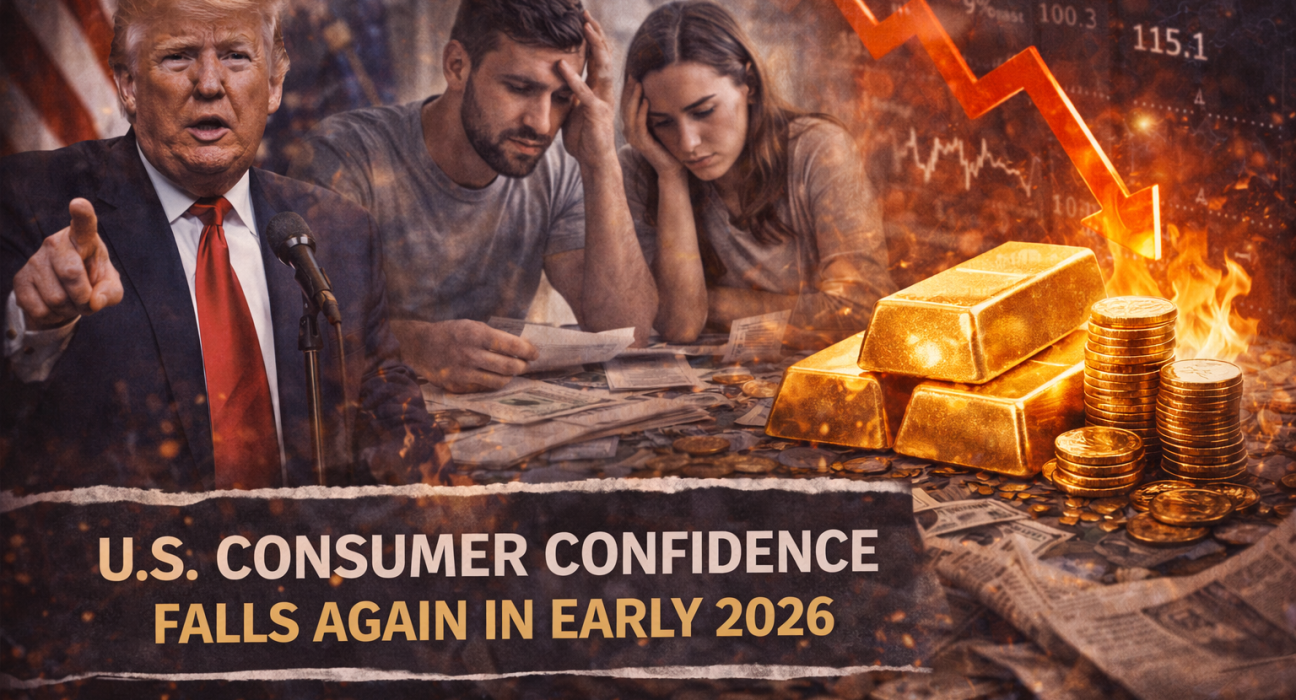
U.S. consumer confidence fell again in early 2026, underscoring a growing disconnect between official assurances about economic stability and how households actually feel about their financial future. While the White House and President Donald Trump continue to insist that “the economy is strong” and that inflation is under control, new data from the Conference Board suggests many Americans remain uneasy — a sentiment mirrored in the rising price of gold, a traditional barometer of economic doubt.
What the Consumer Confidence Data Shows
According to the Conference Board’s latest survey, U.S. consumer confidence declined as households expressed concern about inflation, job security, and future income prospects. While spending has not collapsed outright, respondents reported greater caution, particularly around discretionary purchases and long-term financial commitments.
The survey showed:
- A drop in expectations about future business conditions
- Increased concern about prices for essentials such as housing, utilities, and food
- Less optimism about income growth over the next six months
Economists often view consumer confidence as a leading indicator. When confidence weakens, households tend to delay big purchases, which can slow economic growth even if headline indicators like GDP or employment appear stable.
Trump’s Messaging: “Everything Is Fine”
President Trump has repeatedly dismissed concerns about economic fragility, characterizing consumer unease as exaggerated or politically motivated. In recent remarks, he emphasized:
- Low unemployment relative to historical norms
- Continued consumer spending
- Stock market resilience in certain sectors
From the administration’s perspective, these indicators demonstrate that the U.S. economy remains fundamentally sound and that pessimism is being overstated by critics or media outlets.
This messaging strategy mirrors a broader political pattern: focusing on macro-level indicators that support confidence, while downplaying household-level pressures such as debt burdens, rent increases, insurance costs, and lingering inflation in everyday goods.
However, economists note that macro stability does not always translate into personal financial security. Even modest inflation can feel severe to households already stretched by high housing and healthcare costs.
Why Gold Prices Matter in This Context
As consumer confidence has slipped, gold prices have continued to climb, reaching or approaching record highs. This relationship is not coincidental.
Gold historically rises during periods of:
- Economic uncertainty
- Distrust in official economic narratives
- Inflation fears or currency instability
- Expectations of interest-rate cuts
Unlike stocks or bonds, gold does not depend on corporate earnings or government creditworthiness. When investors — both institutional and individual — lose confidence in traditional assets or policy assurances, demand for gold often increases.
In this sense, gold acts less as a bet on disaster and more as a hedge against uncertainty. Its rise suggests that a significant portion of investors are not fully convinced by claims that economic conditions are “fine,” even if they are not predicting an imminent collapse.
The Disconnect: Data vs. Lived Experience
The divergence between official optimism and public sentiment highlights a structural issue in modern economies: aggregate indicators can mask uneven impacts.
While some households benefit from rising asset values or stable employment, others face:
- Higher interest payments on credit cards and loans
- Rising rents and insurance premiums
- Stagnant wages relative to living costs
Consumer confidence surveys capture this lived experience more directly than GDP or stock indices. The decline suggests that many Americans feel vulnerable — even if the economy, on paper, is growing.
This helps explain why gold has attracted renewed interest not only from professional investors, but also from everyday savers seeking perceived stability.
Pros and Cons of the Current Moment
Pros
- The economy has avoided a deep recession so far
- Employment remains relatively strong
- Consumer spending has not collapsed
- Gold’s rise provides a hedge for portfolios
Cons
- Consumer confidence continues to weaken
- Inflation pressures persist in daily expenses
- Economic messaging risks losing credibility
- Rising gold prices may signal deeper unease
What This Could Mean Going Forward
Short-term:
If consumer confidence continues to slide, spending may slow, increasing pressure on growth. The administration may respond with stronger rhetoric, targeted relief, or renewed emphasis on interest-rate policy.
Medium-term:
If gold prices remain elevated, it may reinforce perceptions that investors expect volatility or policy shifts, including possible Federal Reserve rate cuts.
Long-term:
Persistent disconnects between official narratives and public experience can erode trust. Over time, this can influence elections, policy credibility, and financial behavior — including greater reliance on alternative assets like gold.
Conclusion
The decline in consumer confidence alongside rising gold prices paints a picture of quiet economic doubt, even as political leaders insist that conditions are stable. Gold’s ascent does not necessarily predict a crisis, but it does reflect skepticism — a hedge against the possibility that official optimism is overstating economic resilience.
As long as households feel financially constrained and uncertain about the future, confidence may lag behind political messaging. In that gap between reassurance and reality, assets like gold often thrive.
References & Further Reading
AP News — U.S. consumer confidence falls as inflation worries persist
https://apnews.com/article/consumer-confidence-economy-spending-inflation-conference-board-f36b997dc46ac9c3577d05db52166846
Conference Board — Consumer Confidence Index methodology
https://www.conference-board.org
Reuters — Gold prices and safe-haven demand amid economic uncertainty
https://www.reuters.com/markets/commodities/
World Gold Council — Why gold rises during economic doubt
https://www.gold.org
Federal Reserve — Interest rates, inflation, and economic outlook
https://www.federalreserve.gov