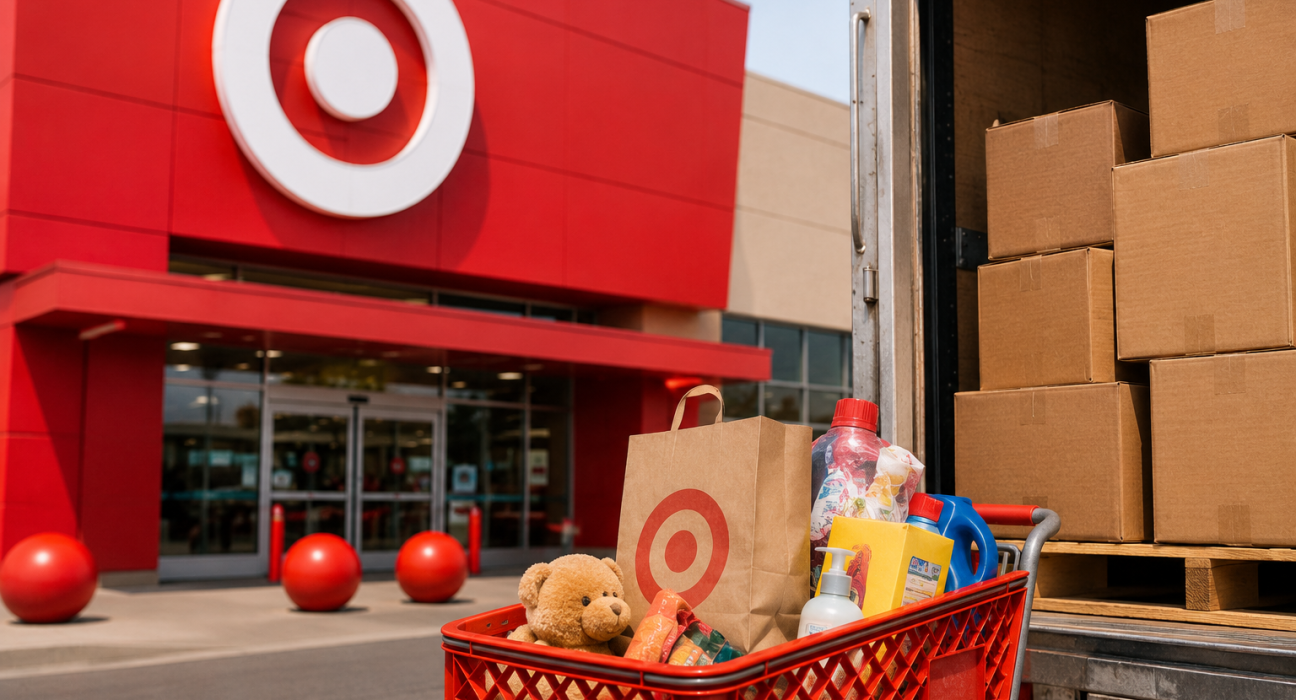
Target’s latest quarterly earnings reveal just how financially significant the Supreme Court’s February 2026 tariff ruling has become for American businesses. The retailer disclosed that it received $994 million in pre-tax tariff refunds, helping push quarterly operating income to roughly $2.6 billion, about double the comparable figure from a year earlier.
The payment was not a government subsidy or special bailout for Target. It was a reimbursement of import duties the company had previously paid under tariffs that the U.S. Supreme Court later ruled were imposed without lawful authority under the International Emergency Economic Powers Act, or IEEPA.
The implications extend well beyond one retailer. By early August, federal court filings showed that the government had already returned roughly $100 billion in tariffs to U.S. importers, representing about 60% of the duties collected under the invalidated policies.
What the Supreme Court Actually Ruled
On February 20, 2026, the Supreme Court ruled 6–3 in Learning Resources, Inc. v. Trump that IEEPA did not authorize the president to impose the sweeping tariffs introduced after President Donald Trump returned to office in 2025.
The Court did not rule that presidents can never impose tariffs. Instead, it concluded that Congress had not granted tariff authority through IEEPA, a law designed primarily to address economic emergencies through mechanisms such as blocking transactions and assets.
Chief Justice John Roberts’ majority opinion emphasized that tariffs function as taxes on American importers and that Congress normally delegates tariff authority explicitly and with defined limits. The Court found neither in IEEPA.
That distinction is important because the administration has continued imposing tariffs through other statutes. Reuters reports that the White House shifted toward laws including Sections 122 and 301 of the Trade Act and Section 232 of the Trade Expansion Act, which contain more explicit trade authorities.
So the Supreme Court ruling did not end Trump’s tariff agenda. It invalidated one of the principal legal mechanisms used to implement it.
Why Target Received Nearly $1 Billion
Target imports a substantial portion of the products it sells. Its own filings state that approximately half of its merchandise is sourced outside the United States, with China remaining its largest individual overseas sourcing market.
When IEEPA tariffs were imposed, Target — as the importer of record on many products — paid those duties to U.S. Customs and Border Protection.
Once the tariffs were ruled unauthorized, the Court of International Trade directed Customs to develop a process for returning the money. Reuters reported that Customs subsequently established an automated refund mechanism, with qualifying importers receiving both the original duties and interest in many cases.
That is how Target ultimately recovered $994 million.
Target had previously warned investors that the amount and timing of any refund were uncertain. Its 2025 annual report specifically disclosed that the Supreme Court decision could materially affect the company’s financial results but said Target could not yet estimate the recovery.
The Refund Dramatically Improved Target’s Quarter
AP reported that Target’s quarterly net income reached approximately $1.87 billion, while the tariff refund added roughly $1.65 per share to earnings. Comparable sales also increased 3.8%, suggesting the quarter was not strong solely because of the reimbursement.
Target is simultaneously undergoing a turnaround under CEO Michael Fiddelke.
The retailer has:
- Reduced prices on more than 10,000 products.
- Expanded and refreshed merchandise.
- Increased store remodels.
- Improved digital and same-day delivery.
- Attempted to attract more young families.
- Continued reducing sourcing dependence on China.
That distinction matters because the nearly $1 billion refund is primarily a one-time accounting benefit, not evidence that Target suddenly generated an additional $1 billion through normal retail operations.
The company’s underlying sales improvement provides a better measure of whether its turnaround is sustainable.
Target Is Not Alone
Target is one of many companies receiving significant refunds.
Estée Lauder disclosed $38 million in tariff refunds, although the company noted that those reimbursements only partly offset approximately $102 million in additional tariff-related costs over the year.
Nintendo similarly recorded roughly $300 million in reduced costs from refunded U.S. tariffs, contributing to a sharp increase in quarterly operating profits.
Even Walmart is benefiting substantially. Reuters reported this week that the retailer is using some of its approximately $2.9 billion in tariff refunds to help finance price reductions as consumers face economic pressure.
This confirms that Target’s reimbursement is part of a far broader reversal of tariff revenue collected from American businesses.
The Federal Government Is Feeling the Other Side of the Refunds
What improves corporate profits simultaneously reduces federal revenue.
Reuters reported that tariff refunds helped push the federal government into a $120 billion June budget deficit, compared with a $27 billion surplus during June 2025.
In June alone, approximately $49.2 billion in tariff refunds were issued — more than double the gross customs duties collected that month.
That demonstrates an unusual economic reversal.
When the tariffs were initially collected, they appeared as government revenue and costs to importers. Now significant portions of that revenue are flowing back to businesses while still leaving the wider economy with the disruption created while those tariffs were in force.
Did Consumers Pay for These Tariffs?
This is one of the most important questions.
Technically, American importers pay tariffs, not foreign governments.
Companies then choose whether to:
- Absorb the cost through lower margins.
- Negotiate lower supplier prices.
- Shift sourcing.
- Increase consumer prices.
- Use some combination of those approaches.
Economic research has generally found that much of the cost of tariffs ultimately falls on American companies and consumers, although the exact distribution varies by product and market.
Target itself acknowledged in previous earnings discussions that tariffs contributed materially to costs and influenced inventory and pricing decisions.
Target CFO Jim Lee now says the company will continue investing in lower prices, but Target has not committed to directly returning the $994 million to customers.
That means shoppers should not expect individual tariff refund checks.
Instead, consumers may benefit indirectly if retailers use reimbursements to reduce prices, invest in inventory, expand stores, pay workers, reduce debt, or return money to shareholders.
The Bigger Question: Can the Government Simply Replace the Tariffs?
In many cases, yes — but only using lawful statutory authority.
Following the Supreme Court defeat, the administration quickly introduced new tariff measures through other trade laws.
Some of those measures are already being challenged.
Reuters reported that small businesses recently sued over new tariffs imposed under Section 301, arguing that the administration again exceeded the authority Congress granted.
At the same time, the government scored a separate victory when the Court of International Trade upheld Trump’s authority to eliminate the de minimis exemption for certain low-value imports.
The emerging legal picture is therefore more complicated than either “Trump’s tariffs were illegal” or “the president can tariff anything.”
The real question is which law Congress authorized the president to use, under what conditions, and for which products or countries.
Pros
For Businesses and Consumers
- Refunds return money collected under tariffs the Supreme Court found unauthorized.
- Companies may use refunds to reduce prices or absorb remaining tariff costs.
- The ruling provides clearer limits on executive tariff authority.
- Retailers can potentially reinvest billions into inventory, employees and supply chains.
For Constitutional Governance
The decision reinforces Congress’ constitutional role in taxation and tariffs while still preserving presidential powers granted under specific trade statutes.
Cons and Continuing Risks
- Refunds create a significant loss of previously collected federal revenue.
- Companies are not legally required to pass reimbursements directly to consumers.
- New tariffs imposed under alternative statutes continue creating business uncertainty.
- Companies that changed suppliers or raised prices because of the original tariffs cannot necessarily reverse those changes easily.
- Continuing court challenges make long-term trade planning difficult.
What This Could Mean Going Forward
The most immediate consequence will be additional corporate refunds.
With roughly $100 billion already returned and billions more potentially outstanding, quarterly earnings across retail, manufacturing, technology and consumer goods may receive temporary boosts throughout 2026.
The second consequence may be price competition.
If Walmart, Target and other major retailers use refunds to finance price cuts, competitors may have to follow, potentially giving consumers some indirect benefit from the Supreme Court decision.
The third consequence is legal.
Future administrations may be considerably more cautious about using emergency statutes to construct sweeping trade policies without explicit congressional authorization.
Finally, the controversy could influence how Congress writes future trade laws. Lawmakers may either restrict presidential tariff authority or explicitly expand it, depending on the political outcome of the current debate.
Conclusion
Target’s nearly $1 billion tariff reimbursement provides one of the clearest illustrations yet of the extraordinary financial consequences of the Supreme Court’s 2026 tariff decision.
The refund helped Target nearly double quarterly operating income, but it is not simply corporate windfall money: it represents duties the company previously paid under a tariff regime the Supreme Court later concluded lacked statutory authorization.
At the same time, the story does not mark the end of tariffs. The Trump administration has shifted to other laws, new duties remain in effect, additional legal challenges are underway, and retailers continue adjusting their global supply chains.
The deeper story is therefore about more than Target.
It is about who has the constitutional authority to impose hundreds of billions of dollars in taxes on imports, who ultimately pays those costs, and what happens when a massive economic policy operates for months before the courts conclude that the government did not have the legal authority to impose it in the first place.
References
Original BBC Report
BBC News — Target receives almost $1 billion in tariff refunds following Supreme Court ruling.
Independent Reporting
Reuters — Target raises forecasts as turnaround gains momentum.
https://www.reuters.com/business/retail-consumer/target-lifts-annual-forecasts-again-fiddelkes-turnaround-takes-root-2026-08-19/
Associated Press — Target sales rebound and tariff refund boosts earnings.
https://apnews.com/article/5c868444a86dc9ba1ae6df01a6e74d2b
Reuters — U.S. government refunds $100 billion in tariffs invalidated by Supreme Court.
https://www.reuters.com/legal/government/us-refunds-100-billion-tariffs-struck-down-by-supreme-court-filing-shows-2026-08-05/
Reuters — Tariff refunds contribute to June federal deficit.
https://www.reuters.com/world/us/tariff-refunds-push-us-june-budget-deficit-120-billion-2026-07-13/
Reuters — Supreme Court strikes down Trump global tariffs.
https://www.reuters.com/legal/government/us-supreme-court-rejects-trumps-global-tariffs-2026-02-20/
Reuters — How businesses receive IEEPA tariff refunds.
https://www.reuters.com/legal/legalindustry/how-get-your-ieepa-tariff-refunds–pracin-2026-04-22/
Reuters — Estée Lauder earnings and tariff refunds.
https://www.reuters.com/business/retail-consumer/estee-lauder-forecasts-annual-profit-above-estimates-strong-china-demand-2026-08-19/
Reuters — Nintendo earnings boosted by tariff reimbursement.
https://www.reuters.com/business/retail-consumer/nintendo-q1-operating-profit-jumps-151-beating-analyst-estimates-2026-08-06/
Primary Legal and Corporate Documentation
U.S. Supreme Court — Learning Resources, Inc. v. Trump, February 20, 2026.
https://www.supremecourt.gov/opinions/25pdf/24-1287_new_3135.pdf
Target Corporation — 2025 Annual Report and tariff-risk disclosures.
https://corporate.target.com/getmedia/79214b4b-6331-4b1c-b76f-acff121b40f9/2025-Annual-Report-Target-Corporation.pdf