The U.S. Food and Drug Administration has authorized a robotic system capable of locating a patient’s vein, inserting a needle and completing a blood draw largely autonomously — a milestone that could signal a much broader transformation in routine healthcare.
The device, called Aletta, was developed by Dutch medical robotics company Vitestro. On August 19, 2026, the FDA granted the system De Novo marketing authorization, making Aletta the first standalone robotic device authorized in the United States to draw blood from a patient’s arm without hands-on intervention from the operator.
The important distinction is that Aletta is autonomous, but it is not unsupervised. A trained phlebotomist must initiate and oversee the procedure and remain available if something goes wrong. The FDA says one trained professional can supervise as many as three machines simultaneously.
How the Robot Actually Draws Blood
Aletta automates nearly the entire traditional blood-draw procedure.
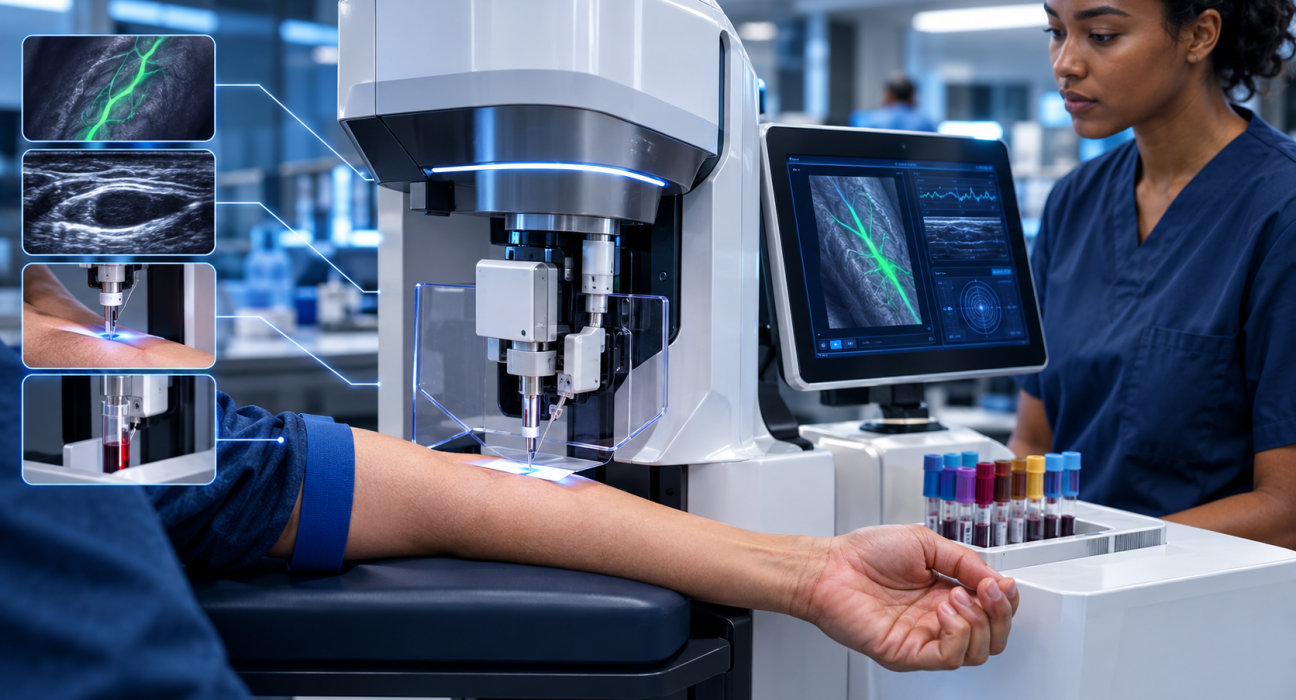
After the patient positions their arm and the procedure is started, the machine uses near-infrared imaging, ultrasound and Doppler ultrasound to identify an appropriate vein and distinguish it from an artery. If the system cannot identify an appropriate vein, it will not attempt the puncture.
Once a vein is selected, Aletta can:
- Apply the tourniquet
- Prepare and disinfect the skin
- Position the needle
- Insert the needle
- Fill and change collection tubes
- Dispose of the needle
- Apply a bandage
The supervising phlebotomist then verifies that the correct tubes were filled appropriately.
That distinction matters. The technology is not merely a machine that helps a healthcare worker locate difficult veins. It automates the physical procedure itself.
How Accurate Is It?
The clinical results are particularly important because inserting needles is a task where small errors matter.
A peer-reviewed multicenter European study involving 1,633 patients reported a 94.5% first-stick success rate when Aletta identified an appropriate vein. Results included a 97.4% first-stick rate among patients with a BMI above 30, 92.7% among people reporting difficult venous access and 93.4% among patients older than 65.
Researchers reported a 0.3% hemolysis rate and a 0.6% rate of device-related adverse events, all categorized as mild. Ninety percent of patients described the pain as similar to or less than a manual blood draw, while 82% either preferred the robotic system or had no preference between it and a human phlebotomist.
The FDA says its authorization relied on clinical evidence showing successful blood-draw performance comparable to or better than trained human phlebotomists when the machine proceeded with a needle stick. The evaluation included patients with different health conditions, skin tones and self-reported difficulty accessing veins.
What Happens if the Patient Moves?
Automating needle insertion creates an obvious safety question: what happens if someone suddenly pulls their arm away?
Aletta incorporates several safeguards.
If excessive movement is detected, the needle automatically detaches and the blood draw stops. Other onboard sensors can pause the procedure and alert the supervising professional when unsafe conditions are detected.
The machine also continuously applies disinfectant while performing its ultrasound scan, and trained personnel clean the system between patients.
These safeguards were central to the FDA’s decision to authorize a completely new category of medical device through its De Novo pathway.
Why Automate Something as Simple as Drawing Blood?
Blood collection is one of the most common medical procedures in healthcare, which is precisely why automation could have substantial consequences.
The FDA specifically cited the growing shortage of trained phlebotomists as one motivation for the technology.
If one professional can supervise three robotic stations, a laboratory could theoretically process more routine patients without tripling its workforce.
The model is therefore closer to workforce multiplication than complete worker replacement.
Human specialists could concentrate on children, medically complicated patients, emergencies and people for whom automated collection is unsuitable while machines handle high-volume routine collections.
The Larger Story: Automation Is Moving Into Physical Healthcare
Perhaps the most consequential aspect of Aletta isn’t the blood draw itself.
Artificial intelligence has already entered healthcare through medical imaging, documentation, diagnostic assistance and administrative automation. Aletta demonstrates another stage: software intelligence combined with robotics performing physical medical procedures on human bodies.
That opens the possibility of future systems performing increasingly sophisticated routine tasks involving injections, vascular access, specimen collection and other standardized procedures.
The FDA’s decision also establishes a regulatory pathway for competitors. Because Aletta received De Novo authorization as a new device type, the FDA established special controls governing areas including labeling, performance testing and clinical testing. Future devices could potentially use that framework when seeking authorization.
Pros
Greater healthcare capacity: One phlebotomist potentially supervising three machines could increase patient throughput.
Consistency: Robotic imaging and needle positioning may reduce variability between individual operators.
Potential help for difficult veins: Ultrasound and infrared imaging provide information unavailable to the naked eye.
Reduced waiting times: Automation could allow laboratories to operate more blood-drawing stations despite staffing shortages.
Potential patient benefits: Clinical research so far suggests high first-stick success and relatively strong patient acceptance.
Cons and Remaining Concerns
Patient acceptance: Some people uncomfortable with needles may be even less comfortable allowing a robot to insert one.
Technology failures: Mechanical, software and sensor failures introduce different categories of medical risk.
Employment disruption: Although Aletta still requires professional supervision, widespread automation could eventually reduce demand for some routine phlebotomy positions.
Cost: Hospitals must determine whether purchasing, maintaining and servicing robotic systems is cheaper than traditional staffing.
Real-world evidence remains important: Regulatory authorization does not establish how the technology will perform across every hospital, patient population and clinical situation over many years.
What This Could Mean for the Future
The biggest implication may be what happens after blood draws.
Healthcare contains thousands of repetitive physical procedures requiring precision but following relatively standardized workflows. Once robotics proves safe and economically viable for one procedure, manufacturers have incentives to expand into others.
Within the coming decade, hospitals could increasingly resemble collaborations between healthcare workers and specialized medical robots.
A nurse or technician might supervise several automated systems while concentrating personally on complicated patients. Laboratories could become increasingly automated from the moment blood enters the collection tube through testing and analysis.
The development could also accelerate investment in AI-assisted robotic healthcare, combining computer vision, ultrasound, sensors, machine learning and precision robotics.
That does not mean doctors, nurses or phlebotomists disappear. Aletta itself demonstrates why: the FDA still requires trained human oversight.
Instead, the emerging model appears to be one in which machines increasingly perform standardized physical tasks while healthcare professionals supervise them and intervene when human judgment is required.
Conclusion
Aletta represents something larger than a sophisticated blood-drawing machine.
For decades, medical robots have primarily helped professionals perform procedures. This system crosses an important threshold by allowing a machine to independently identify human anatomy, make a procedural decision and physically perform a common medical task under professional supervision.
If the technology performs reliably outside clinical trials, automated blood collection could become increasingly ordinary — appearing in hospitals, laboratories and outpatient centers much as automated laboratory equipment already has.
The larger question is no longer whether robotics will enter routine healthcare. It is how much of routine healthcare can safely be automated, and which responsibilities humans should continue to control.
References
Primary article
TechSpot — FDA approves robot that can find your vein, insert a needle and draw blood
Additional reporting and primary documentation
U.S. Food and Drug Administration — First-of-its-kind robotic blood draw authorization
FDA Medical Device News and Updates
Vitestro — Aletta autonomous robotic phlebotomy system
Vitestro — Multicenter clinical study results
Vitestro — Information for phlebotomists and clinical implementation