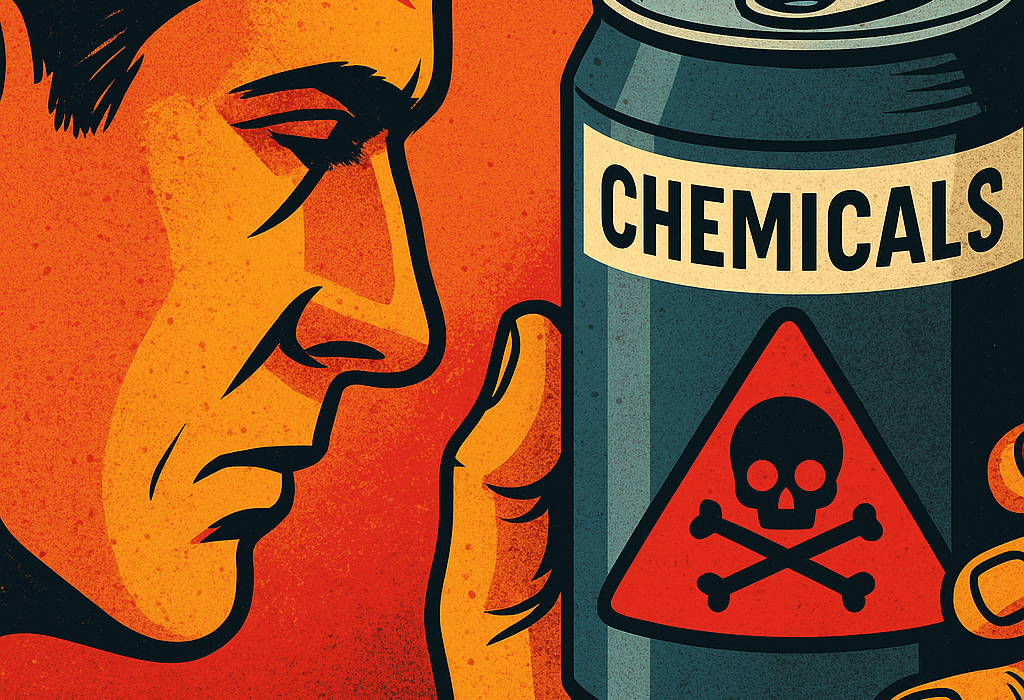
A major scientific report released Wednesday warns that four families of synthetic chemicals widely used in the global food system—phthalates, bisphenols, pesticides, and PFAS “forever chemicals”—are driving rising rates of cancer, infertility, neurodevelopmental disorders, and ecological degradation. The financial impact is staggering: researchers estimate the global health burden reaches up to $2.2 trillion per year, a cost comparable to the annual profits of the world’s 100 largest corporations.
The report, authored by dozens of scientists from the Institute of Preventive Health, the Center for Environmental Health, ChemSec, and academic institutions in the U.S. and U.K., was coordinated by Systemiq, a sustainability consultancy. The researchers focused on the four chemical groups because they are among the most prevalent, best-studied, and most clearly linked to serious harms in both humans and ecosystems.
Beyond health-related costs, the authors estimate at least $640 billion in environmental damages—including agricultural losses and water filtration expenses needed to meet safety standards for PFAS and pesticides. The report describes human exposure to endocrine disruptors as a potential demographic threat. If current exposure levels continue, the authors project 200 million to 700 million fewer births globally between 2025 and 2100 due to declining fertility.
Chemical production has grown more than 200-fold since the 1950s, with more than 350,000 synthetic chemicals now in circulation, most of which have never been comprehensively tested for long-term safety. Unlike pharmaceuticals, industrial chemicals receive minimal pre-market safety testing, and post-market monitoring is limited. This regulatory gap, scientists argue, has allowed harmful substances to proliferate across food systems, household products, and the natural environment.
Philip Landrigan, a leading pediatric public health expert at Boston College and co-author of the report, described the findings as a “wake-up call.” He emphasized that chemical pollution is “every bit as serious as climate change” and highlighted concerning trends in childhood health. Infectious diseases have dramatically declined over the past century, yet rates of noncommunicable diseases—such as childhood cancers, neurodevelopmental disorders, and metabolic diseases—have risen. Landrigan attributes part of this shift to increased exposure to synthetic chemicals.
The report outlines the dangers associated with each chemical class:
- Phthalates and Bisphenols: Common in plastic packaging and disposable gloves used in food preparation, these chemicals are known endocrine disruptors linked to infertility, hormonal imbalance, obesity, and developmental impairment.
- Pesticides: Central to industrial agriculture, large-scale pesticide use contributes to ecological decline and chronic human health issues. Post-harvest treatments also prolong exposure.
- PFAS (“Forever Chemicals”): Found in greaseproof packaging, popcorn bags, ice cream tubs, and now pervasive in soil, air, and water, PFAS are linked to cancer, liver damage, immune suppression, and decreased fertility.
The scientists note that chemical pollution has already crossed a planetary boundary—a threshold of environmental disruption identified by the Stockholm Resilience Centre. Exceeding this boundary means chemical contamination may now be destabilizing the conditions that supported the development of modern human civilization.
Landrigan expressed particular concern about chemicals that impair brain development in children, decreasing intelligence, creativity, and lifetime productivity. He also warned that the four chemical families examined represent “only the tip of the iceberg,” noting that thousands of poorly understood substances remain unregulated and unstudied. He cautioned that society tends to ignore chemical risks until glaring harms—such as birth defects—become unavoidable.
The report concludes by urging governments and international organizations to strengthen chemical regulation, phase out known harmful substances, improve monitoring, and redesign food systems to reduce dependence on synthetic chemical inputs.
Pros
(From a neutral analytical perspective — not an endorsement.)
- Raises global awareness of an under-regulated public health threat with major economic implications.
- Provides robust scientific synthesis, summarizing decades of research across toxicology, public health, and environmental science.
- Offers economic estimates that may motivate policymakers who respond to financial impacts.
- Encourages innovation toward safer materials and more sustainable agricultural practices.
Cons
- Policy implementation gaps may remain large, as many nations lack regulatory infrastructure to enforce new chemical controls.
- Industry resistance could slow reform, especially in agriculture, plastics, and food packaging sectors.
- Cost of transition to safer alternatives may burden farmers and manufacturers without adequate support.
- Public alarm without specificity may cause confusion, as the report focuses on chemical families rather than identifying individual products.
Future Projections
Short-Term:
- Increased policy discussions in the EU, U.S., and international health bodies around regulating PFAS and endocrine disruptors.
- Food companies may face pressure to reduce chemical additives in packaging and processing.
Medium-Term:
- Governments may introduce chemical safety reforms paralleling climate and biodiversity policy.
- Litigation over PFAS and pesticide contamination is likely to expand, increasing financial risk for manufacturers.
Long-Term:
- If exposures remain high, demographic impacts—including declining fertility—may reshape health systems and labor markets.
- A global shift toward regenerative agriculture and non-toxic packaging materials may accelerate as economic costs rise.
References & Further Reading
The Guardian – Report on global chemical pollution and health costs
https://www.theguardian.com/environment/
Stockholm Resilience Centre – Planetary boundaries and chemical pollution
https://www.stockholmresilience.org/
Boston College Global Public Health Program – Research on chemical exposure and child development
https://www.bc.edu/
ChemSec – Reports on hazardous chemicals and regulatory gaps
https://chemsec.org/
Center for Environmental Health – Endocrine disruptor research
https://ceh.org/
Systemiq – Sustainability analysis and food system research
https://www.systemiq.earth/
EPA – PFAS toxicity and exposure pathways
https://www.epa.gov/pfas