Overview & Key Points
The article reports that China’s trade surplus has surpassed $1 trillion for the first time in the first 11 months of the year, driven by stronger exports to non-U.S. markets as firms work around sharply higher U.S. tariffs under President Donald Trump. In November alone, China recorded a $111.68 billion monthly surplus, up from $90.07 billion in October and above market expectations. Overall exports grew 5.9% year-on-year, reversing October’s 1.1% contraction, while imports rose a modest 1.9%.
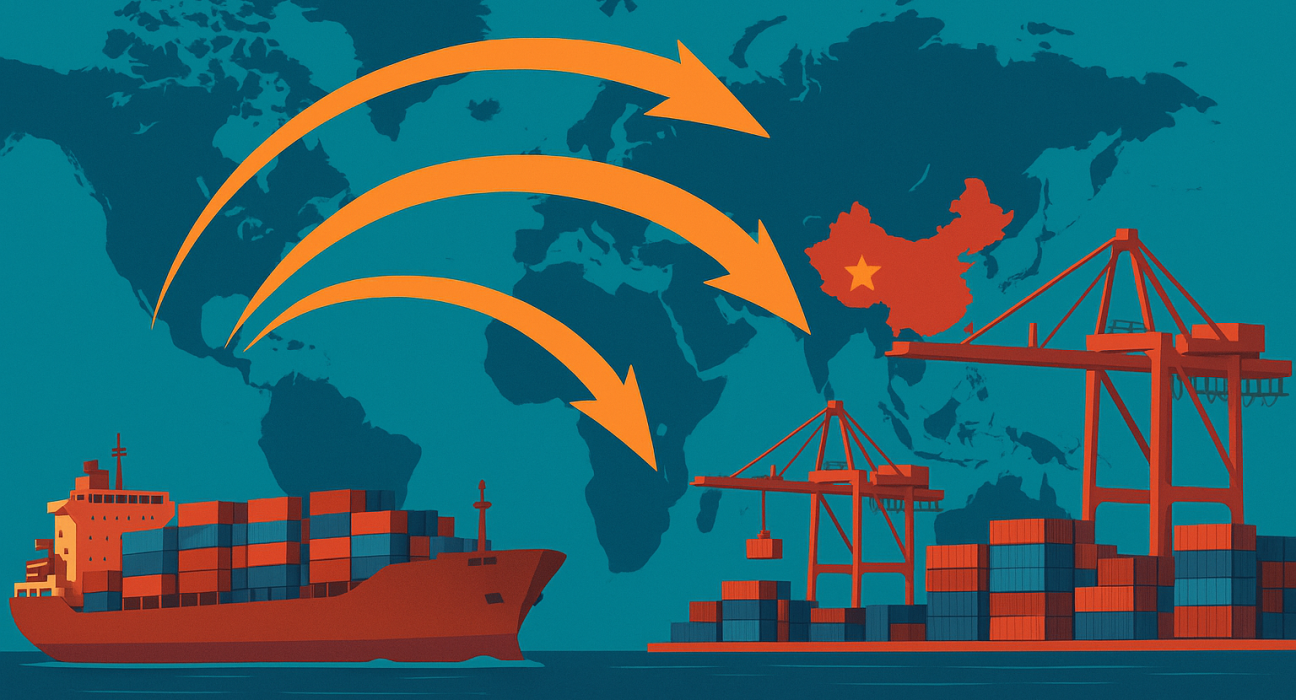
A key dynamic is trade rerouting. Exports to the United States fell about 29% year-on-year in November, but shipments to other destinations surged:
- European Union: +14.8%
- Australia: +35.8%
- Southeast Asia: +8.2%
These patterns line up with broader research showing that U.S. tariffs on China tend to reduce direct U.S. imports from China but increase Chinese exports to the EU and South/Southeast Asia as supply chains reorganize.
Despite a partial U.S.–China trade “truce” and some tariff cuts agreed after the Trump–Xi meeting in October, the average U.S. tariff on Chinese goods remains around 47.5%, high enough to squeeze profit margins and discourage direct shipments. Nevertheless, Chinese exporters are offsetting this through:
- Strong demand for electronics and semiconductors, where global shortages and higher prices support revenue.
- Leveraging Chinese firms’ global footprints to produce or transship through third countries with lower tariff exposure, especially in Southeast Asia.
On the import side, the article notes mixed signals. China’s imports are growing, but only slowly, reflecting weak domestic demand and a prolonged property downturn. Indicators such as declining copper imports and eight consecutive months of contracting factory activity highlight underlying softness.
At the same time, specific trade flows are strengthening:
- Rare earth exports jumped after a bilateral agreement to accelerate shipments of critical minerals.
- Soybean imports are on track for a record year, with China buying more from the U.S. and Latin America following recent commitments.
China’s political leadership is responding at the policy level. The Politburo has pledged to expand domestic demand and use more proactive fiscal policy in 2026, a theme expected to be fleshed out at the Central Economic Work Conference, as Beijing tries to shift from export-led growth to a more balanced, consumption-driven model.
Potential Upsides / “Pros”
- Resilience of Chinese Exports
- The ability to reroute trade and gain market share in Europe, Australia, and Southeast Asia shows that Chinese manufacturers remain highly competitive and adaptable, even under unusually high U.S. tariffs.
- Diversification Away From a Single Market
- Reducing reliance on the U.S. market lowers China’s exposure to any one country’s trade policy, which may improve long-term stability for Chinese exporters and their workers.
- Supply Chain Opportunities for Other Regions
- Europe and Southeast Asia benefit from cheaper or more abundant Chinese goods, and some ASEAN economies gain by hosting new production hubs and transshipment nodes, bringing investment and jobs.
- Momentum for Domestic Reforms
- Pressure from tariffs and external demand uncertainty strengthens the case in Beijing for accelerating reforms to boost consumption, services, and high-tech industries like EVs, batteries, and robotics.
Risks & Downsides / “Cons”
- Persistent Global Imbalances
- A more than $1 trillion surplus can fuel international criticism that China is still overly export-dependent, potentially inviting new protectionist measures from other major economies, not just the U.S.
- Fragile Domestic Demand
- Weak property markets, cautious consumers, and underperforming imports point to domestic fragility. If external demand slows or new tariffs emerge, China could face a sharper growth downturn.
- Trade Tensions with Third Markets
- As Chinese exports surge into Europe and ASEAN, these regions may respond with anti-dumping actions or their own industrial policies aimed at limiting Chinese dominance in strategic sectors (e.g., EVs, solar, batteries).
- Efficiency Costs of Tariffs and Rerouting
- Economic research on the earlier U.S.–China trade war shows that tariffs raised costs for consumers and disrupted efficient supply chains, with welfare losses on both sides. Trade rerouting reduces but does not eliminate these costs.
What This Could Mean for the Future
In the near term (1–3 years), China is likely to continue expanding its share of global exports, especially in higher-value manufacturing and electronics, even as direct shipments to the U.S. remain depressed. Several forecasts suggest China’s share of global goods exports could rise from about 15% today to roughly 16–16.5% by 2030, assuming no major global downturn or coordinated pushback.
However, this trajectory is not guaranteed. If trade partners perceive China’s surplus and industrial policies as threatening, they may tighten tariffs, subsidies, or local-content rules, raising the risk of a more fragmented global trading system. Europe’s balancing act between access to Chinese goods and protecting its own industries will be especially pivotal.
Inside China, the sustainability of growth will hinge on whether policymakers can successfully pivot to domestic demand—boosting household incomes, social safety nets, and service-sector jobs—while managing risks from real estate, local government debt, and an aging population. Politburo statements and upcoming economic work conferences suggest this shift is now a top political priority, but implementation will likely be gradual.
For the global economy, a world in which Chinese exports remain strong but are more geographically diversified means:
- More complex and regionally fragmented supply chains.
- Ongoing competitive pressure in manufacturing sectors worldwide.
- Continued sensitivity of markets to any change in U.S.–China relations, as even “rerouted” trade ultimately depends on demand from advanced economies.
References & Further Reading
- Reuters – China’s November exports, imports, and record trade surplus Reuters
- Financial Times – China’s trade surplus tops $1tn for first time Financial Times
- AP News – China’s trade surplus tops $1 trillion as exports surge AP News+1
- Euronews – China’s exports grow 5.9% in November, US shipments drop 29% euronews
- ECB Economic Bulletin – Effects of US–China trade tensions on euro area European Central Bank
- NBER Working Paper – Economic impacts of the US–China trade war NBER
- McKinsey Global Institute – “The great trade rearrangement” McKinsey & Company
- Studies on trade war impacts on Southeast Asia and third-country trade Wiley Online Library+2IDEAS/RePEc+2
- Reuters & other coverage on Politburo and domestic demand pivot Investing.com+4Reuters+4Bloomberg+4