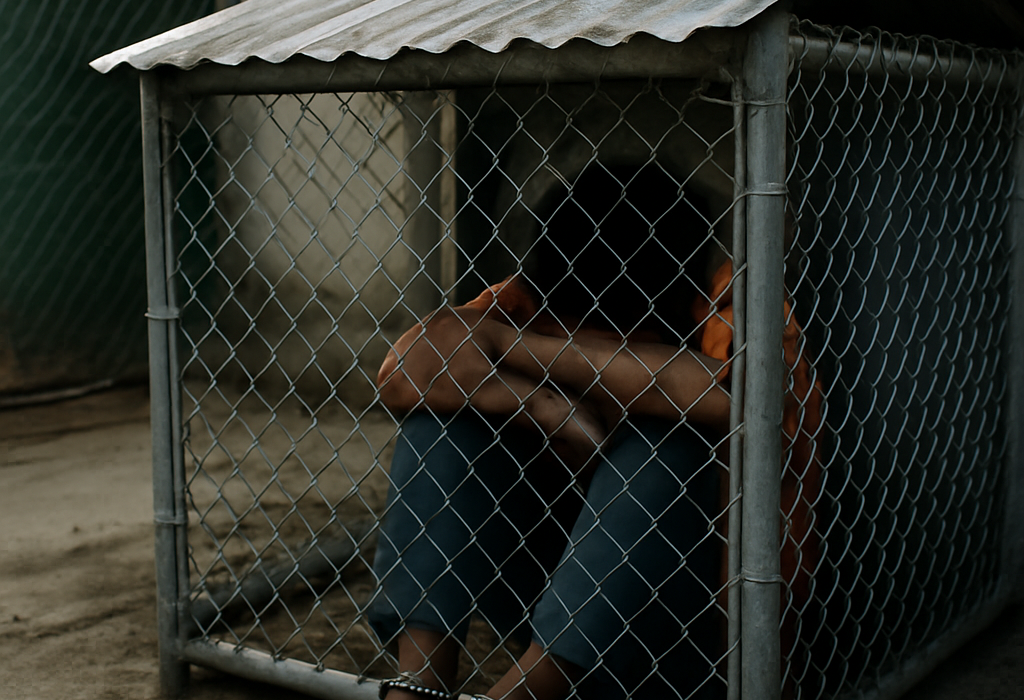
A newly published Amnesty International report alleges severe and systemic mistreatment of migrants at Florida’s state-run Everglades detention facility—nicknamed “Alligator Alcatraz”—as well as at the privately operated Krome North immigration processing center in Miami. The findings, based on interviews with detainees, advocacy groups, and an onsite visit to Krome, describe conditions that Amnesty says amount to cruel, inhuman, and degrading treatment, and in some cases may rise to torture.
One of the most disturbing allegations centers on a 2-foot-high outdoor metal cage, known to detainees as “the box,” where individuals were reportedly shackled, denied water, and left for hours or even up to a full day in extreme South Florida heat and humidity. According to testimony collected by Amnesty, detainees were placed in the box for trivial or nonexistent infractions, including attempting to call for medical help on someone else’s behalf.
The Everglades facility is operated by the Florida Department of Emergency Management (DEM), unique among U.S. immigration detention sites because it is state-run rather than federally managed. The camp opened in July following a widely publicized visit by President Trump and quickly gained a reputation for harsh conditions. A federal judge ordered it closed in August after lawsuits and public outcry, but operations resumed months later when two Trump-appointed appellate judges blocked the closure.
Florida officials categorically denied Amnesty’s allegations. Ron DeSantis’s press secretary called the report “politically motivated,” asserting the claims were fabricated and endangered staff.
However, Amnesty’s findings extend beyond the Everglades camp. At the federally contracted Krome North Service Center—operated by Akima Global Services LLC under a $685 million ICE contract—Amnesty documented overcrowding, prolonged solitary confinement, medical neglect, delays in intake processing, inadequate sanitation, and reports of violence by guards. Human Rights Watch issued a separate report earlier this year describing detainees at Krome being forced to kneel with their hands cuffed behind them while eating from plates on the floor “like dogs.”
Across both facilities, Amnesty reported persistent issues: overflowing toilets, insects, stagnant water, constant bright lights, spoiled or insufficient food, and restrictive shackling policies requiring detainees to be restrained whenever they were outside their cells. Medical care was described as inconsistent or denied altogether, contributing to risk of serious illness or psychological harm.
One of the report’s most serious concerns is that “Alligator Alcatraz” appears to operate outside standard federal oversight systems, including the tracking and registration tools used by ICE. Amnesty argues that this creates conditions amounting to incommunicado detention—where detainees may be transferred repeatedly with no reliable way for attorneys or family members to locate them—raising concerns of enforced disappearance, a violation under international human rights law.
The political context around the facility adds further complexity. The Everglades camp reopened despite the judicial order to close after FEMA reimbursed Florida $608 million for migrant transport and detention operations. The facility’s rapid expansion, controversial operating structure, and limited transparency have led civil rights groups to press for federal intervention.
Amnesty concludes its report with recommendations calling for the closure of Alligator Alcatraz, an end to Florida’s cooperation agreements with federal immigration authorities, and a broader transformation of U.S. immigration detention practices. The organization criticizes what it calls the federal government’s ongoing “criminalization of migration,” urging the Trump administration to halt mass detention policies.
Mary Kapron, one of Amnesty’s researchers, summarized the findings starkly: the conditions amount to cruelty, and officials at both the state and federal level must act immediately to address what the group characterizes as a human rights crisis.
Pros
(From a neutral analytical perspective, identifying possible arguments used by officials or agencies—not moral endorsements.)
- State officials deny wrongdoing, arguing that allegations are unverified and harmful to facility staff.
- Supporters of state-run detention models may argue that Florida’s approach provides flexibility and responsiveness not seen in federal facilities.
- Federal oversight debates may lead to clearer frameworks for state–federal cooperation in immigration detention.
Cons
- Human rights violations: Allegations include conditions that may constitute torture, incommunicado detention, and enforced disappearance.
- Lack of oversight: Operating outside ICE’s tracking systems increases risk of abuse and lack of accountability.
- Medical neglect and unsanitary conditions pose serious health risks.
- Overcrowding and abusive disciplinary practices undermine due process and legal representation.
- Political tensions may overshadow urgent humanitarian concerns.
Future Projections
Short-Term:
- Increased federal scrutiny of both facilities, potentially including DOJ or DHS investigations.
- Court challenges may escalate, especially regarding tracking, medical care, and solitary confinement practices.
- Krome and Alligator Alcatraz could face temporary or partial suspensions pending review.
Medium-Term:
- Pressure from human rights organizations may force ICE and the Trump administration to revise detention protocols.
- Congressional committees may hold hearings on state-run detention models.
- Lawsuits from detainees and civil rights groups may expand, possibly resulting in damages or injunctions.
Long-Term:
- This case may influence national policy debates on whether immigration detention should be reduced or abolished.
- Increased transparency requirements could be legislated for both federal and state detention sites.
- International bodies may scrutinize U.S. compliance with anti-torture conventions and human rights treaties.
References & Further Reading
The Guardian – Amnesty report alleges abuse at Florida immigration jail
https://www.theguardian.com/us-news/
Human Rights Watch – Treatment of detainees at Krome Processing Center
https://www.hrw.org/
Associated Press – Legal battles and conditions inside U.S. immigration detention
https://apnews.com/
Reuters – Federal court rulings on immigration facilities and state-run detention
https://www.reuters.com/world/us/
NPR – Coverage of migrant detention practices and federal oversight
https://www.npr.org/
Miami Herald – Reporting on Florida’s emergency management role in immigration detention
https://www.miamiherald.com/
ICE – Detention standards and facility oversight documentation
https://www.ice.gov/detention-management