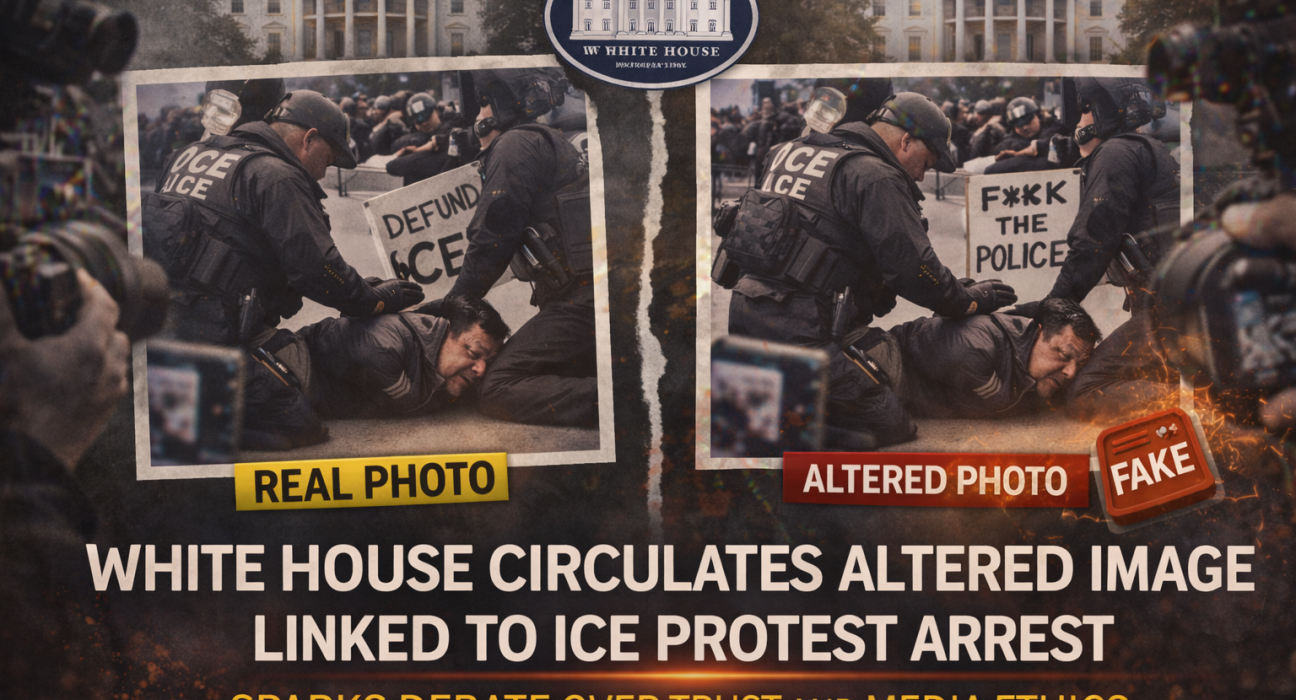
Reporting by The Guardian that the White House circulated an altered image related to the arrest of protesters during a demonstration against Immigration and Customs Enforcement (ICE) has sparked a wider debate about government narrative control, evidentiary standards, and the future of media credibility. While image manipulation is not new in politics, the incident raises renewed concerns because it intersects directly with law enforcement, protest rights, and public trust in official communications.
What Happened
According to The Guardian, the White House distributed or promoted an image connected to an arrest made during an ICE-related protest outside the White House that was later shown to be digitally altered. The alteration reportedly changed contextual elements of the image in a way that critics argue misrepresented the circumstances of the arrest.
While the White House did not deny that the image had been modified, officials framed its use as illustrative or contextual rather than evidentiary. Nonetheless, journalists and media watchdogs emphasized that the image was presented in a way that implied authenticity, particularly in a law-and-order context involving protest activity.
Why the White House Would Do This
Analysts and former communications officials point to several overlapping motivations that help explain the decision:
1. Narrative Control
Modern administrations operate in a fragmented media environment where images often shape public opinion more quickly than detailed explanations. Altering an image can be a way to simplify or sharpen a narrative, especially around politically charged topics like immigration enforcement and protest activity.
2. Political Signaling
ICE enforcement and protests against it have become symbolic flashpoints. Presenting a visual that reinforces themes of disorder, threat, or law enforcement legitimacy can function as political messaging aimed at supporters rather than neutral documentation.
3. Speed Over Precision
In the era of real-time social media, government communications increasingly prioritize speed and virality. That environment reduces internal friction that once slowed the release of questionable visuals, increasing the risk of ethical shortcuts.
4. Assumption of Audience Skepticism
Ironically, some officials operate under the belief that “everyone knows images are edited,” and therefore the ethical line is less rigid. Media scholars argue this assumption accelerates a dangerous normalization of manipulated evidence.
Legal Implications
From a legal standpoint, the issue hinges on how the image is used, not merely whether it was altered.
- If used as evidence in a legal proceeding, an altered image could raise serious due process concerns.
- If used as political communication, it may not violate the law but still undermines norms that separate state power from propaganda.
Legal experts note that while there is no broad federal statute prohibiting government image manipulation for messaging, such actions could become relevant in:
- Civil rights litigation
- Claims of misleading the public
- Oversight or ethics inquiries
The key risk is precedent: once image alteration is normalized in official communications tied to arrests or protests, courts may face increasing difficulty distinguishing factual records from curated narratives.
What This Means for the Media
The incident highlights a growing crisis for journalism and storytelling:
Erosion of Visual Trust
Images have traditionally been treated as a high bar of proof. As official sources distribute altered visuals, even authentic footage becomes suspect, accelerating public cynicism.
Burden Shift to Journalists
News organizations must now treat even government-released imagery as potentially unreliable, increasing verification costs and slowing reporting — or risking the spread of misinformation.
Weaponization of “Fake” Claims
Once manipulation is acknowledged, bad actors can dismiss real evidence by claiming it is altered, even when it is not — a phenomenon often called the liar’s dividend.
Implications for the Future of Law
If this practice expands, legal scholars warn of several consequences:
- Challenges to evidentiary standards, especially in protest-related cases
- Greater reliance on raw, body-cam or third-party footage
- Increased litigation over authenticity
- Pressure to mandate provenance tools, such as cryptographic verification of official media
Courts may eventually require clearer chains of custody for images, even those released by government entities.
Implications for Public Storytelling and Democracy
At a societal level, the controversy reflects a deeper tension: who gets to define reality.
When the state alters images connected to arrests or dissent:
- Protesters may fear misrepresentation
- The public may question whether enforcement actions are being justified after the fact
- Democratic accountability weakens as narratives replace records
This is particularly sensitive in the context of immigration enforcement, where affected communities already express fear of surveillance, mischaracterization, and lack of recourse.
Pros and Cons
Arguments Defending the White House Action:
- Communications are not court exhibits
- Images often require contextual framing
- The alteration did not change the underlying fact of an arrest
Arguments Criticizing the Action:
- Blurs line between information and propaganda
- Undermines trust in official records
- Sets a precedent for selective visual truth
- Weakens protections for protest and dissent
Future Outlook
Short Term:
Expect increased scrutiny of government-released visuals and more aggressive fact-checking by newsrooms.
Medium Term:
Congressional or inspector general oversight may expand into how federal agencies use AI and image manipulation tools.
Long Term:
Society may move toward authenticated media systems, where official images must carry verifiable metadata proving they are unaltered — fundamentally changing how public truth is established.
Conclusion
The White House’s use of an altered image tied to an ICE protest arrest is not just a communications misstep; it is a signal of how fragile the boundary between storytelling and state power has become. As technology makes manipulation easier, the responsibility to preserve factual integrity grows heavier — not lighter. How institutions respond now will shape the future credibility of law, media, and democratic accountability.
References & Further Reading
The Guardian — White House circulated altered image linked to ICE protest arrest
https://www.theguardian.com/us-news/2026/jan/22/white-house-ice-protest-arrest-altered-image
Columbia Journalism Review — Visual manipulation and public trust
https://www.cjr.org
Electronic Frontier Foundation — Government transparency and digital integrity
https://www.eff.org
Brennan Center for Justice — Protest rights and government accountability
https://www.brennancenter.org