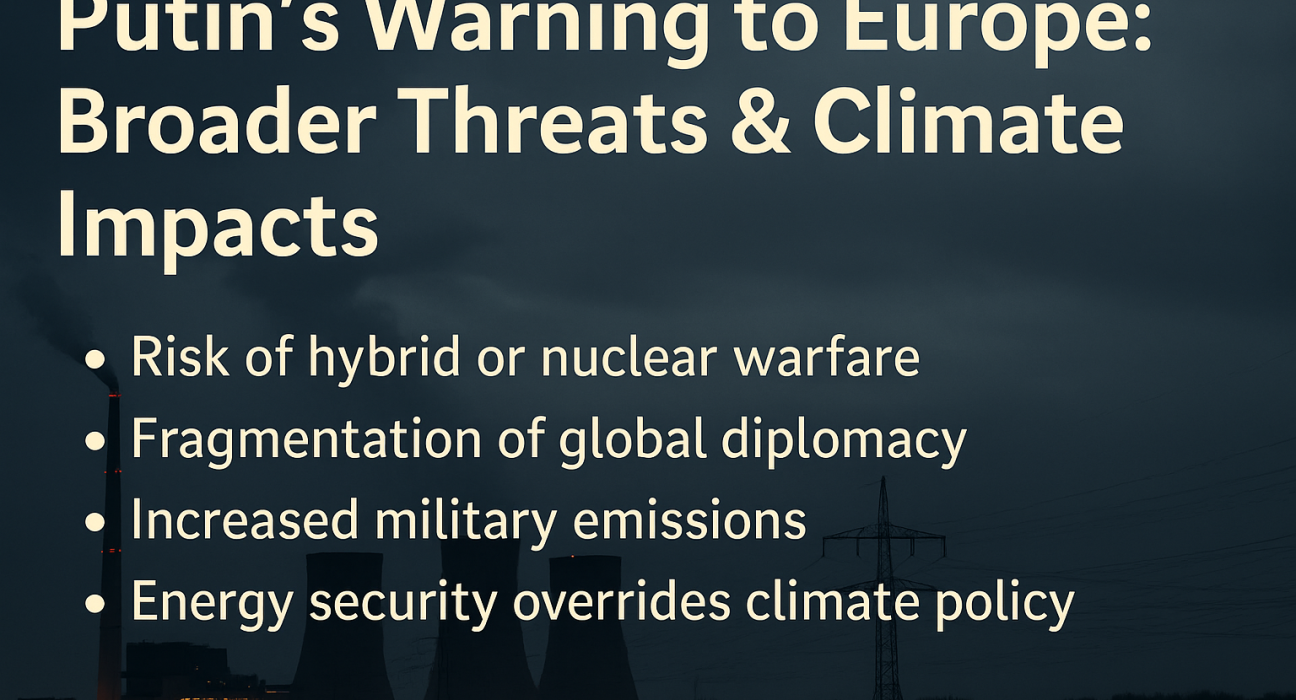
Russian President Vladimir Putin’s recent statement — that a war initiated by Europe would end so decisively that “there would be no one left to negotiate with” — represents one of the starkest warnings issued since the start of the Ukraine conflict. While intended as a deterrent, the message signals deepening geopolitical instability and raises concerns far beyond military confrontation. These concerns include global security, resource vulnerability, systemic economic risks, and even climate-related repercussions.
This analysis explores additional threats, structural global factors, and what such rhetoric could mean for the climate and the planet as a whole.
1. Rising Threats Beyond Direct Military Confrontation
A. Escalation Toward Nuclear Posturing
Putin’s language aligns with previous veiled nuclear references by Russian officials. Even without explicit mention, the implication that Europe could be left without negotiating partners is widely interpreted as invoking Russia’s superior tactical nuclear capabilities.
Risk factors:
- NATO nuclear response protocols becoming activated.
- Increased deployments of nuclear-capable systems across Europe.
- Heightened alert levels, raising accident or miscalculation risks.
B. Hybrid Warfare Escalation
If Europe and Russia drift closer to confrontation, hybrid attacks become more likely:
- Cyberattacks on European power grids, banks, ports, and communication networks
- Disinformation campaigns designed to fracture European unity
- Energy blackmail, including covert disruptions to pipelines or LNG terminals
- Attacks on undersea cables that handle both Internet and energy flows
These measures can destabilize nations without firing a shot.
C. Expansion of Russia’s Influence in the Global South
If Europe becomes more adversarial, Russia may deepen alliances with:
- China
- Iran
- North Korea
- BRICS nations
This reshapes global power balances and complicates multilateral climate, trade, and security efforts.
2. Key Global Factors Interacting With the Conflict
A. Fragmenting International Institutions
Putin argues that Europe has “locked itself out of peace talks.” At the same time:
- NATO is expanding.
- The UN Security Council is deadlocked.
- EU foreign policy consensus is fractured between hawks and states seeking “strategic autonomy.”
This fragmentation reduces the world’s ability to address global issues cooperatively — including climate change.
B. Global Economic Weakening
A prolonged European–Russian standoff increases:
- Energy price volatility
- Food insecurity (Ukraine and Russia are major agricultural exporters)
- Inflation across major economies
- Higher military spending at the expense of climate and public-welfare budgets
Europe is already preparing for:
- Reduced gas flows
- Supply chain instability
- A potential wave of climate and war refugees
C. Rising Authoritarian–Democratic Polarization
Putin’s framing positions Europe as aggressors and Russia as surgically defensive. This feeds into a broader ideological conflict between:
- Authoritarian states emphasizing “security first,”
- Democratic states prioritizing “rules-based order.”
This rivalry diverts attention and resources away from global climate goals.
3. Implications for the Global Climate and Environmental Security
Tensions of this magnitude affect the climate crisis in multiple direct and indirect ways.
A. Climate Diplomacy Breakdown
Climate agreements — including COP negotiations — require cooperation between Russia, Europe, China, and the US.
War or heightened hostility makes:
- joint emissions reduction targets harder to negotiate,
- shared climate research harder to coordinate,
- trust between major emitters harder to restore.
This could widen the gap to the 1.5°C or 2°C global warming targets.
B. Increased Military Emissions
The military sector is one of the world’s largest unreported emitters:
- Fighter jets burn thousands of gallons per hour.
- Armored vehicles and naval fleets rely heavily on fossil fuels.
- Large-scale troop mobilizations produce enormous emissions.
Scaled-up activity in Europe, Russia, or the Black Sea region dramatically increases global CO₂ output.
C. Energy Security Overrides Climate Policy
If Europe fears further Russian aggression:
- Governments may delay retiring coal plants,
- Increase LNG imports,
- Boost domestic oil and gas extraction,
- Invest more in nuclear and less in renewables short-term.
Even green-leaning countries might prioritize energy independence over climate commitments.
D. Critical Mineral Bottlenecks
Modern militaries require:
- lithium, cobalt, and nickel for drones and electronics,
- rare earth elements for radar and missile systems.
Competition over these materials slows renewable energy expansion, which requires the same minerals for:
- EV batteries,
- wind turbines,
- solar panels.
A military rush for resources drives up prices globally, limiting green energy adoption.
E. Ecosystem Damage From Conflict Zones
War zones suffer:
- soil contamination,
- damaged forests,
- polluted rivers,
- toxic military waste,
- unexploded ordnance that hinders land restoration.
Ukraine alone has experienced trillions in environmental and agricultural damage since 2022 — a global climate setback.
4. What Putin’s Warning Ultimately Signals for the Planet
A. A Higher-Risk World
The rhetoric suggests a geopolitical environment where:
- diplomacy is eroding,
- security dilemmas are intensifying,
- misunderstandings become more dangerous.
High-risk geopolitical climates reduce global cooperation at the exact moment the planet requires unprecedented unity to address climate change.
B. Potential for Cascading Global Instability
If tensions with Russia escalate further, the world may experience:
- higher food prices,
- climate migration surges,
- disrupted supply chains,
- weakened climate agreements,
- more fossil-fuel dependency,
- reduced funding for environmental programs.
C. The Threat of “Crisis Fatigue”
With nations consumed by war, elections, and economic distress, global climate urgency may lose momentum — a catastrophic outcome as the world approaches irreversible tipping points.
Conclusion
Putin’s warning is more than a geopolitical provocation. It reflects a world drifting into deeper instability with ripple effects across global security, economic systems, and the climate crisis. The intersection of war, energy dependence, superpower rivalry, and environmental strain creates a fragile global landscape where even rhetoric can reshape international priorities.
Sustained conflict or even heightened tension between Europe and Russia could derail climate progress, destabilize food and energy systems, and weaken the cooperative frameworks essential for addressing the planet’s most existential threat: global warming.