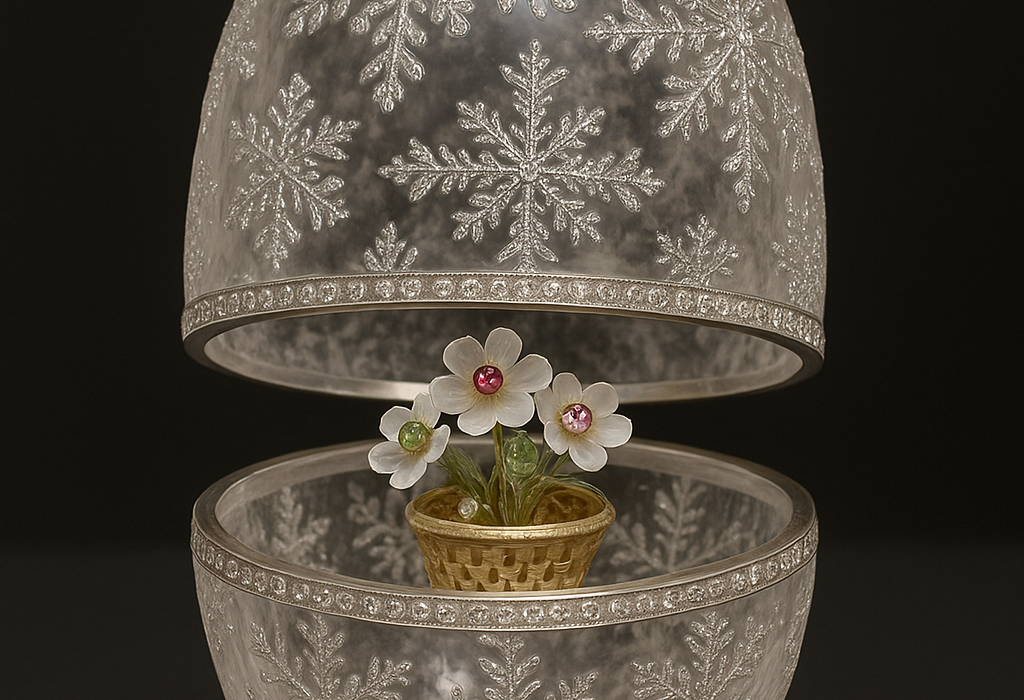
A glittering relic of Russia’s imperial past is heading to the auction block, and experts say it could shatter every previous record for Fabergé artistry. Christie’s has announced the sale of the famed Winter Egg, an exquisitely carved crystal-and-diamond imperial treasure valued at more than £20 million (NZ$46 million).
The Winter Egg, crafted in 1913, is one of the most coveted objects created by Peter Carl Fabergé, the legendary jeweler to Russia’s czars. Only a handful of the elaborately designed imperial eggs remain outside museum collections, and Christie’s confirms that just seven are still held in private hands.
Displayed this week at the auction house’s London headquarters, the 10-centimetre-tall egg appears almost ethereal: a piece of frozen time, sculpted from clear rock crystal and adorned with a delicate platinum snowflake motif inlaid with 4,500 tiny diamonds. When opened, it reveals its “surprise” — a miniature basket filled with jeweled quartz flowers, symbolizing the coming of spring.
“It’s the Fabergé equivalent of the Mona Lisa,” said Margo Oganesian, head of Christie’s Russian Art department. “Exceptionally rare, magnificently crafted, and historically irreplaceable. In a way, it’s like the world’s most luxurious Kinder Surprise.”
A Jewel Born From Imperial Tradition
The Winter Egg is one of only two eggs designed by Alma Pihl, a pioneering female artist working within Fabergé’s workshop. Commissioned by Czar Nicholas II as an Easter gift for his mother, Dowager Empress Maria Feodorovna, it was created at a time when the Romanov dynasty still appeared unshakable.
Between 1885 and 1917, the imperial family received more than 50 Fabergé eggs, each containing a hidden surprise. Czar Alexander III began the tradition, while Nicholas II expanded it by gifting one egg annually to both his wife and his mother.
Just a few years after the Winter Egg’s creation, the Romanovs fell to revolution. Nicholas II, his wife, and their children were executed in 1918, and many imperial treasures were lost, scattered, or quietly sold by the struggling Soviet government.
From Mystery to Market
Like many royal artifacts, the Winter Egg has had a storied journey. In the 1920s, a London dealer purchased it for just £450, a fraction of its historic value, as Soviet authorities sold off precious artworks to raise cash. For decades it vanished from public knowledge, resurfacing only when Christie’s auctioned it in 1994 for more than 7 million Swiss francs, then roughly £5.6 million (NZ$15 million). It sold again in 2002 for £9.6 million (NZ$22.2 million).
Now, more than a century after its creation, the Winter Egg is poised to exceed its own storied past. Christie’s estimates it will eclipse the current auction record of £18.5 million, set in 2007 for a Fabergé egg made for the Rothschild banking family.
A Vanishing Legacy
Of the original imperial masterpieces, only 43 Fabergé eggs are known to survive, most safeguarded in museum collections or private foundations. Their rarity makes each auction appearance a global event — a moment when history, craftsmanship, and immense wealth converge.
As Christie’s prepares for Tuesday’s sale, collectors and museums worldwide are watching closely. Whether the Winter Egg lands in another private collection or returns to public view, its value lies not only in diamonds and artistry but in its connection to a vanished empire and a tradition that ended with revolution.
For now, it sits under bright display lights in London — glittering, delicate, and waiting to make history once again.