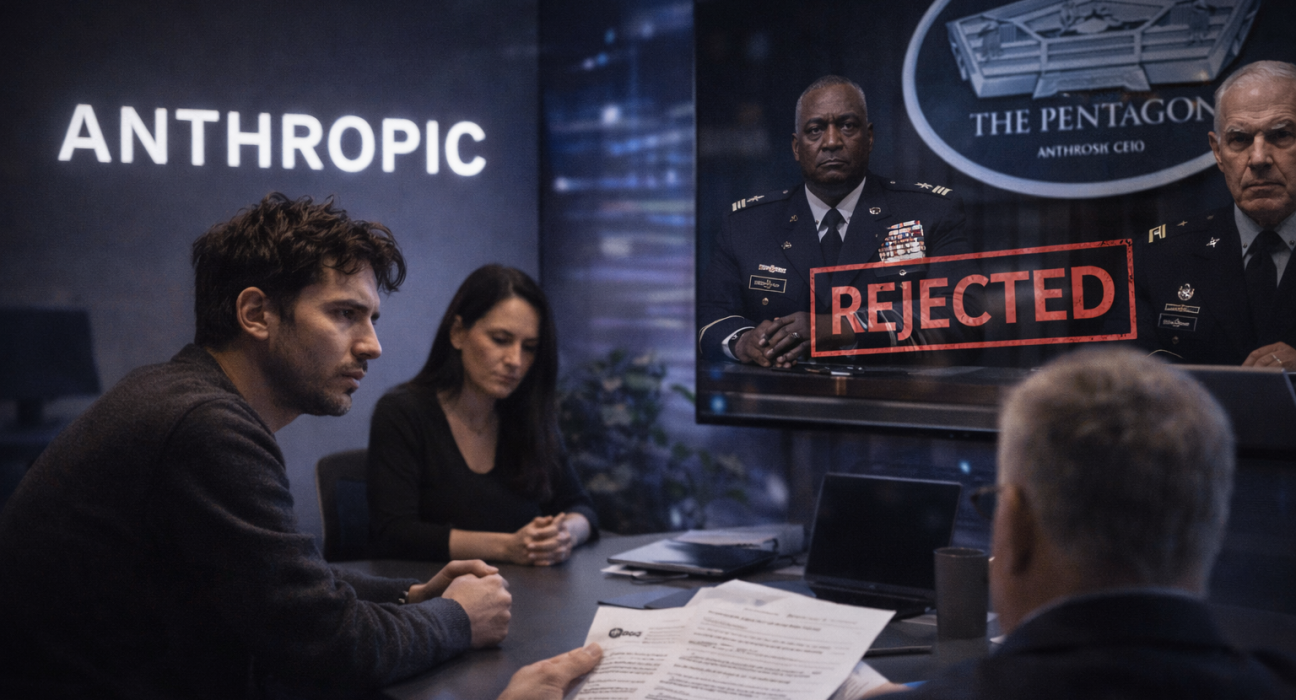
Anthropic — a U.S. artificial intelligence developer known for safety-focused large language models — has publicly rejected a recent offer from the U.S. Department of Defense (DoD) to revise contract terms that would allow Pentagon use of its Claude AI system for “all lawful purposes,” including applications the company views as ethically problematic. The refusal deepens an ongoing dispute between the AI company and the Pentagon, with significant implications for AI governance, national security, private-sector ethics, and military technology policy.
According to reporting from CNN and Reuters, Anthropic CEO Dario Amodei stated that recent Pentagon contract language — which the defense department framed as a compromise — did not sufficiently protect against the use of Claude in ways the company sees as unsafe, specifically mass domestic surveillance and fully autonomous weapons that could operate without human involvement. Amodei said Anthropic “cannot in good conscience accede to their request.”
Backstory: AI, Ethics, and Military Use
Anthropic’s Claude is one of the most advanced large language models and has been used by U.S. intelligence and defense agencies under classified contracts since 2024. It is distinctive among AI labs for having achieved a level of adoption within classified programs, but its usage policies explicitly prohibit direct deployment for surveillance of U.S. citizens and lethal systems that operate without human oversight.
In early 2026, tensions escalated as the Pentagon pushed back against these restrictions. Defense Secretary Pete Hegseth and senior Pentagon officials demanded that Anthropic remove certain safety guardrails in its DoD contract, arguing the military needs the ability to use AI systems for any lawful defense purpose. Officials warned that if Anthropic did not comply by a deadline, the contract could be canceled, and the company could be designated a “supply chain risk” — typically a label applied to foreign adversaries — potentially jeopardizing Anthropic’s entire defense business.
What Anthropic Rejected
The latest Pentagon offer reportedly attempted to adjust contract language to address some concerns, but Anthropic leaders said it still contained provisions that could be interpreted as allowing or enabling the company’s AI to be used for mass surveillance or lethal autonomous systems. Amodei and Anthropic reiterated that these uses are contrary to the company’s ethical commitments and believe current AI systems are not reliable enough for life-or-death autonomous decisions.
Anthropic’s public statement emphasized its continued willingness to work with the military but stressed that concrete legal assurances were necessary to protect against uses it viewed as harmful. The company likewise clarified that it is already providing AI technology across some DoD systems under existing agreements, demonstrating a history of cooperation even amid the dispute.
Pentagon’s Position and Response
Pentagon officials, including spokesman Sean Parnell, have repeatedly stated that the DoD does not seek to use AI for unauthorized mass surveillance or to deploy fully autonomous weapon systems without human control. However, they assert that the department needs broad operational authority to apply technology as needed under lawful defense missions. That phrasing has been a core point of contention.
Senior Department of Defense leadership, including Undersecretary for Research and Engineering Emil Michael, has publicly criticized Amodei, accusing him of placing personal judgment above national security needs and claiming that no single tech company should “dictate the terms” of military operational decisions.
Broader Reactions and Industry Context
The dispute has triggered reactions beyond just Anthropic and the Pentagon. Multiple sources report that tech workers at Anthropic’s competitors — including OpenAI and Google — publicly expressed support for Anthropic’s ethical stance, even while they maintain their own defense contracts. Opinion pieces and former military analysts have also weighed in, noting parallels between this standoff and past tech-military tensions such as Google’s Project Maven in 2018.
A bipartisan mix of lawmakers has criticized the Pentagon’s handling of the negotiations. Some see the department’s approach as heavy-handed and lacking transparency; others express concern that strict corporate safety policies could impede national defense readiness.
Legal and Strategic Implications
If Anthropic continues to resist Pentagon demands, the company risks losing its $200 million contract and potentially being excluded from future defense supply chains — a designation the Pentagon has said it may pursue. Some analysts also raise the possibility of the Pentagon invoking the Defense Production Act to compel compliance or assert broader usage authority.
For the Pentagon, ensuring access to state-of-the-art AI is seen as vital in defense planning, including responses to hostile drone swarms, cyber threats, and autonomous battlefield systems. For Anthropic and safety advocates, unrestrained use of AI in lethal systems or domestic data aggregation carries societal and ethical risks that could outlast any single contract negotiation.
Pros
• Ethical Boundary Setting: Anthropic’s stance reinforces calls for explicit safeguards against controversial uses of AI, aligning with broader societal demands for responsible AI deployment.
• Industry Leadership: By publicly articulating principles, Anthropic contributes to the ongoing discourse about aligning AI capabilities with democratic and ethical norms.
• Maintaining Guardrails: The company’s refusal may prevent premature deployment of technology that could exceed current reliability and safety limits in sensitive applications.
Cons
• Contract and Supply Chain Risk: The company could lose significant Pentagon business and be labeled a supply chain risk, undermining revenue and future defense collaborations.
• National Security Concerns: Pentagon leaders argue that limiting AI usage could impair defense capabilities or flexibility in responding to evolving threats.
• Internal Tensions: The public feud could strain trust between government agencies and tech firms, complicating future partnerships.
Future Projections
- Continued Negotiations and Public Debate: Negotiations may continue behind the scenes, with both sides potentially involving legislative or executive branch oversight.
- Policy Influence: Outcomes could shape future U.S. AI governance norms, particularly regarding military applications.
- Industry Standards: Other AI developers may revisit their safety policies in light of this high-profile confrontation.
- Regulatory Scrutiny: Lawmakers may pursue clearer statutory frameworks for AI use in defense to avoid ad-hoc disputes.
- Technology Adoption Paths: Defense agencies might seek alternative providers if Anthropic remains unwilling to meet terms.
References
- CNN – Anthropic rejects latest Pentagon offer: ‘We cannot in good conscience accede to their request’
https://www.cnn.com/2026/02/26/tech/anthropic-rejects-pentagon-offer - Reuters – Anthropic cannot accede to Pentagon’s request in AI safeguards dispute, CEO says
https://www.reuters.com/sustainability/society-equity/anthropic-rejects-pentagons-requests-ai-safeguards-dispute-ceo-says-2026-02-26/ - AP News – Anthropic CEO says it ‘cannot in good conscience accede’ to Pentagon’s demands
https://apnews.com/article/anthropic-ai-pentagon-hegseth-dario-amodei-9b28dda41bdb52b6a378fa9fc80b8fda - Wikipedia – Anthropic background and military contract context
https://en.wikipedia.org/wiki/Anthropic - Associated additional reports on negotiation dynamics and industry reactions (Bloomberg, Reuters)