1. What’s actually happening right now
From today’s reporting:
- Trump declared on Truth Social that “the airspace above and surrounding Venezuela” should be considered closed, aimed at airlines, pilots, “drug dealers, and human traffickers.” Venezuela called this a “colonialist threat” and illegal under international law. Reuters+1
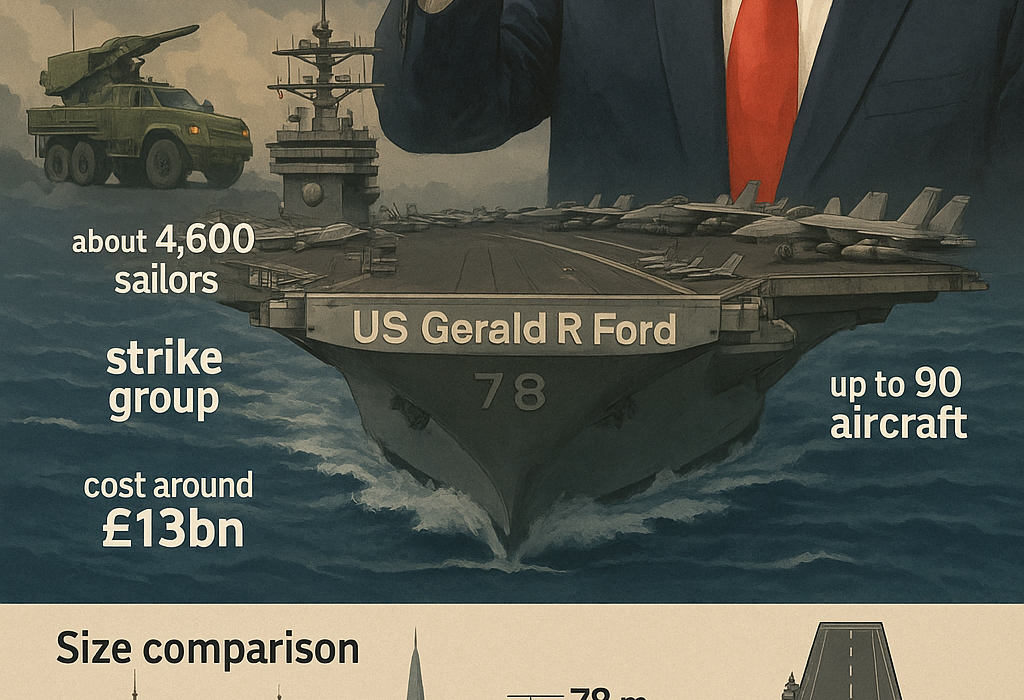
- The U.S. has deployed the USS Gerald R. Ford carrier strike group and other warships (around 11 ships, ~15,000 troops) to the Caribbean under Operation Southern Spear, officially framed as an anti-narcotics campaign targeting Venezuelan drug routes. New York Post+1
- U.S. forces have carried out dozens of strikes on boats they say are drug-smuggling vessels; a Washington Post investigation and Venezuelan officials allege unlawful killings and say this is really about regime change and oil. Reuters+1
- Washington has designated “Cartel de los Soles” as a Foreign Terrorist Organization, alleging it’s a narco-network linked to Maduro and top military brass. Venezuela calls the cartel “non-existent” and says the FTO label is a pretext for intervention. Reuters
So, officially: it’s a counter-drug / counter-terror operation. But the scale (carrier group, thousands of troops, airspace rhetoric) looks, to many analysts, more like coercive pressure on a government than a typical drug-interdiction campaign.
2. Official justification: Drugs, terrorism, and “protecting Americans”
The Trump administration’s stated line is roughly:
- Maduro and senior officials are at the core of a narco-state shipping cocaine and other drugs that kill Americans. Reuters+1
- Cartel de los Soles and gangs like Tren de Aragua are labeled as terrorist organizations, which gives U.S. agencies wider legal authority to target them globally. Reuters
- The naval deployment and airspace warnings are pitched as necessary to stop trafficking routes by sea and air. New York Post+1
Even a lot of critics accept that some drugs move via Venezuela. But when you line up the hardware with the problem, many specialists say “drugs alone” doesn’t fit:
- The Economist and others point out that the deadliest drug in the U.S., fentanyl, comes overwhelmingly from Mexico/Asia and crosses the land border, not by boat from Venezuela. Wikipedia
- High-end destroyers and a supercarrier are overkill tools for chasing go-fast boats, and interdiction can be done with cheaper coast-guard-style assets. Wikipedia
That mismatch is why people start talking about ulterior motives.
3. Oil: why it’s always part of the conversation
Venezuela’s oil reality
- Venezuela has the world’s largest proven oil reserves – ~303 billion barrels as of 2023. Council on Foreign Relations+2Al Jazeera+2
- Because of corruption, mismanagement, and sanctions, output has collapsed. Oil exports were only about $4 billion in 2023, tiny for a country with that much crude. Al Jazeera+1
- U.S. sanctions were re-imposed and tightened in 2025; a Congressional brief notes a 25% tariff threat on countries importing Venezuelan oil to pressure Maduro. Congress.gov+1
How does that tie to U.S. motives?
From mainstream think tanks and energy analysts, a few themes show up:
- Leverage over future production
- If there is a post-Maduro transition, whoever helps midwife that outcome could gain influence over who gets upstream contracts, service deals, and offtake agreements.
- Analyses from Chatham House, Bloomberg, and others note that U.S. policy oscillates between punishment (sanctions) and selective opening (Chevron licenses) in ways that keep Washington heavily involved in Venezuela’s future oil path. Chatham House+2Bloomberg+2
- Denying rivals a strategic energy asset
- Russia, China, and Iran have all used Venezuelan oil and gas projects to gain influence and evade sanctions. Maritime Strategy Center+2FDD Action+2
- Several policy papers explicitly warn that Venezuela has become a “base of operations for America’s adversaries” in the Caribbean, with Russian arms, Chinese finance, and Iranian drones in the mix. National Security Journal+2Diplomat Magazine+2
- From that angle, squeezing Caracas is not only about the barrels themselves, but about pushing out rival influence near U.S. waters.
- Oil bargaining chips in negotiations
- Reporting suggests Maduro’s circle has floated giving the U.S. or U.S. companies very favorable access to the oil sector in exchange for security guarantees or sanctions relief. The Guardian+1
- The combination of military pressure + sanctions can be read as a way to force those terms, or at least to shape any transition so it’s friendlier to U.S. economic interests.
So your “rumors about oil” aren’t just conspiracy stuff people made up on Reddit; serious analysts routinely flag oil and energy-geopolitics as a central background factor, even if it’s not the only one.
4. Regime change logic: getting rid of Maduro
There’s a long paper trail showing that many in Washington want Maduro out, not simply “better counter-drug co-operation”:
- An International Crisis Group report warns of a “slide toward regime change” and notes that U.S. forces are already sinking boats and massing assets in ways that could easily escalate. Crisis Group+1
- A Foreign Affairs essay literally titled “How to Topple Maduro – And Why Regime Change Is the Only Way Forward in Venezuela” argues explicitly for using U.S. leverage to unseat him. Foreign Affairs
- An op-ed in The Guardian and multiple U.S. think-tank pieces openly discuss “regime change” as Trump’s real political goal, with drugs and terrorism as the framing. The Guardian+1
Put simply: a lot of mainstream foreign-policy voices aren’t even hiding that they see the operation as a pressure campaign to collapse or coerce Maduro’s government, not just drug interdiction.
5. Great-power competition: Russia, China, Iran and the “backyard” problem
Another widely cited “hidden” motive is big-power competition:
- For two decades Venezuela has presented itself as part of an anti-U.S. axis with Russia, China, Iran, and Cuba. Maritime Strategy Center+2Diplomat Magazine+2
- U.S. and European analysts worry about:
- Russian arms and air-defense systems in the country
- Chinese loans, infrastructure projects, and energy stakes
- Iranian drones, intelligence cooperation, and ties to regional networks National Security Journal+2FDD Action+2
- U.S. Army and policy journals explicitly frame Venezuela as a platform for rival powers in the Caribbean Basin, which is traditionally seen in Washington as a U.S. “sphere of influence.” Army University Press+2National Security Journal+2
From that lens, closing airspace and deploying a massive naval force sends three signals at once:
- To Maduro: your external lifelines won’t save you.
- To Russia/China/Iran: don’t even think about deploying serious hardware here.
- To regional neighbors: the U.S. still dominates security in the Caribbean.
6. Domestic U.S. politics and “optics”
A bunch of commentary also highlights internal U.S. political incentives:
- Trump constantly links Venezuela to immigration and crime, claiming its prisons have been “emptied” into the U.S., and casting the naval buildup as defending the homeland. Wikipedia+1
- “Tough on drugs / tough on terror / tough on socialism at our doorstep” plays well with parts of his base, especially heading toward elections.
- Some analysts argue this crisis provides a rally-around-the-flag opportunity, shifting attention from domestic issues and reinforcing Trump’s “strong leader” branding. China-US Focus+1
So even if there are genuine security concerns, the timing and messaging also serve very clear political purposes at home.
7. So what are the “ulterior motives” most supported by evidence?
Putting everything together, here’s a reality-based summary of the non-official motives that are credible and widely discussed:
- Regime-change pressure
- Strongly supported by policy papers, op-eds, and leaks describing explicit interest in Maduro’s ouster. Crisis Group+2Foreign Affairs+2
- Energy and oil leverage (not just “stealing oil,” but shaping the future of the sector)
- Venezuela’s huge reserves + U.S. sanctions + selective oil licenses create a framework where Washington has big incentive to control how and with whom Venezuela does business post-crisis. Bloomberg+3Council on Foreign Relations+3Al Jazeera+3
- Containing rival powers in the Western Hemisphere
- U.S. security documents and independent analysis repeatedly point to concern about Russian, Chinese, and Iranian activity in Venezuela; the buildup looks like a way to re-assert regional primacy. Congress.gov+3National Security Journal+3Diplomat Magazine+3
- Domestic political theater and narrative control
- The “closed airspace,” terrorism labels, and dramatic deployments resonate strongly with U.S. domestic narratives about border security and drugs, especially in an election context. Reuters+2Wikipedia+2
None of that disproves that there are real narcotics or organized-crime issues involving Venezuelan actors. But looking at the scale and character of the response, and what elites are openly writing, it’s reasonable to say:
Drugs are the public frame; regime change, oil leverage, and great-power competition look like core underlying drivers.