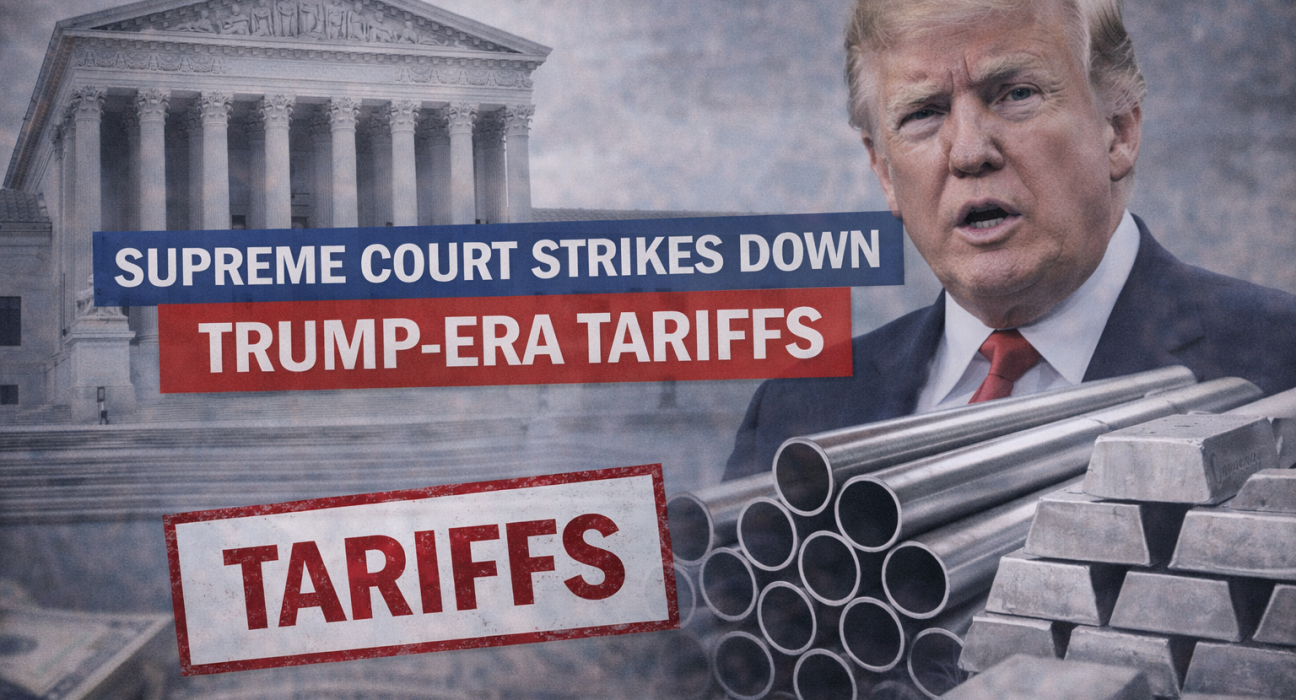
In a significant legal and economic decision, the U.S. Supreme Court ruled that a set of tariffs imposed during former President Donald Trump’s administration were unlawful. The ruling, reported by NBC News, delivers a major blow to a key pillar of Trump’s trade strategy and raises important questions about executive power, congressional authority, and the future of U.S. trade policy.
What Happened — The Core of the Ruling
The Supreme Court held that the tariffs — broadly applied to imported goods from numerous countries — were not properly authorized by Congress as required under U.S. trade law. Instead, the court said the executive branch overstepped its statutory authority by imposing broad tariffs without clear legislative backing.
This ruling affects tariffs covering billions of dollars worth of imported products — including aluminum, steel, and other industrial goods — and could require the government to refund certain tariff revenues collected since the measures were implemented.
The court’s decision underscores a constitutional principle: while the president has authority to act in national security and trade matters, Congress must provide clear statutory authority for sweeping fiscal actions like tariffs.
Why These Tariffs Were Controversial
The tariffs in question were originally justified on national security grounds, tied to a seldom-used provision of U.S. trade law (Section 232 of the Trade Expansion Act). The Trump administration argued that imported steel and aluminum threatened national security by weakening domestic industries.
Critics had long challenged this rationale by saying:
- The scope of the tariffs exceeded reasonable national security defense needs
- The economic impact on consumers and manufacturers was large
- Jobs in tariff-dependent industries were harmed
- The justification was a thin legal basis for expansive economic action
The Supreme Court’s rejection of this justification reinforces these concerns and sets firmer limits on how future presidents may use national security claims to impose tariffs.
Immediate Economic Impacts
1. Refunds and Trade Finance
If the U.S. government is required to refund some tariff revenue, this could involve hundreds of millions or even billions of dollars in payments back to importers — a significant fiscal impact.
This affects companies that relied on tariff relief in pricing goods for American consumers and businesses.
2. Consumer Prices and Supply Chains
Tariffs often raise costs for U.S. consumers and manufacturers who rely on imported inputs. With the court’s decision:
- Imported goods may become cheaper over time
- Manufacturers using imported components could see reduced production costs
- Consumers could benefit from lower retail prices
However, changes won’t be instantaneous, and renegotiation of trade contracts may be needed.
Political and Global Trade Implications
A Blow to Protectionist Messaging
For advocates of tariff-based protectionism, this decision undercuts a central policy tool. Tariffs were a hallmark of Trump’s approach to trade — used to pressure trading partners such as China, the European Union, Canada, and Mexico.
The ruling may influence future trade negotiations by:
- Weakening the U.S. negotiating stance in tariff leverage
- Forcing policymakers to rely more on diplomacy and traditional trade agreements
- Encouraging Congress to update trade law authority if tariffs are to be used again
Impact on International Relations
Foreign governments opposed the tariffs and retaliatory measures for years. The court’s decision might:
- Ease diplomatic tensions with trading partners
- Reduce retaliatory tariffs on U.S. agricultural and industrial exports
- Encourage renewed multilateral engagement
Yet partner confidence may remain shaken after years of trade uncertainty tied to tariff escalation.
Constitution and Separation of Powers
A major theme in the ruling is the balance of power between branches of government:
- The Constitution gives Congress the power to regulate commerce
- The president has authority over foreign relations and national security
The Supreme Court’s decision asserts that economic actions with fiscal impact — like sweeping tariffs — require clear legislative authorization, not broad executive interpretation.
This precedent may affect future disputes over executive power, including:
- National security actions
- Economic sanctions
- Regulatory authority in global trade
Pros and Cons of the Decision
Pros
✔ Strengthens Legislative Authority
The ruling reinforces that major fiscal and economic decisions must have clear congressional backing.
✔ Potential Consumer Benefits
Reduced tariff barriers may lower costs for goods that rely on imported inputs.
✔ Trade Normalization
Tariff rollback can ease international trade relations, especially with close allies.
Cons
✖ Short-Term Industry Disruption
Domestic producers previously protected by tariffs may face competitive pressure.
✖ Trade Negotiation Challenges
Without tariffs as leverage, policymakers may have fewer tools in trade talks.
✖ Fiscal Implications
Refunds and revenue losses could impact the federal budget.
What Happens Next
1. Administrative Response
The Biden administration may need to revise its trade policy approach in light of the ruling, potentially seeking:
- Congressional approval for new tariff authorities
- Alternative mechanisms within trade law
- Greater emphasis on negotiated trade agreements
2. Congressional Action
If lawmakers want tariffs as a tool, Congress may consider:
- Updating statutes to explicitly authorize national security tariffs
- Creating clearer frameworks for executive trade actions
- Strengthening oversight provisions
Long-Term Outlook
This Supreme Court decision will resonate beyond the immediate tariff issue:
- It reaffirms constitutional checks on executive action
- It may shift U.S. trade policy toward traditional mechanisms
- It signals to markets and global partners that U.S. trade policy is subject to judicial limits
- It alerts future administrations that broad economic measures require clear legislative consent
In a geopolitical context where economic power interplays with national security, trade instruments will remain central — but this ruling narrows the range of tools available without explicit congressional backing.
Conclusion
The Supreme Court’s decision to strike down the Trump-era tariffs represents a major moment in U.S. trade law. It underlines the constitutional balance between legislative authority and executive power, sets limits on tariff use, and could reshape how the U.S. engages with key global markets.
While some domestic industries may feel exposed in the short term, consumers and trading partners may benefit from lower barriers and reduced uncertainty. The ruling reinforces that economic policy — especially fiscal tools like tariffs — must be grounded in clear legal authorization.
References & Further Reading
NBC News — Supreme Court strikes down Trump’s tariffs in major blow to president
https://www.nbcnews.com/politics/supreme-court/supreme-court-strikes-trumps-tariffs-major-blow-president-rcna244827
Reuters — U.S. trade law and tariff authority overview
https://www.reuters.com/world/us/supreme-court-trump-tariffs-2026-02-14/
Brookings Institution — Trade policy and executive power
https://www.brookings.edu
Congressional Research Service — U.S. tariff law basics
https://www.everycrsreport.com
OECD — Global trade impacts of tariff policy
https://www.oecd.org/trade