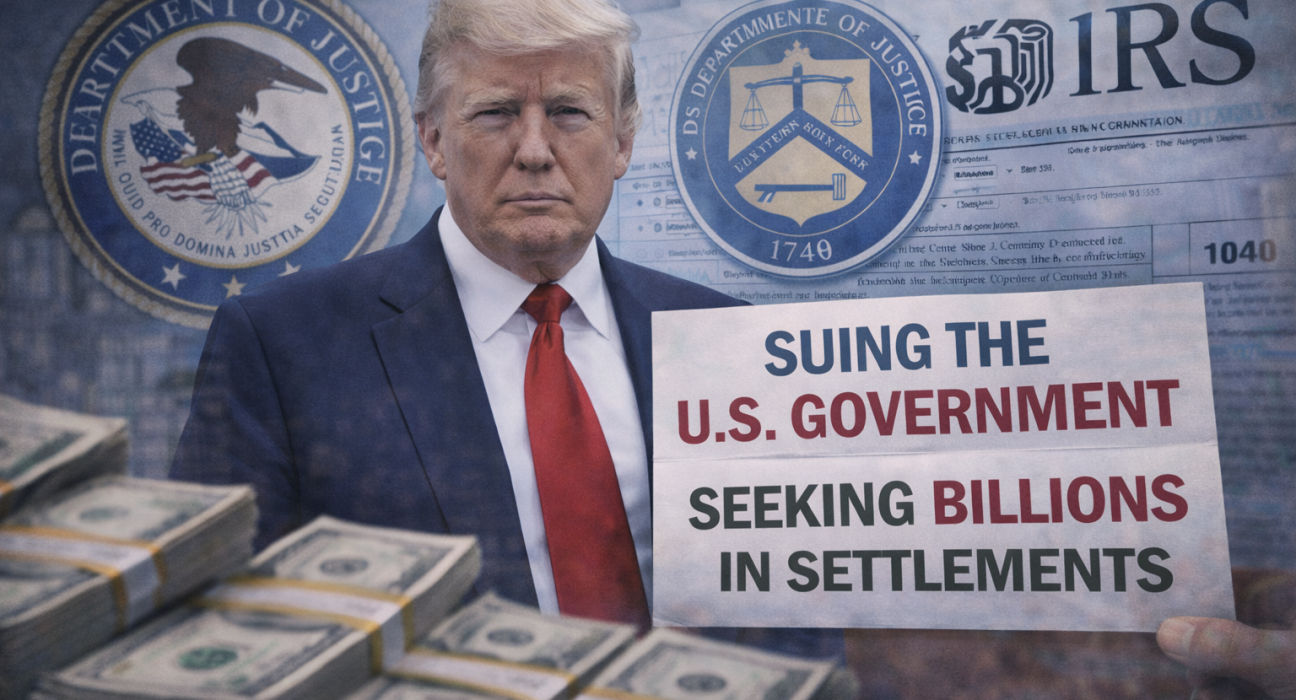
A recently published report by NPR and associated outlets reveals an unusual and controversial legal strategy by President Donald Trump: he is actively filing claims against the **U.S. government — including the Justice Department, IRS, and Treasury — seeking billions of dollars in settlements. Given that Trump is both the head of the federal government and the nominal defendant or beneficiary in these legal actions, legal experts, watchdogs, and lawmakers are raising serious concerns about conflict of interest, executive power limits, and the implications for taxpayers.
What Trump Is Seeking and Why
According to reporting, Trump has filed multiple administrative claims and lawsuits asserting that he was harmed by federal actions, and he is now seeking compensation from the government for those harms. A key example includes:
- A claim for roughly $230 million relating to Justice Department—and FBI—investigations, including searches of his Florida property and probes into his campaign’s ties to Russia. Trump characterizes these government actions as unjustified and personally damaging.
- A separate lawsuit filed against the Internal Revenue Service (IRS) and the U.S. Treasury, seeking at least $10 billion in damages for the unauthorized disclosure of his tax returns in 2019 by an IRS contractor. That case directly involves alleged privacy violations dating back to Trump’s first presidential term.
Trump has publicly suggested that, if any settlement were reached, he might donate the proceeds to charity — a point he made in speeches and interviews. However, legal analysts note that a future settlement could still place taxpayer money into his hands or those of his foundations, even if he pledges it to charitable causes.
Why This Situation Is Unusual
The strategy stands out for several reasons:
1. President as Both Plaintiff and Executive
In normal practice, claims against the government are handled by career lawyers in the Justice Department or by independent litigants. But in these disputes, Trump is effectively suing the same federal government he leads. This raises deep questions about:
- Conflict of interest
- Separation of powers
- Ethical oversight in conflicts involving the executive branch
Legal observers highlight that it would be “an extraordinary conflict” for a sitting president’s political appointees to evaluate and possibly authorize settlements in cases where their boss is the plaintiff.
2. Scope of Damages Sought
Historically, settlements against the federal government rarely exceed $10 million — even in significant cases such as injury claims or federal malpractice. Trump’s claims dwarf those precedents: $230 million for investigative actions and $10 billion for the tax leak case. Lawyers who have worked in federal claims review note that such scales are far outside normal practice.
3. Taxpayer Liability
If a settlement were approved and paid out of the federal Judgment Fund — a pool of taxpayer dollars set aside to satisfy court judgments against the United States — ordinary Americans could ultimately foot the bill. Because settlements against the federal government are paid from this fund, the payments do not directly come out of the president’s own pockets, even if publicly framed as “charitable.”
Legal Challenges and Questions
Legal scholars and former prosecutors have several key objections and unanswered questions:
- Conflict of Interest: When the plaintiff and the leader of the defendant entity are the same person, can a fair adjudication or settlement occur without undue influence?
- Statute of Limitations: For the IRS tax leak suit, some experts note that the statute of limitations may have expired, making parts of the case legally questionable.
- Appropriateness of Claims: Federal Tort Claims Act cases traditionally handle personal injury, accidents, or negligence — not high-profile political disputes over investigations or leaks.
- Role of Career DOJ Lawyers: Although career attorneys typically defend the government in such claims, final settlement decisions rest with political appointees who report to the president.
Some critics argue that the cases effectively ask the government to compensate Trump for policies and actions that occurred while he was in office — actions that he effectively authorized himself. That raises fundamental questions about accountability and whether such claims should be paused until after a presidency ends.
Political and Public Reactions
Reactions vary sharply across political and legal commentators:
Supportive Views
Supporters argue Trump is asserting his rights against what he perceives as politically motivated government investigations or leaks. They argue that no individual — even a former or sitting president — should be exempt from seeking justice if harmed by government action.
Critical Views
Critics view the strategy as a form of “weaponizing” the legal system for personal gain, with taxpayer dollars potentially flowing to a wealthy individual without independent checks. Many believe the optics and legal central conflict of interest undermine public faith in legal fairness. Online discussions — such as on Reddit — reflect widespread skepticism about the fairness of allowing a president to sue his own government and potentially benefit from it. Discussions question whether taxpayers could ultimately be responsible for billions if such suits succeed or settle.
Possible Outcomes and Risks
1. DOJ Defense
It remains possible the Justice Department will vigorously defend against these claims — particularly the $230 million and $10 billion lawsuits — in court, pointing to statutory defenses and statutes of limitations.
2. Settlement Negotiations
If settled, even for lesser amounts, it could set a controversial precedent where presidential claims against the government are resolved while the president remains in power.
3. Congressional Oversight
Recognizing the conflict potential, some lawmakers may pursue oversight hearings or legislative action to restrict how and when a sitting president can pursue legal claims against the government.
4. Judicial Scrutiny
Courts may also face pressure to scrutinize not only the merits of these lawsuits but the processes by which settlements are approved, particularly when political appointees influence outcomes.
Conclusion
President Trump’s efforts to pursue lawsuits — including claims worth billions of dollars — against the federal government he leads raise unprecedented legal and ethical questions. Whether through claims over investigations or lawsuits over leaked tax information, the administration’s approach contrasts sharply with historical norms and could put taxpayers on the hook through the Judgment Fund. Beyond legal merits, the situation highlights broader debates about conflict of interest in government, separation of powers, and how executive authority should be balanced against accountability.
References & Further Reading
NPR / WBUR — Trump would like the government he leads to pay him billions
https://www.npr.org/2026/02/18/nx-s1-5702503/trump-government-lawsuits-pay-himself-billions
NPR — Trump sues IRS and Treasury for $10 billion over leaked tax information
https://www.kjzz.org/news/politics/2026-02-18/trump-would-like-the-government-he-leads-to-pay-him-billions
Reuters — Trump too busy to be defendant but sues others
https://www.reuters.com/legal/government/trump-too-busy-be-defendant-plenty-time-sue-2026-02-13/
Wall Street Journal — Trump lawsuit against IRS puts him on both sides
https://www.wsj.com/us-news/law/trump-lawsuit-against-irs-puts-him-on-both-sides-of-the-same-case-116cfa2d
Reddit community discussions on Trump suing IRS and taxpayers paying settlements
https://www.reddit.com/r/law/comments/1qqq18l/trump_sues_irs_treasury_for_10_billion_over/