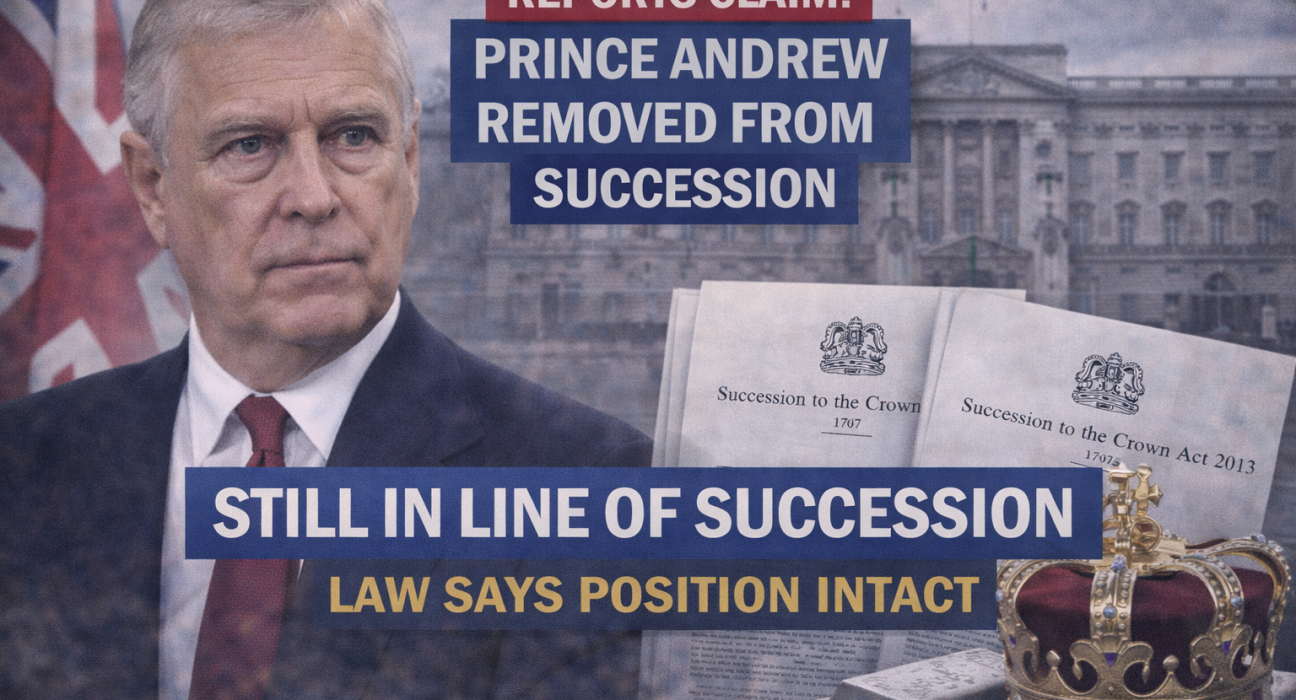
Recent media and social attention have focused on reports suggesting that the British government has removed Prince Andrew Mountbatten-Windsor from the line of succession to the throne. This stems from changes in his public status and royal roles, but a closer look at the legal and constitutional framework shows that while his influence and honors have changed, his formal position in succession remains intact.
What the Reports Are Saying
Some outlets have interpreted recent changes in Prince Andrew’s titles and honors as effectively removing him from the line of succession. This impression comes largely from his withdrawal from public duties, removal of military titles, and loss of government-funded security — actions ordered by King Charles III and executed by royal officials and relevant ministries.
However, no British law or official constitutional instrument has formally removed Andrew from the statutory line of succession. As of 2026, he still legally remains in line, occupying a position further down the list of heirs to the throne.
What Has Actually Changed
1. Loss of Public Roles and Honors
Prince Andrew has experienced a series of changes since his association with the Jeffrey Epstein scandal became public:
- He stepped back from public royal duties and patronages in 2019.
- His military honorary rank of vice-admiral was withdrawn in late 2025 by direction of King Charles III.
- He no longer receives government-funded security and must rely on private arrangements.
- Royal household references to his active roles and honours have been altered to reflect his reduced status.
These changes signify a removal of public office, funding, and ceremonial roles, but they do not, on their own, change his legal position in the hereditary succession.
Line of Succession Basics
The British line of succession is governed by law — not discretionary executive or royal orders. Current statutes include:
Succession to the Crown Act 2013
This act modernized succession rules and affirmed gender-neutral primogeniture for those born after October 28, 2011, and removed historic discrimination against those who marry Catholics. The act remains the principal governing statute for succession.
Unlike titles or honors, succession itself is governed by statute and cannot be altered by government press statements or administrative changes alone.
What the Law Says
The law specifies that the throne passes by hereditary descent from a common ancestor, subject to parliamentary statutes. No recent statute has removed Prince Andrew from succession.
Why Titles and Honours Can Change — But Succession Stays
In the UK system, titles, honours, military ranks, and public duties are separate from succession rights:
- Titles (e.g., Duke of York) can be surrendered or rendered dormant.
- Honours and military ranks can be withdrawn by the monarch or on royal advice.
- Public duties and funded security protections can be ended.
However, the hereditary right to succeed to the throne follows strictly from lineage as defined by statute, not by royal discretion regarding titles or roles.
This means that while Prince Andrew’s public life and functional status have changed dramatically, his legal position in the line of succession remains unaffected absent formal legislative change.
Why the Confusion Has Arisen
Several overlapping developments help explain the misunderstanding:
1. Public Withdrawal from Roles
Andrew’s removal from frontline royal duties and honors conveys a symbolic distancing from the monarchy.
2. Security and Funding Removal
Government-linked protections and funding ended after discussions between royal and government figures — a highly unusual step that grabbed headlines.
3. Media Interpretation
Language about “removing him from succession” can be misleading. Many outlets conflate titles or duties with legal heir status.
None of the changes reported so far constitute a formal, legal removal from the hereditary sequence.
What Would It Take to Remove Someone From the Succession?
To legally remove someone — including a member of the royal family — from the line of succession, Parliament must pass legislation that amends the relevant succession statutes. This has happened historically, but only through clear acts of Parliament. For example:
- Changes in the 1700s (such as the Succession to the Crown Act) were parliamentary, not discretionary royal or governmental changes.
No such act exists in 2026 affecting Prince Andrew’s position.
So Is He Actually Out of Line?
No.
Prince Andrew remains part of the official British line of succession. What has changed is that he has:
- Given up the Duke of York title in public use
- Lost honorary military roles
- Withdrawn from public royal duties
- Seen government-supported security arrangements end
But his hereditary claim, grounded in birthright and current law, remains in place until and unless Parliament legislates otherwise.
Why This Matters
Constitutional Stability
The British monarchy operates under centuries of law and constitutional practices. Succession changes are serious and rare, requiring parliamentary action.
Public Trust and Interpretation
Confusion between ceremonial status and legal rights underscores how media reporting and public perception can diverge from constitutional reality.
Precedent and Future Debate
This situation highlights the distinction between role, honor, and duty versus legal claim to the throne — and shows why formal legal mechanisms matter in monarchies.
In Summary
- Prince Andrew’s public roles and honors have been significantly reduced.
- He is still legally in the line of succession to the British throne.
- Removal from titles, funding, and duties does not equal a legal removal from succession.
- Only Parliament could legislate a change in succession order.