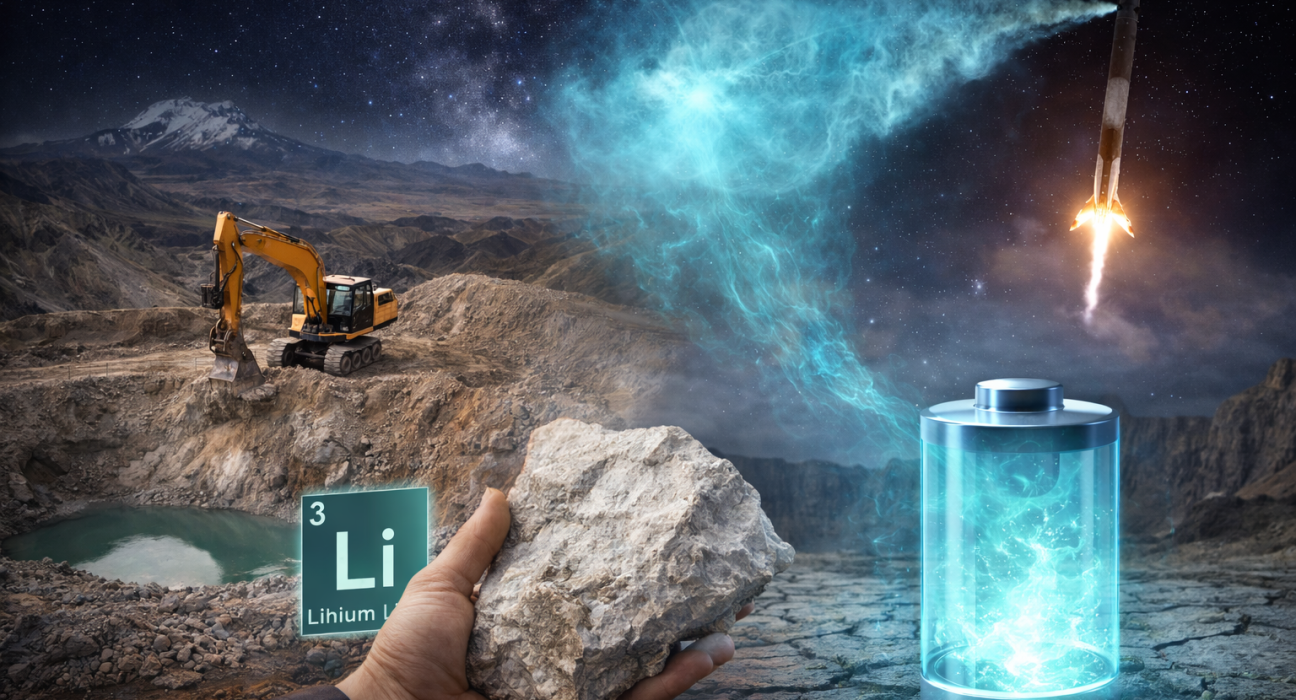
Recent scientific reporting across multiple outlets highlights lithium’s expanding relevance — from deep volcanic basins in the western United States to unexpected traces detected in Earth’s upper atmosphere. Together, findings from Nature Communications Earth & Environment, coverage by Earth.com, and reporting from ScienceAlert illustrate how lithium intersects with geology, energy policy, and even aerospace activity.
1. The Volcanic Basin Lithium Resource
The Nature Communications Earth & Environment study examines a clay-rich lithium deposit formed within an ancient volcanic caldera in the western United States. Researchers identified lithium concentrations resulting from hydrothermal alteration — a process in which volcanic ash and glass interacted with mineral-rich alkaline fluids over millions of years.
Geochemical analysis suggests the basin may contain up to 15 million metric tons of lithium in clay minerals such as smectite and illite. However, the study emphasizes that this represents a geological resource estimate, not a confirmed economically recoverable reserve. Further drilling, economic feasibility assessments, and environmental reviews would be required before extraction could proceed.
Clay-hosted lithium differs from traditional brine deposits in South America or hard-rock spodumene sources in Australia. Extraction may require excavation and chemical leaching processes, which introduce environmental and cost considerations.
If partially recoverable, the deposit could meaningfully strengthen U.S. domestic lithium supply, reducing reliance on imports and supporting electric vehicle (EV) battery production and renewable energy storage.
2. Environmental and Development Considerations
The geological discovery intersects with environmental concerns:
• Water usage in arid western regions
• Chemical processing waste management
• Land disturbance from open-pit mining
• Indigenous and local land rights considerations
Lithium extraction projects in similar regions have previously faced regulatory scrutiny and legal challenges. Environmental impact assessments would be central to any development timeline.
The Nature study does not advocate mining but provides scientific groundwork that could guide future exploration.
3. Atmospheric Lithium Linked to SpaceX Rocket Re-entry
In a separate but scientifically related context, reporting from ScienceAlert describes how researchers detected a plume of lithium in Earth’s upper atmosphere traced to the re-entry of a SpaceX rocket. Scientists analyzing atmospheric chemistry identified lithium signatures consistent with material released during spacecraft re-entry.
When rockets burn up upon re-entry, materials from batteries, structural alloys, and other onboard components can vaporize and disperse into the upper atmosphere. Lithium-based components are widely used in aerospace systems, including high-energy batteries.
The lithium plume detection was notable because atmospheric lithium concentrations are typically low. Researchers were able to trace the anomaly back to a specific rocket return event, demonstrating how human technological activity can measurably influence upper atmospheric chemistry.
Overlap and Broader Context
While the volcanic basin and atmospheric plume stories differ in scale and domain, they intersect around lithium’s expanding footprint in modern technology:
• Energy Transition Demand – Lithium demand is increasing due to EV batteries and grid storage systems.
• Aerospace Use – Lithium-based batteries are critical for satellites, rockets, and spacecraft.
• Environmental Impact Across Domains – From mining impacts on land to atmospheric dispersal during rocket re-entry, lithium’s lifecycle spans Earth systems and near-space environments.
Both stories highlight how lithium has become embedded in strategic industries.
Environmental Concerns Across Both Contexts
Mining Concerns
Clay-hosted lithium extraction could require chemical-intensive processing, raising concerns about groundwater protection and ecosystem stability.
Atmospheric Impact
Although the lithium plume from rocket re-entry appears localized and temporary, it raises broader questions about cumulative atmospheric effects as space launches increase globally.
Space activity has expanded significantly in recent years, with private companies increasing launch frequency. While current atmospheric lithium contributions are small compared to natural geochemical cycles, long-term impacts remain an area of study.
Strategic and Policy Implications
Lithium is classified as a critical mineral due to its importance in:
• Electric vehicles
• Renewable energy storage
• Consumer electronics
• Aerospace systems
Domestic lithium discoveries may reduce supply chain vulnerability. However, technological demand also expands lithium’s environmental footprint, both terrestrially and in near-space environments.
Governments balancing energy transition goals must also evaluate environmental sustainability.
Pros
• Strengthens domestic supply potential
• Supports clean energy transition
• Advances geological and atmospheric science
• Demonstrates traceability of human technological impacts
Cons
• Mining environmental risks (water, land, waste)
• Economic uncertainty in clay extraction
• Potential cumulative atmospheric impacts from increasing rocket launches
• Regulatory and community opposition risks
Future Projections
- Expanded geological exploration of volcanic basins
- Development of more environmentally efficient lithium extraction technologies
- Increased atmospheric monitoring tied to aerospace growth
- Policy frameworks balancing mineral security with environmental protection
- Continued lithium demand growth tied to EV adoption and space sector expansion
Conclusion
Lithium’s role in modern civilization is expanding across multiple domains — from ancient volcanic formations beneath the Earth’s surface to trace plumes in the upper atmosphere linked to spaceflight. The recent research underscores both opportunity and responsibility: securing critical minerals for energy transition while managing environmental and technological externalities.
Lithium is no longer just a battery component; it is a cross-sector resource influencing geology, climate policy, industrial strategy, and aerospace science.
References
- Nature Communications Earth & Environment
https://www.nature.com/articles/s43247-025-03154-8 - Earth.com
https://www.earth.com/news/us-volcano-basin-hides-15t-lithium-trove-researchers-reveal-pr25/ - ScienceAlert
https://www.sciencealert.com/lithium-plume-in-our-atmosphere-traced-back-to-returning-spacex-rocket