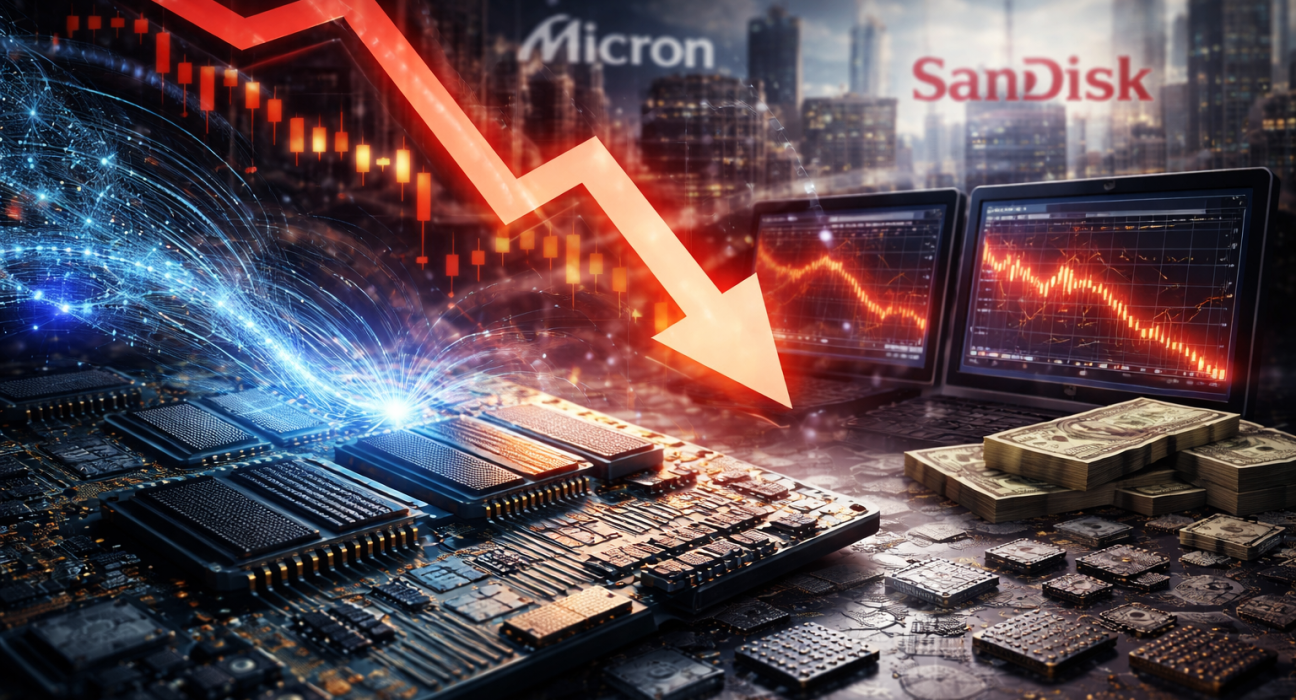
A new artificial intelligence breakthrough from Google has sent shockwaves through the semiconductor sector, causing shares of memory chip companies—including Micron Technology and Western Digital (which operates SanDisk)—to drop sharply. Reports from GuruFocus and Yahoo Finance describe how a new AI memory compression technology could significantly reduce the need for traditional memory hardware, triggering investor concerns about long-term demand.
What Google Announced
Google reportedly unveiled an AI-driven memory compression system capable of dramatically reducing the amount of physical memory required for large-scale computing tasks.
The breakthrough centers on:
- More efficient data storage during AI model processing
- Reduced reliance on high-capacity DRAM and NAND memory
- Improved performance without proportional increases in hardware
In simple terms, the innovation suggests that AI systems can do more with less memory, potentially lowering the need for expensive hardware infrastructure.
Immediate Market Reaction
Following the announcement:
- Shares of Micron Technology dropped notably
- Stocks tied to NAND storage, including Western Digital (SanDisk), also declined
- The broader semiconductor sector saw increased volatility
Investors interpreted the announcement as a potential threat to one of the fastest-growing segments of the tech industry: AI-driven memory demand.
For years, companies like Micron have benefited from the surge in AI workloads, which require massive amounts of memory for training and inference.
Why Memory Chips Matter in AI
AI systems—especially large language models—require enormous data processing capacity. This has created strong demand for:
- DRAM (used for active computing memory)
- NAND flash (used for storage)
Memory is a critical bottleneck in AI performance, and companies have invested heavily in expanding capacity to meet demand.
However, if software innovations reduce memory requirements, the entire supply-demand equation could shift.
What the Compression Breakthrough Could Mean
The key concern is that software efficiency may outpace hardware demand growth.
If AI systems can:
- Compress data more effectively
- Use memory more efficiently
- Reduce duplication of stored information
Then companies may not need to purchase as much physical memory as previously expected.
This could:
- Lower costs for AI infrastructure
- Reduce demand growth for memory chips
- Shift value from hardware to software innovation
Broader Industry Context
The semiconductor industry has historically followed a pattern where hardware demand increases alongside software complexity.
However, recent trends suggest a potential shift:
- AI companies are optimizing models to run more efficiently
- Cloud providers are prioritizing cost reduction
- Energy consumption concerns are driving efficiency improvements
Google’s development fits into a broader movement toward optimization over expansion.
Competing Interpretations
View 1: Threat to Memory Chip Industry
Some analysts believe the breakthrough could significantly impact long-term demand:
- AI workloads may require fewer hardware upgrades
- Memory pricing power could weaken
- Growth projections for chipmakers may need revision
From this perspective, the market reaction reflects a structural concern, not just short-term volatility.
View 2: Overreaction by Markets
Others argue the sell-off may be premature:
- AI demand is still growing rapidly overall
- Efficiency gains may expand adoption rather than reduce total demand
- Hardware improvements remain necessary for high-performance computing
In this view, compression technology could increase total AI usage, offsetting reduced per-system memory needs.
Economic Implications
The development highlights a key dynamic in technology markets:
Hardware vs Software Value Shift
As software becomes more efficient:
- Hardware may become less of a limiting factor
- Margins may shift toward software providers
- Infrastructure costs may decrease
This could reshape competitive dynamics across the tech industry.
Pros (Potential Benefits of the Breakthrough)
• Lower costs: Reduced memory requirements can decrease infrastructure expenses
• Energy efficiency: Less hardware usage may lower power consumption
• Scalability: AI systems could become more accessible and widely deployed
• Innovation acceleration: Software optimization may drive faster technological progress
Cons (Risks and Concerns)
• Impact on semiconductor companies: Reduced demand growth could affect revenues
• Market volatility: Sudden shifts in expectations can destabilize tech stocks
• Uncertainty about adoption: It remains unclear how quickly the technology will be implemented
• Potential overcorrection: Investors may be reacting to early-stage developments without full data
Future Projections
1. Continued AI Optimization Trends
More companies are likely to focus on improving efficiency rather than simply scaling hardware.
2. Hybrid Demand Model
Memory demand may still grow overall, but at a slower pace than previously expected.
3. Increased Competition in AI Infrastructure
Cloud providers and tech companies may compete to offer the most efficient AI systems.
4. Semiconductor Industry Adaptation
Chipmakers may shift focus toward specialized memory solutions or AI-optimized hardware.
5. Market Rebalancing
Investors may reassess valuations across the semiconductor sector as new technologies emerge.
Conclusion
Google’s AI memory compression breakthrough has introduced a new variable into the rapidly evolving AI economy. While the immediate market reaction reflects concerns about reduced demand for memory hardware, the long-term impact remains uncertain.
The development underscores a broader shift in technology: efficiency is becoming just as important as scale. Whether this leads to a slowdown in semiconductor growth or a transformation of the industry will depend on how quickly the technology is adopted and how it reshapes AI infrastructure.
References
Primary Sources
- GuruFocus – Micron and SanDisk stocks fall after Google AI memory breakthrough
https://www.gurufocus.com/news/8745034/micron-sandisk-stocks-tumble-after-google-unveils-ai-memory-compression-breakthrough - Yahoo Finance – Market reaction to AI memory compression announcement
https://finance.yahoo.com/markets/stocks/articles/micron-sandisk-stocks-tumble-google-124732063.html
Additional Context Sources
- Semiconductor industry analysis on AI memory demand
- Reports on DRAM and NAND market trends
- Cloud infrastructure efficiency research from major tech firms