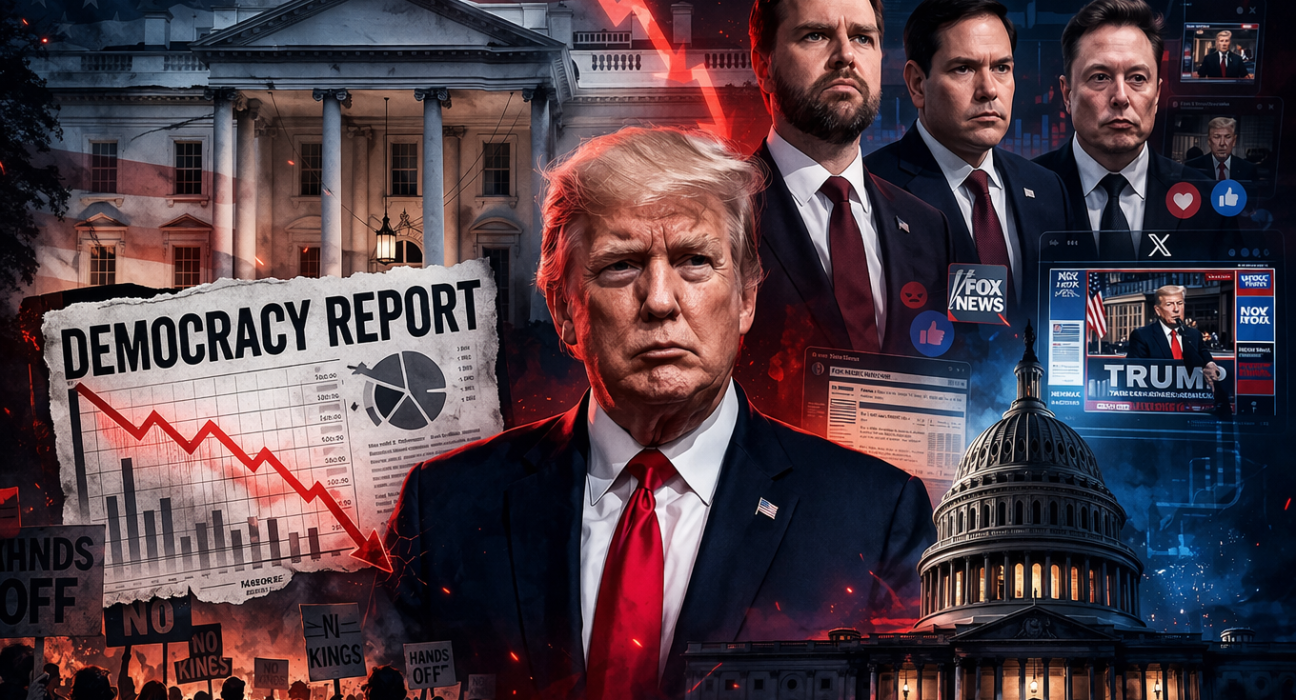
A new international report assessing democratic conditions in the United States has sparked political debate after being publicly criticized by Donald Trump and his allies. The report, produced by the V-Dem Institute, suggests that democratic indicators in the U.S. have declined in recent years—an assessment that has been contested by some political figures and commentators.
Coverage from CNN and supporting analysis from academic and policy sources show how the report has become part of a broader discussion about media, governance, and institutional trust.
What the V-Dem Report Found
The V-Dem Institute, based in Sweden, publishes annual reports evaluating democracy worldwide using a wide range of indicators, including:
- Electoral integrity
- Freedom of expression
- Judicial independence
- Media environment
- Civil liberties
In its latest findings, the organization categorized the United States as experiencing democratic decline, citing concerns such as political polarization, disputes over election legitimacy, and pressure on institutions.
The report places the U.S. below some other established democracies in certain categories and suggests that trends over the past decade indicate measurable changes in democratic performance.
Researchers emphasize that the report is based on aggregated expert assessments and long-term data modeling, rather than a single event or policy.
Political Response and Criticism
Donald Trump publicly criticized the report, arguing that it misrepresents the state of democracy in the United States.
Critics of the V-Dem findings argue:
- The methodology relies heavily on subjective expert surveys
- The report may reflect academic or ideological bias
- It does not adequately capture the strength of U.S. institutions, such as constitutional checks and balances
Supporters of the report, on the other hand, say it highlights long-term structural trends rather than short-term political outcomes.
This divide reflects broader disagreements over how democracy should be measured and who determines those standards.
Media’s Role in the Debate
The CNN report notes that the controversy has also expanded into a debate about media coverage and influence.
Some political figures argue that:
- Media outlets amplify negative narratives about democratic institutions
- Coverage of reports like V-Dem can shape public perception internationally
Others counter that:
- Independent media reporting is a core component of democratic accountability
- Transparency about institutional challenges strengthens, rather than weakens, democracy
The issue underscores the complex relationship between media, public opinion, and governance.
How Democracy Is Measured
Measuring democracy is inherently complex, and multiple organizations produce global rankings, including:
- Freedom House
- The Economist Intelligence Unit
- V-Dem Institute
Each uses different methodologies and weighting systems.
For example:
- Some focus on electoral processes and civil rights
- Others include political culture and participation
- Some rely more heavily on expert surveys, while others incorporate quantitative indicators
Because of these differences, countries can receive varying rankings depending on the framework used.
Broader Context: Global Democratic Trends
The V-Dem report aligns with a broader trend identified by multiple research organizations: concerns about democratic backsliding in various parts of the world.
Common factors cited globally include:
- Increased political polarization
- Challenges to election legitimacy
- Expansion of executive power
- Pressure on independent institutions
However, analysts note that these trends vary significantly by country and do not necessarily indicate uniform decline.
In the case of the United States, some indicators remain strong, including:
- Regular elections with high participation
- Independent judiciary
- Active civil society
The debate centers on whether recent developments represent normal political fluctuation or a more sustained structural shift.
Pros (Arguments Supporting the Report’s Findings)
• Long-term data analysis: Uses historical trends rather than isolated events
• Comparative framework: Allows comparison across countries and time periods
• Focus on institutional health: Examines multiple dimensions of democracy
• Highlights potential risks: Identifies areas where democratic norms may be under pressure
Cons (Criticism of the Report)
• Subjectivity concerns: Reliance on expert opinions can introduce bias
• Methodological complexity: Results may be difficult for the public to interpret
• Political sensitivity: Findings can be used in partisan debates
• Variation across rankings: Different organizations produce different conclusions
Future Projections
1. Continued Debate Over Democratic Metrics
Discussions about how democracy should be measured are likely to intensify, particularly in politically polarized environments.
2. Increased Scrutiny of Institutions
Reports like V-Dem may lead to further analysis of election systems, media environments, and judicial independence.
3. Role of Media in Shaping Perception
Media coverage of such reports will continue to influence both domestic and international views of democratic systems.
4. Policy and Reform Discussions
Some policymakers may use these findings to advocate for reforms aimed at strengthening democratic processes.
Conclusion
The controversy surrounding the latest V-Dem report illustrates the challenges of assessing democracy in a complex and evolving political landscape. While the report identifies areas of concern, its conclusions remain subject to interpretation and debate.
The broader discussion reflects a fundamental question: how should democratic health be measured, and who defines the standards? As political, academic, and media perspectives continue to diverge, the conversation itself has become part of the democratic process.
References
Primary Source
- CNN – Trump and allies respond to V-Dem democracy report
https://edition.cnn.com/2026/03/18/media/trump-vdem-democracy-media-report
Additional Context Sources
- V-Dem Institute – Annual democracy reports and methodology
- Freedom House – Global Freedom in the World reports
- Economist Intelligence Unit – Democracy Index
- Academic literature on democratic backsliding and institutional analysis