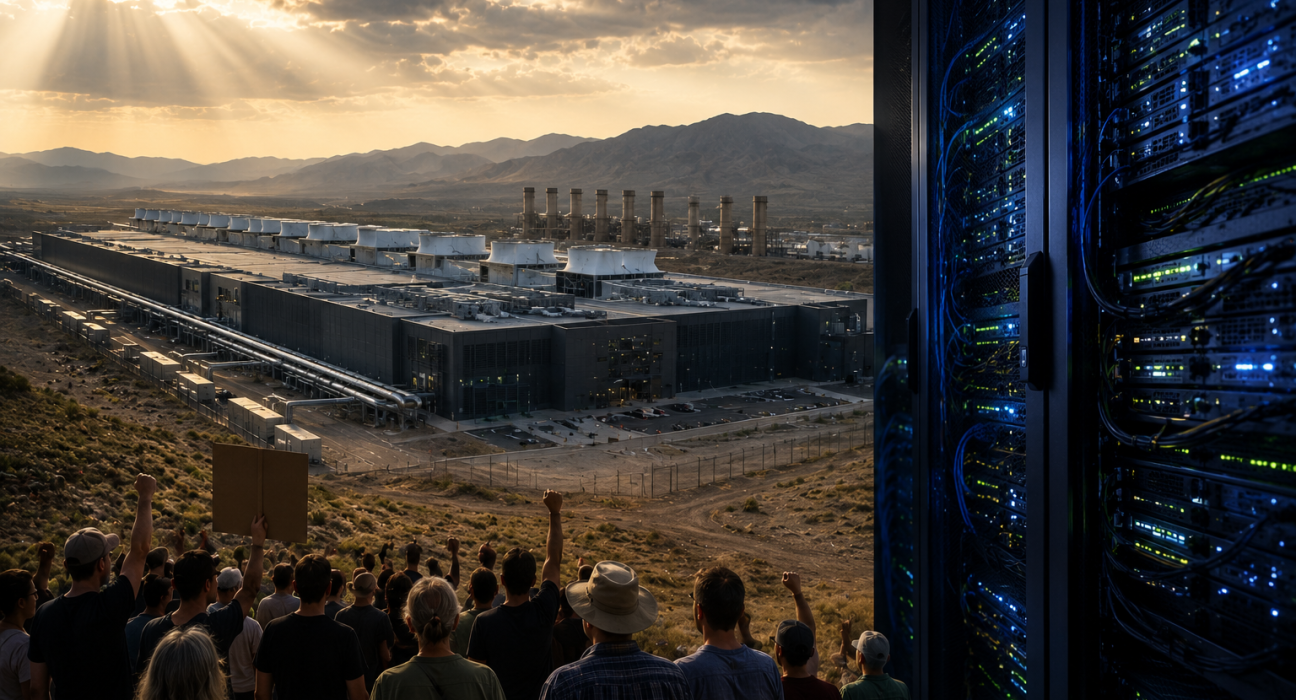
A growing conflict over the expansion of large-scale data centers is unfolding in Utah, where officials have approved new developments despite increasing public opposition. According to reporting from The Guardian, residents, environmental advocates, and local officials are raising concerns about the long-term impact of massive data infrastructure projects tied to cloud computing and artificial intelligence growth.
The dispute reflects a broader global trend: as AI and digital services expand rapidly, communities are beginning to question the environmental, economic, and social costs of the infrastructure required to power them.
What Happened in Utah
Utah officials approved major data center developments even as public backlash intensified over concerns involving:
- Water consumption
- Electricity demand
- Environmental strain
- Local resource allocation
The proposed facilities are part of a larger nationwide surge in data center construction driven by:
- Artificial intelligence systems
- Cloud computing services
- Streaming and digital infrastructure
- Enterprise data storage
Residents and activists argue that the long-term burden on local communities may outweigh the economic benefits promised by developers.
Why Data Centers Are Expanding Rapidly
1. AI Growth
The rise of generative AI has dramatically increased computing demand.
AI systems require enormous processing power for:
- Training large models
- Running real-time AI services
- Managing massive datasets
This has created a race among technology companies to expand infrastructure capacity.
2. Cloud Computing Demand
Modern internet services increasingly depend on centralized computing infrastructure.
Data centers power:
- Streaming platforms
- Online storage
- Financial systems
- Government and enterprise applications
As digital dependence grows, so does the need for additional facilities.
Key Concerns Behind the Backlash
1. Water Usage
One of the most controversial issues is water consumption.
Many large data centers use water for cooling systems, and critics argue this is particularly problematic in drought-prone regions like Utah.
Concerns include:
- Stress on local water supplies
- Competition with residential and agricultural use
- Long-term sustainability
Environmental groups warn that expanding water-intensive infrastructure in arid regions may worsen existing climate and resource pressures.
2. Electricity Demand
Data centers consume vast amounts of electricity.
AI-focused facilities, in particular, can require:
- Continuous high-capacity power
- Large-scale cooling systems
- Backup infrastructure
Critics worry this could:
- Increase energy costs
- Pressure electrical grids
- Lead to additional fossil fuel usage if renewable energy capacity is insufficient
3. Limited Local Benefit
Some residents argue that while data centers generate tax revenue and construction jobs, they often:
- Employ relatively few permanent workers
- Occupy large amounts of land
- Place strain on infrastructure without proportionate community benefit
This has led to debates about whether incentives offered to tech companies are justified.
Industry Perspective
Technology companies and developers argue that data centers:
- Support economic growth
- Strengthen digital infrastructure
- Create investment opportunities
- Enable AI and cloud innovation
They also note efforts to improve sustainability through:
- Renewable energy sourcing
- Advanced cooling technologies
- Water recycling systems
Companies increasingly emphasize commitments to environmental goals, though critics question whether these measures are sufficient.
Broader National and Global Trend
The Utah controversy is part of a larger movement across the U.S. and globally.
Communities in states such as:
- Arizona
- Virginia
- Texas
have also raised concerns about data center expansion.
Internationally, countries in Europe and Asia are debating:
- Energy allocation
- Environmental regulations
- AI infrastructure policy
The issue reflects a growing realization that the digital economy has physical and environmental costs.
AI and Infrastructure: A New Industrial Era
Analysts increasingly compare the AI boom to earlier industrial revolutions.
Just as factories once reshaped cities and resource use, AI infrastructure may reshape:
- Energy systems
- Water management
- Land development
- Regional economies
This raises broader policy questions about how societies balance:
- Innovation
- Economic growth
- Environmental sustainability
Pros (Supportive Perspectives)
• Economic investment: Data centers bring capital and infrastructure development
• AI and tech growth: Supports expanding digital economy
• Tax revenue: Local governments may benefit financially
• Innovation leadership: Helps regions attract major technology companies
Cons (Concerns and Risks)
• Water consumption: Significant strain on limited resources
• Energy demand: Increased pressure on power grids and sustainability goals
• Environmental impact: Land use and infrastructure expansion concerns
• Limited employment: Fewer permanent jobs compared to resource use
Future Projections
1. Increased Regulation
States may introduce stricter environmental and water-use requirements for data centers.
2. Shift Toward Sustainable Infrastructure
Companies may invest more heavily in renewable energy and low-water cooling systems.
3. Community Resistance Growth
Public opposition may intensify as more projects are proposed.
4. Strategic Location Changes
Developers may prioritize regions with abundant water and renewable energy access.
5. AI Infrastructure Expansion
Despite backlash, demand for data centers is expected to continue growing rapidly.
Conclusion
The Utah data center controversy highlights the growing tension between technological expansion and environmental sustainability. As AI and cloud computing accelerate demand for digital infrastructure, communities are increasingly confronting the real-world costs of powering the modern internet.
The broader challenge moving forward will be finding ways to support innovation while ensuring that resource use, environmental impact, and local community interests remain part of the equation.
References
Primary Source
- The Guardian – Utah approves data centers despite backlash
https://www.theguardian.com/us-news/2026/may/13/utah-approves-datacenter-backlash
Additional Context Sources
- Reporting on AI infrastructure growth and energy demand
- Studies on water consumption in data center operations
- Coverage of community opposition to tech infrastructure projects