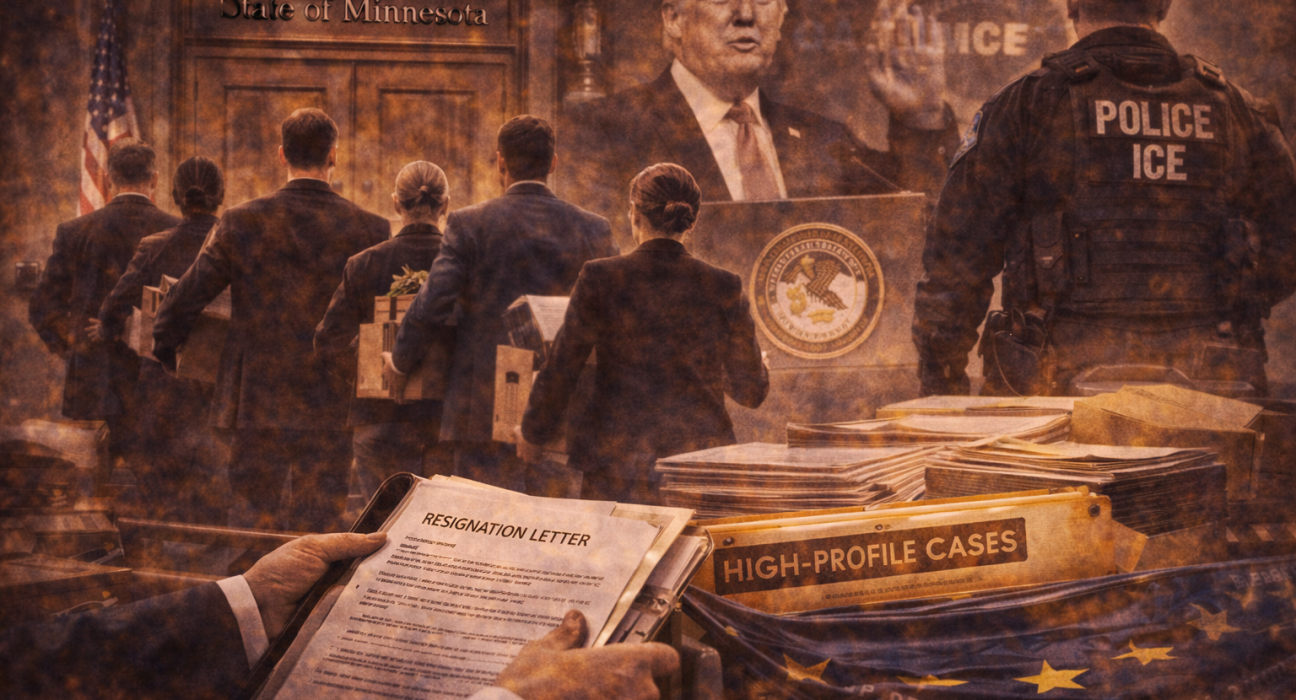
At least eight additional federal prosecutors — on top of multiple earlier departures — are in the process of leaving the Minnesota U.S. Attorney’s Office. Their exits reflect deep internal disagreement with decisions coming from the Department of Justice (DOJ) and the Trump administration about how certain high-profile cases are being handled.
Key factors driving the departures include:
1. Dispute Over How Critical Cases Are Handled
The catalyst for the initial wave of resignations — and now these additional departures — was disagreement over prosecutorial direction related to the fatal shooting of Renée Good, a Minneapolis resident who was killed during a federal immigration enforcement action by ICE agents. Career prosecutors reportedly objected when DOJ leadership:
- Declined to authorize a civil rights investigation into the shooting, despite precedents in other law-enforcement fatalities.
- Sidelined the local Bureau of Criminal Apprehension and state prosecutors from full participation in investigations.
- Pressured the Minnesota office to focus on possible charges against Good’s widow rather than scrutinizing the conduct of the federal agent involved.
These decisions diverged sharply from standard practices where state and federal agencies typically coordinate investigations of officer-involved deaths. Prosecutors saw this as undermining thorough, unbiased inquiry and ethical prosecution.
2. Broader Political Tension and Ethical Conflict
Many career prosecutors felt they were being instructed to pursue politically influenced priorities — including pushing cases that they believed lacked legal basis or sufficient evidence — while ignoring or limiting investigations into federal agent conduct. This clash between DOJ directives and ethical prosecutorial independence was a prime reason for earlier waves of resignations and is motivating others to leave as well.
Hundreds of Justice Department lawyers across the country have either been pushed out or left voluntarily amid similar concerns about political pressure and shifting prosecutorial priorities under the Trump administration.
Who Will Replace Them?
Federal prosecutors who quit are typically replaced through one or more of the following mechanisms:
1. Internal Appointments
Remaining senior prosecutors or deputies within the office may take on expanded responsibilities temporarily. In Minnesota, U.S. Attorney Daniel Rosen, a Trump appointee, is overseeing the office, and he can allocate duties among remaining staff.
2. Transfers From Other Districts
When large numbers of experienced attorneys depart, the DOJ often reassigns prosecutors from other districts or divisions to fill shortages. These replacements may be career attorneys with less local experience, or DOJ trial attorneys from Washington, D.C.
3. Temporary or Contracted Staff
In some cases, the Justice Department brings in outside attorneys or detailees — including military JAG lawyers — to help handle caseloads while longer-term appointments are processed.
However, one key concern is that the sudden influx of new or less experienced staff may leave the office under-prepared to handle complex prosecutions, from fraud cases to civil rights matters, especially if departures continue faster than replacements can be trained.
What This Means for Ethics and the Rule of Law
1. Prosecutorial Independence Is Under Stress
Federal prosecutors traditionally operate with a high degree of professional autonomy. They decide whether to pursue charges based on evidence, legal standards, and ethical obligations — not political directives. The resignations suggest many prosecutors felt that this independence was being compromised by the DOJ’s choices in politically sensitive cases.
2. Loss of Institutional Knowledge
With experienced attorneys leaving — including those who led long-running investigations like major fraud probes in the state — the office is losing both courtroom expertise and deep knowledge of local legal networks. That could delay ongoing prosecutions and weaken federal enforcement capacity.
3. Public Confidence Could Erode
When high-ranking prosecutors resign over political disagreements, it fuels public concern about whether prosecutions are being driven by political priorities instead of impartial justice. Critics say this can erode trust in federal law enforcement and the broader justice system.
4. Ethical Signaling
By leaving their positions rather than complying with directives they viewed as improper, these prosecutors are sending a strong signal about professional ethics — even as it weakens the office staffing. Legal ethicists generally view this as an indication of a breakdown in trust between career staff and leadership.
Could This Happen in Other States?
Yes — and there are a few reasons this pattern might spread:
1. Broader DOJ Turnover
Hundreds of Justice Department lawyers have left nationwide under the current administration, especially in units handling civil rights and complex federal crimes. That suggests similar friction exists outside Minnesota and could manifest in other districts.
2. High-Profile Controversial Cases
Where local prosecutors are asked to handle cases implicating politically charged policies — like federal immigration enforcement or significant civil rights disputes — similar ethical tensions could prompt resignations. Prosecutors in other offices may face comparable pressure if DOJ leadership pushes directives that conflict with professional judgment.
3. Policy Disagreements
If the DOJ continues prioritizing politically directive prosecutions or limits traditional investigative cooperation (e.g., excluding local law enforcement from key inquiries), other career prosecutors nationally may also feel they cannot ethically continue under those constraints.
Conclusion
The mass departure of federal prosecutors in Minnesota highlights broader institutional stress within the Department of Justice — particularly around politically charged policy enforcement and ethical prosecutorial independence. Those leaving have cited deep concern about how serious cases are being handled and perceived pressure to pursue or avoid certain investigations. Their replacements will come from a mix of internal promotions and external transfers, but the loss of experience may weaken prosecutorial capacity and public confidence.
The Minnesota case could be a warning sign of similar strain in other U.S. Attorney offices across the country, especially where political priorities intersect sharply with career prosecutors’ ethical obligations and legal judgment.
References & Further Reading
AP News — More departures at the U.S. attorney’s office in Minnesota amid DOJ pressure
https://apnews.com/article/27b1e380562c71072fdbcde10ee8f468
Reuters — Federal judge dissolves order blocking DHS from destroying shooting evidence
https://www.reuters.com/world/judge-dissolves-order-blocking-us-dhs-destroying-shooting-evidence-2026-02-02/
AP News — Homeland Security officers in Minneapolis to wear body-worn cameras
https://apnews.com/article/37af4947057e64efee5e43a8f2e018bb